
Thank you! Your submission has been received. We will get in touch with you soon.
Back to site
Discover the hidden cost of piracy in Argentina, its impact on digital security, and how to protect your brand's audiovisual assets.
Accessing audiovisual content through unofficial channels is no longer a simple copyright infringement. What was once exclusively a distribution problem has evolved into a critical threat to personal finance, user privacy, and corporate reputation. In Argentina, the situation has reached unprecedented levels: nearly 50% of internet-connected households consume pirated audiovisual content.
This figure reveals a profound structural shift in audience behavior. The criminal organizations behind these platforms have moved beyond rudimentary schemes, evolving toward highly complex IT infrastructures. For brand protection and intellectual property (IP) leaders, this scenario demands a completely new operational approach.
In this article, we analyze the landscape of illegal consumption in Argentina, break down the digital security risks users face, and explore how scalable, actionable intelligence solutions allow leading channels to protect their assets in real time.
To understand the magnitude of the problem, one must observe the speed at which these practices are expanding. Between 2020 and 2025, the consumption of pirated content in Argentina experienced 108% growth among households with internet access.
This phenomenon now reaches 34% of all households in the country—surpassing the regional average—particularly regarding live broadcasts. Mass-market technology has facilitated this adoption: currently, 47% of users access illegal content using Smart TVs, mobile apps, unregulated websites, or modified set-top boxes (TV Boxes).
For those responsible for protecting corporate digital assets, this data proves that piracy no longer operates on the fringes of the internet. It has moved directly into consumers' living rooms, operating through interfaces that mimic the experience of legitimate platforms. This sophistication deceives users and complicates manual detection, making automated tools that prioritize critical alerts and reduce operational burden indispensable.
Piracy does not discriminate by format or audience; it capitalizes on immediacy and market fragmentation to expand rapidly. Understanding which content attracts the highest volume of illegal traffic is fundamental to designing effective containment strategies.
The consumption map in Argentina reveals the following priorities among users of illicit platforms:
When analyzing live broadcasts, immediacy dictates the rules of the game. In this segment, football (soccer) accounts for 76% of infringements, followed by motorsports (26%) and tennis (17%).
Live sports content represents one of the greatest challenges for compliance and legal protection teams. Unlike a movie, which retains value over time, the value of a sporting event vanishes the moment the referee blows the final whistle. This means enforcement actions must be instantaneous. If your protection strategy lacks real-time monitoring and automated intelligence, the economic and reputational damage is done before you can issue the first alert.
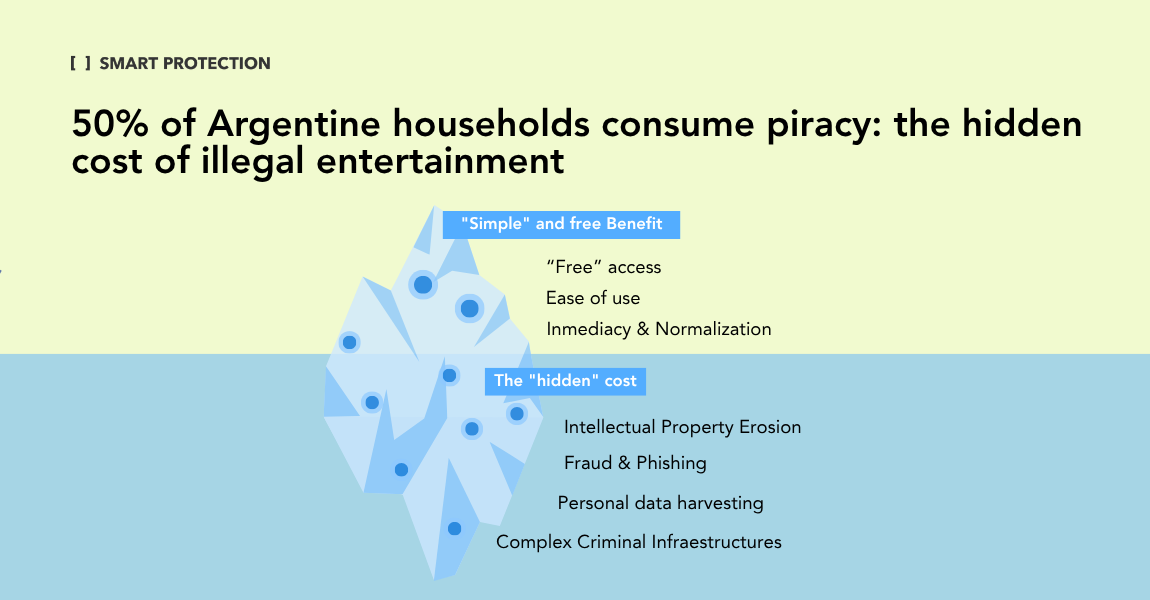
The content production and distribution industry has had to shift its communication strategy in response to new criminal tactics. Historically, institutional campaigns focused almost exclusively on the economic losses suffered by companies. However, the technological transformation forces a reframing of the message: pirated content is merely the bait; the real business is data harvesting.
The motto is direct: What you don't pay for with money, you pay for with data. Illegal platforms capture, process, and monetize the personal information of those who access them, without any oversight or informed consent.
The risk is tangible. Accessing these portals exposes users to multiple cybersecurity threats:
For a brand, the indirect impact is severe. When a user suffers fraud after attempting to access your content through a deceptive link, trust in the digital ecosystem erodes. Protecting your IP not only safeguards your revenue but also reduces the attack surface to which your consumers are exposed.
For brand protection leaders, the volume of infringements can be overwhelming. In an ecosystem where nearly half the country consumes illegal content, relying on manual processes or fragmented tools inevitably leads to operational fatigue and poor results.
You need to transform the chaos of mass alerts into actionable intelligence. This means implementing systems that not only crawl the web for infringements but also automate the prioritization of the most critical threats.
To achieve real efficiency in global IP protection, you must focus on three strategic pillars:
Piracy is no longer a consequence-free shortcut. As we have seen, the hidden cost of the "everything for free" culture falls directly on the privacy and financial security of users. With nearly 50% of Argentine households exposed to this informal circuit, the need to intervene has never been more urgent.
While industry awareness initiatives are a vital step in educating consumers, the operational responsibility lies with the brands. You must ensure your digital assets are protected by robust technological solutions that neutralize these threats at their source.
By proactively protecting your intellectual property, you don’t just defend revenue and the efforts of content creators—you build a secure digital environment where user trust remains intact.
Speak with a Brand Protection Expert HERE.
Sources:

.png)


