
Thank you! Your submission has been received. We will get in touch with you soon.
Back to site

Find and take down fake websites that use your casino's name to steal players. Over 98% deindexed in online gambling, half in under 2.5 hours.
Your casino's name is your best acquisition channel, which is exactly why others try to cash in on it. By the time someone types it into a search bar, the hard work of winning them over is done. Any site that manages to slip into that search gets a player it never paid for.
That's where websites copying your name, logo and design come in, posing as you. And it doesn't stop at Google. The same trick shows up in ads, apps and social profiles that claim to be official. Every player who lands on one is a sign-up or deposit that never reaches your official channel.
At Smart Protection, our website takedown service finds and removes fake sites that use your casino's name. Within hours, and without your team having to file a single claim. Here's how it works.
An SEO report tells you where your site ranks for your own name, and our guide to SEO for casinos and brand protection already explains why ranking first doesn't mean you control that search. What it doesn't tell you either is how many hours that results page was shared with a clone. That's the number that explains how much branded traffic walked out the door.
Say a clone starts showing up on a Friday afternoon for "[your casino] bonus" and nobody notices until Monday. It's had a whole weekend to pick off players who had already decided to play with you. Taking it down in two hours on Monday doesn't undo what happened before.
That's why we suggest looking at it as an exposure window. It opens when the clone starts appearing and closes when it's no longer visible. The shorter it is, the less traffic you lose. And you don't need a precise revenue figure to take it seriously. As Javier Capilla, CEO of Smart Protection, puts it, "exposure on a relevant acquisition path is reason enough to investigate the impact; the clicks, sign-ups and deposits you observe then let you quantify it."
Not being able to measure it is what holds many teams back. Here's how the marketing leadership at a regulated online casino we work with describes it:
"For years it wasn't a priority because we couldn't measure the impact. They showed us which competitors were outranking us on key searches. We ran a test, and in the first week traffic to the site went up, and deposits along with it."
Once protection can be measured, it stops being a cost nobody prioritizes and becomes an acquisition lever.
Many operators report them on their own, with a form to Google, an email to the hosting provider or a complaint to the registrar. The problem isn't that it doesn't work. It's how long it takes to get going.
The window opens before anyone sees it. If detection depends on someone on the team stumbling across the clone, the clock has already been running for a while.
Every case takes work before you can file a claim. Someone has to capture evidence, find the right channel and follow up, and those hours come out of a legal team with other priorities.
And clones are getting more frequent and more sophisticated. On October 7, the Dutch gambling regulator, KSA, reported taking down 26 websites with misleading domains, almost all of them copies of licensed operators, and warned that it's coming across these clones more and more often. Buying lookalike domains or bidding on your own branded searches helps, but for Francisco Vega, Head of Customer Success at Smart Protection, it's no longer enough, because "the level of sophistication of the people targeting them calls for more specialized, ongoing support."

Let's go back to Friday's clone, ranking for "[your casino] bonus" in one of your markets, and see what happens with our Search & Web Takedown service in place.
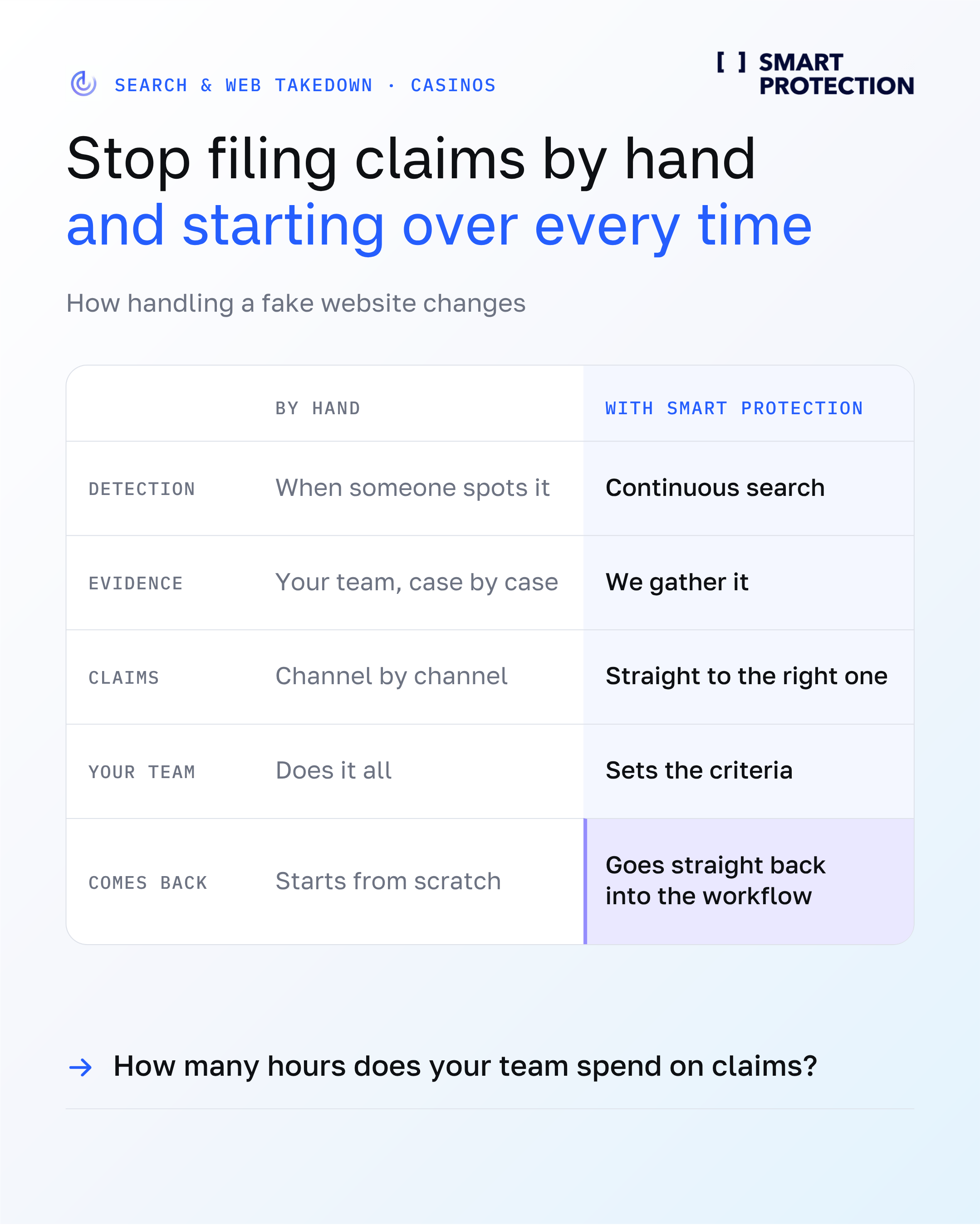
We search for your brand every 30 minutes, with unlimited queries geolocated by country. As soon as the clone surfaces in one of the searches we monitor, it enters the workflow in the next round, tied to the exact query and market where a player would see it. No waiting until Monday.
We capture the content, metadata, screenshots and web certificates, and analyze the text, images and domain to confirm it's misusing your brand.
Then Smart Rules assign it a priority based on criteria you set. A clone ranking well on a bonus search can be flagged as critical, and your own sites and authorized partners never enter the queue.
The claim goes to whoever can act on it. That's Google, to remove the URL from search results, or the registrar, hosting provider or DNS provider when it's about the site itself. When the clone copies protected content from your site without authorization, it may be infringing your copyright, and that's where we have a specific advantage. As members of Google's Trusted Copyright Removal Program (TCRP), we send those deindexing requests through a direct channel and track their status in real time.
Once the infringement is confirmed, the content usually stops being visible within 1 to 4 hours. In online gambling, we get more than 98% of cases deindexed, and half are gone in under 2.5 hours. The final decision always rests with the search engine or platform, which reviews every request.
In a real case with a leading online casino operator, we detected and reported 5,034 infringing results in three months. Of those, we got 4,921 removed from search engines, a 97.75% removal rate.
The infringing domain loses ground on that search, and the space it leaves goes back to your brand. If the clone reappears on another domain, it goes straight back into the same workflow, and the new window starts closing from minute one.
Players don't only look for you on Google. They also click on ads, download apps or join a Telegram channel claiming to be yours. That's why the core service, focused on search engines, can be extended with modules you add when you need them.
Domains that use your name, or variations of it, to impersonate you, like the ones that tack "bonus" or "login" onto your brand. Domain Control detects them and handles their removal.
Fraudulent ads using your brand on Meta. They run on Facebook or Instagram under your name and send players to a site that isn't yours. Ads Control finds them and requests their removal.
Apps and APKs posing as yours in app stores and repositories, right when a player is trying to download you. App Control detects them and requests their removal.
Fake profiles and channels on Facebook, Instagram, TikTok, X, Telegram, YouTube and other networks, presenting themselves as your casino's official channel. Social Media Protection detects them and handles their removal.
On each channel, you decide how far we go. We can detect and remove, only detect if you'd rather your team handle the claims, or only remove what you've already found. It's the same brand impersonation protection we provide in other industries, adapted to the player journey.
That whole process runs without your team stepping in. What's left on your side is minimal, and it helps to be clear about it from day one.
The difference shows inside the team. Here's how the legal leadership at a regulated online casino we work with puts it:
"We'd spent months filing claims by hand and the sites kept coming back. In three months they removed almost 5,000 results, and our legal team is back to focusing on its own work."
Not having to step in doesn't mean you can't see what's happening. Reputation Hub shows you the volume of results and infringements handled and their impact, and you can download reports whenever you need them. That way, work that usually goes unseen becomes a number your leadership team can follow.
Want to see what would show up for your brand today? Request your free analysis and we'll show you which fake websites are appearing in your searches right now.
Ask them for two numbers. How long it takes for content to stop being visible once the infringement is confirmed, and how much of what they claim actually ends up out of search results. Those are the numbers that set the size of your exposure window. Ours are above, and the free analysis is a good way to compare them with your case.
Yes. On each channel, you choose whether we detect and remove, only detect because you'd rather your team handle the claims, or only take care of removal.
No, quite the opposite. Smart Rules apply the criteria your team sets, and your own sites and authorized partners are excluded from any action. Every case is documented with its evidence, so you can always check what was claimed and why.
A fake website isn't just an incident to close out. It's traffic, sign-ups and deposits your brand had already earned, slipping away while the window stays open. Closing it fast protects the continuity of your acquisition.
And it all starts with knowing how wide that window is today. Request your free analysis and we'll show you how much traffic is competing with your official site right now and where to start. It's a real analysis of your brand, not a generic demo, and there's no commitment.
Want to share this with your team? Download the Brand Protection for Casinos and iGaming brochure.


