Thank you! Your submission has been received. We will get in touch with you soon.
Back to site
.png)
Discover why fragmentation and weak infrastructure hurt South American football brand protection.
In South America, brand protection in football does not just face more fraud. It faces a deeper problem: a structural enforcement gap. This gap does not stem solely from the creativity of infringers or the commercial value of tournaments. It is born from a persistent combination of regulatory fragmentation, uneven rights enforcement, massive informal markets, and low operational coordination between public and private stakeholders.
This context directly affects competitions, clubs, sponsors, and broadcasters. It also impacts organizations like CONMEBOL , which operate in an ecosystem where brand notoriety coexists with highly unequal control capabilities across countries. In practice, this means that the exact same infringement can receive very different responses depending on the market, the platform, the competent authority, or the available speed of action.
The result is visible on several fronts simultaneously:
Data helps put the scale of the problem into perspective. Global losses linked to piracy and digital fraud in sports are estimated at $28 billion annually. On a broader level, the OECD - OCDE and the EUIPO - European Union Intellectual Property Office have estimated that the international trade of counterfeit goods accounted for around $509 billion, equivalent to 3.3% of global trade. In parallel, within the illegal streaming environment, various analyses have shown that a device can be exposed to malware in just 71 seconds when accessing pirated content, and there is a 57% probability that certain illegal applications contain malicious software.
From a brand protection perspective, this offers a clear takeaway: the problem is not just the fraud itself. The problem is the lack of a regional control infrastructure capable of detecting, prioritizing, and acting with consistency.
When analyzing brand protection risk in South America, it is easy to stay on the surface. You see illegal streaming, unofficial jerseys, fake tickets, or accounts using brands without permission. All of that is real. But if you stop there, you miss the root cause.
The root cause is structural.
Unlike other, more integrated markets, enforcement in LATAM usually depends on a complex combination of:
This means that simply holding the rights is not enough. You must be able to enforce them in an efficient, repeatable, and regionally coherent manner. And that is where the gap appears.
CONMEBOL concentrates some of the most valuable assets in South American football: high-visibility competitions, intense regional audiences, global sponsors, and media rights that sustain a large part of the commercial ecosystem. However, those assets circulate in markets where effective protection does not always match the level of exposure.
In practice, this creates an uncomfortable paradox. The higher the symbolic and commercial value of South American football, the greater the incentive for abuse. Yet, regional response capacity does not grow at the same pace.
For you, this changes how risk is interpreted. You are no longer managing isolated incidents. You are operating within an architecture where dispersion favors reoffending.
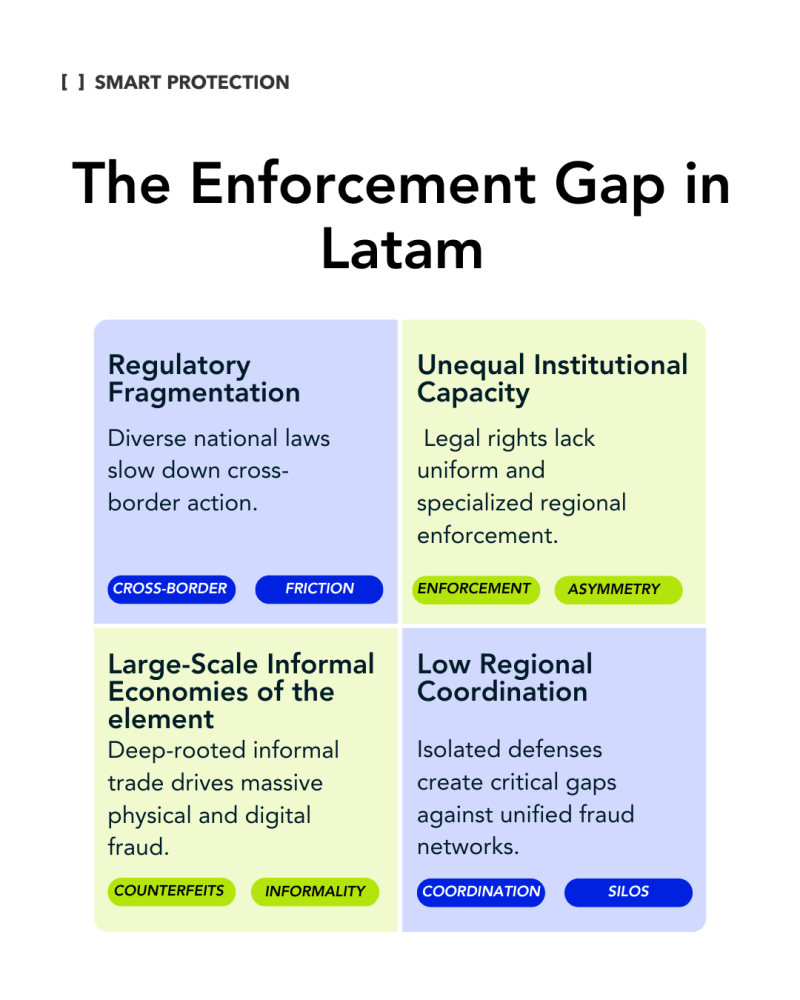
The gap does not stem from a single factor. It opens at several points in the system.
Every market has its own rules, priorities, and action mechanisms. What might be resolved relatively quickly in one country may require more time, more evidence, or a more complex legal route in another.
This especially affects cross-border infringements, such as:
From an operational perspective, this implies more friction, more manual coordination, and less consistency.
Not all countries possess the same level of specialization in intellectual property, digital crimes, or enforcement linked to sports rights. Even when a legal framework exists, the practical capacity to act can vary wildly.
This translates into something very simple: the existence of a right does not guarantee its effective defense.
In several South American markets, informality is not peripheral; it is a structural part of commerce. This amplifies the circulation of unauthorized products, resold tickets, and promotions that use brands without control.
For brand protection teams, this creates a dual challenge:
Although competitions are regional and brands circulate without borders, the response often remains fragmented. Each stakeholder works under their own logic, their own vendors, their own timelines, and their own priority criteria.
This point is decisive. When fraud operates as a network, but the response continues to operate as a collection of silos, the asymmetry becomes structural.
Illegal streaming is one of the most visible and costly fronts in the ecosystem. It does not just divert audiences; it also erodes media rights, reduces value for broadcasters, and pressures the commercial logic of sponsorships, exclusivities, and territorial monetization.
In the case of South American football, the problem intensifies due to several factors:
This directly affects tournaments and clubs. If the official broadcast loses traction to illegal options, the impact is not limited to the broadcaster. It also affects the entire value chain that sustains the sport.
Furthermore, illegal streaming is no longer just a rights infringement. It is also a cybersecurity risk. Data regarding exposure to malware, identity theft, and financial fraud shows that consumers pay a cost as well.
In South America, informal merchandising is not a marginal phenomenon. In many markets, it is part of the daily commercial landscape. Jerseys, caps, scarves, accessories, and event-specific products circulate through street channels, open-air markets, unauthorized stores, and digital environments.
The problem is not just the volume. It is the normalization.
When consumers coexist with unofficial products for years, the threshold of suspicion drops. The distinction between official, inspired, replica, or counterfeit becomes blurred. For clubs, leagues, and rights holders, this erodes several assets simultaneously:
From a brand protection perspective, this category demands a different approach. A one-off takedown is rarely enough. You need visibility into patterns, high-pressure zones, and the digital points of sale that amplify distribution.
Ticket fraud has a unique intensity in South America because it combines passion, urgency, and informal transaction channels. In high-demand matches, this mix creates the ideal environment for scams.
The most frequent schemes include:
In practice, the damage happens very fast. The fan discovers the fraud close to the event, when the window for a solution is minimal. This shifts the frustration onto the brand, even if the club or competition played no part in the transaction.
This point connects with another key idea in the current ecosystem: the ticket is no longer just an access product. It is also a gateway to digital fraud.
Trademark infringement in South American football is not limited to physical counterfeits. It also appears in:
Here, the problem is broader than just logo usage. What is being exploited is credibility. The infringer uses visual cues, commercial language, and emotional contexts to induce trust.
For you, this implies that protection can no longer focus solely on registered assets. You must monitor contexts of use, the potential for confusion, and transactional harm.
An effective response in LATAM requires accepting a reality: you will not eliminate the structural gap overnight. However, you can manage it better by reducing friction, improving visibility, and prioritizing with regional criteria.
If you are developing a broader strategy, this analysis connects naturally with other fronts such as sports impersonation fraud, football ticket fraud, and digital IP monitoring at major events and high-profile clubs.

The brand protection challenge in South American football cannot be understood merely as a collection of incidents. Nor can it be explained solely by the growth of digital fraud or the expansion of informality. The underlying problem is more structural.
What you see in the CONMEBOL ecosystem is a constant tension between increasingly valuable sports brands and a regional enforcement capacity that remains unequal, fragmented, and often reactive.
This changes the strategic priority.
It is no longer enough to chase infringements one by one. You need to build a regional logic of visibility, prioritization, and coordination. You need to understand where abuse repeats, which channels accelerate it, and what type of response actually delivers an impact in complex operational contexts.
From a brand protection perspective, that is the key conclusion: in South America, the problem is not just the fraud. It is the lack of a regional control infrastructure capable of responding to fraud with consistency.
If you want to review how to strengthen that visibility and turn more signals into prioritized actions, Smart Protection can help you evaluate where your digital exposure is concentrated today and how to structure a more efficient response.
What does "LATAM sports piracy" mean in the context of football?
It refers to the piracy of sports content in Latin America, especially unauthorized match retransmissions through websites, apps, social networks, and unlicensed services.
Why is brand protection in South America structurally more complex?
Because it combines regulatory fragmentation, unequal institutional capacities, large-scale informal economies, and low coordination between rights holders, platforms, and authorities.
What role does CONMEBOL play in this issue?
CONMEBOL concentrates competitions and assets of high commercial and reputational value in a region where enforcement capacity is unequal. This places it at the center of a regional challenge, not just a sporting one.
How does informal merchandising affect clubs and competitions?
It affects licensing revenue, quality control, perceived authenticity, and brand value. Furthermore, it normalizes the consumption of unauthorized products.
Why is ticket fraud so relevant in LATAM?
Because it blends high demand, emotional urgency, and informal transaction channels. This creates an environment highly favorable to illegal resale, phishing, and non-existent tickets.
What type of unauthorized brand use is most common in South American football?
It is common to see misuse on social media, commercial promotions, domains, streaming sites, graphics, giveaways, and campaigns that suggest non-existent official associations.
How can you improve regional enforcement in brand protection?
You can improve it through regional collaboration, continuous digital monitoring, clear prioritization criteria, consumer education, and operational integration between internal areas and external partners.
What does a solution like Smart Protection offer in this context?
It helps you centralize visibility, detect abuse across multiple channels, prioritize threats with better criteria, and reduce the operational burden in a fragmented regional environment.
Talk to a Brand Protection Expert HERE.