
Thank you! Your submission has been received. We will get in touch with you soon.
Back to site
.png)
Discover how FC Barcelona faces digital identity fraud, fake academies, and social media scams across Europe and LATAM.
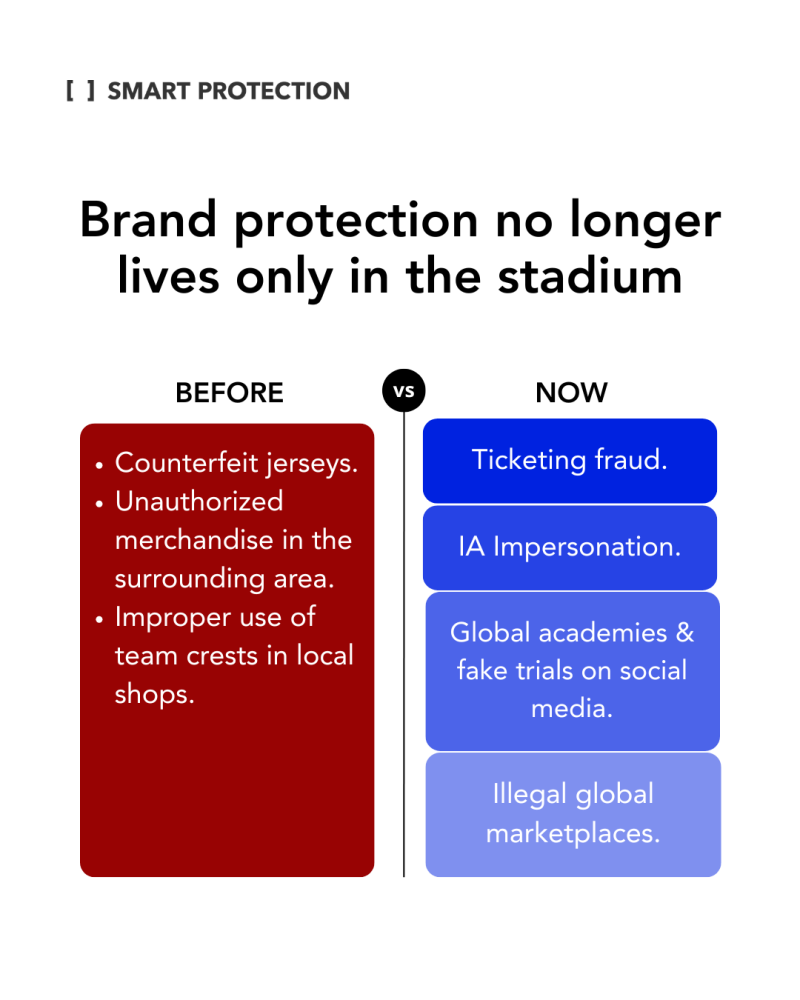
For years, brand protection in football focused on physical assets: counterfeit shirts, unauthorized merchandising, misuse of crests, and irregular ticket resale. That problem remains, but it no longer explains the true level of exposure facing a global club on its own. Today, in an environment shaped by social media, international academies, digital fan engagement, and viral content, the risk has shifted elsewhere: digital identity.
In that new context, a club such as FC Barcelona is not only protecting a name or a crest. You are protecting a network of trust signals. You are protecting academies, social accounts, youth programs, announcements, fan experiences, ticket sales, player image rights, and messages that the public interprets as official. When that identity is falsified, the impact is no longer only reputational. It also becomes transactional fraud, data theft, deceptive talent recruitment, and commercial exploitation of the brand.
This shift is structural. It is no longer enough to think of counterfeit activity as the main category. Now you can see a clear expansion of what could be defined as sports impersonation fraud and football social media scams: fake academies promising access to the club, supposed trials for young players, profiles pretending to be players or official departments, fake giveaways, and false ticketing campaigns distributed through social platforms.
The data helps explain the scale. Global losses linked to piracy and digital fraud in sport are estimated at around $28 billion per year. At the same time, various cybersecurity studies show that users who interact with pirated or fraudulent environments can expose their devices in as little as 71 seconds, and that there is a 57% probability that certain illegal applications contain malware. On social platforms, the acceleration is also visible: Meta has removed millions of fake accounts globally across different periods, while TikTok and X have strengthened verification and moderation systems precisely because impersonation has become one of the most effective forms of digital fraud.
For brand protection teams, this means something very specific: the value of the club no longer exists only in the stadium. It also lives in the digital identity that thousands or millions of people recognize, trust, and use to make decisions.
FC Barcelona is one of the clearest examples of how a football club becomes a global brand infrastructure. Its value does not depend only on sporting results. It also depends on its academy, its international reach, its digital community, its commercial ecosystem, and the emotional connection it creates across generations of fans.
This changes the attack surface completely.
In the past, brand abuse was concentrated in products or physical channels. Today, the club’s identity circulates through:
In practice, the more digital the relationship between the club and the fan base becomes, the more profitable it is for a third party to copy that relationship.
From a brand protection perspective, this matters for three reasons.
1. Digital identity drives immediate action
A counterfeit shirt can damage revenue. But a fake Instagram or TikTok account can do something faster: create direct contact, promise access, collect payments, or divert traffic in minutes. The barrier to entry is lower, and the speed of distribution is much higher.
2. Fraud no longer looks like fraud
Many scams do not present themselves as openly suspicious. They are framed as opportunity. A supposedly affiliated academy. An exclusive trial. A message from a scout. A ticket link. A campaign for fans. That logic lowers the user’s guard.
3. Credibility is built with simple elements
It is not necessary to replicate the club’s entire infrastructure. In many cases, it is enough to combine a similar name, an official image, a well-written bio, and a few purchased followers to create the appearance of authenticity. This is especially effective in markets where the consumer does not always distinguish between a verified account, a fan account, and a fraudulent one.
This point connects with other risks across the wider ecosystem. If you analyze the problem more broadly, you will see that this threat relates to phenomena such as ticketing fraud and regional piracy. This means the issue connects naturally with analysis around ticketing fraud in football and the structural enforcement challenge in South America.
1. Fake academies and false training opportunities
One of the most sensitive risks for a club with a global brand is the spread of fake academies or programs that suggest a non-existent official relationship.
The pattern is usually consistent:
In Europe, this type of fraud often moves through more structured channels: websites, forms, local ads, and polished social media profiles. In LATAM, it also mixes with messaging apps, closed groups, Facebook and Instagram pages, and more direct promises of international visibility.
This means the damage goes beyond trademark abuse. It can also involve:
From an operational perspective, this is a particularly delicate risk because it combines brand, trust, and aspiration. It is not a cold fraud model. It is an emotional one.
2. Trial scams and fake talent recruitment
Closely linked to the issue above is another pattern that is becoming more visible: false trials or trial scams.
Here, the fraud is presented as a selection process for young players. Sometimes it appears as an official training camp. In other cases, it simulates a private call-up, an international scout review, or contact from a scouting network.
The scheme often includes:
In markets with high competitive pressure and strong aspirations to reach European football, the impact can be significant. LATAM is especially vulnerable for one clear reason: there is enormous aspiration for sporting mobility and strong trust in the symbolic value of European clubs.
For you, this creates an additional tension. The brand is not only being used to sell. It is being used to recruit, filter, or manipulate expectations. When that happens, the problem is no longer only commercial. It is also reputational and, in some cases, ethical.
3. Player impersonation and fake social media accounts
The third major category is the most visible and, at the same time, the fastest growing: impersonation on social media.
This includes multiple formats:
This risk is especially powerful because social media is now the main point of contact between the brand and the fan base. In many cases, the user’s first relationship with the club does not begin on the official website. It begins on Instagram, TikTok, X, or YouTube.
That changes the order of priorities. You can no longer think of social media as a secondary channel. For many audiences, it is the brand’s main interface.
In addition, the technical ease of creating fake accounts has lowered the cost of fraud. An actor can open multiple profiles, replicate official aesthetics, use real clips, buy engagement, and launch campaigns across different geographies with very little investment. When AI tools are added for text, image, or voice, the sense of authenticity becomes even stronger.
4. Fake tickets distributed through social media
Although the focus of this article is digital identity, there is one category that clearly shows how both worlds are now connected: fake tickets distributed through social media.
In these cases, the fraud does not begin on a website. It begins with a profile, an ad, a story, or a direct message. It then redirects the user to:
This confirms a key idea: digital identity is not used only to deceive. It is used to open the door to more profitable fraud.
Digital identity fraud does not operate in the same way across all regions. However, LATAM and Europe now form a connected circuit.
Europe: visual legitimacy and operational sophistication
In Europe, fraud often relies on stronger visual quality, more credible websites, better segmented campaigns, and more refined use of domains and paid ads. The goal is to appear official for long enough to convert traffic or payments.
LATAM: speed, social media, and informal channels
In LATAM, you see a different combination:
This does not mean lower sophistication. It means a different kind of effectiveness. More direct, more social, and more reliant on linguistic and cultural proximity.
The connecting point
Both regions are connected because the brand is global, but the tactics are localized. A campaign may rely on European visual assets and be commercially deployed in LATAM. Or the reverse may happen: it may originate in LATAM and use servers, marketplaces, or external infrastructure elsewhere.
For you, this has one clear implication: you cannot separate regional protection from global protection. If abuse scales through social platforms, the language, jurisdiction, and channel can change quickly.
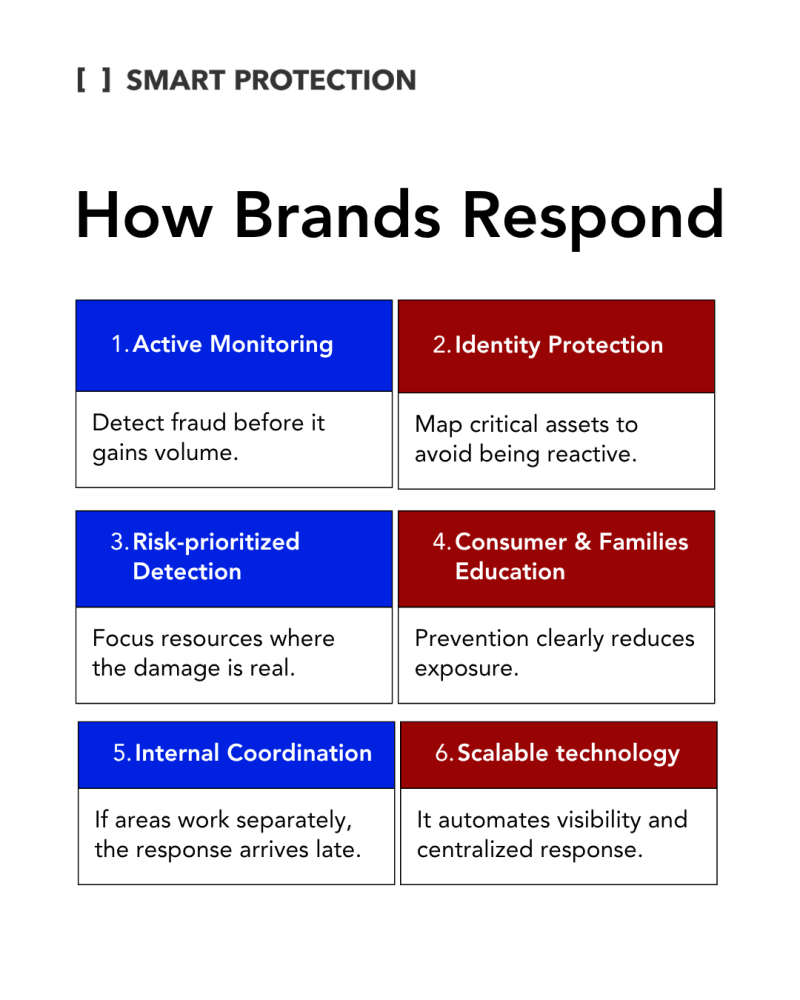
An effective response does not depend on a single action. It requires a continuous structure of visibility, prioritization, and coordination.
1. Active social media monitoring
You need continuous monitoring of:
This allows you to detect threats before the fraud gains volume.
2. Digital identity protection
You need to define which assets make up your critical digital identity:
Without that map, monitoring loses context and enforcement becomes reactive.
3. Risk-based detection and prioritization
Not every impersonation case has the same impact. It is important to prioritize by:
This reduces noise and helps you focus resources where the damage is real.
4. Consumer and family education
In this type of fraud, prevention is critical. Explaining how to identify official accounts, how to verify legitimate academies, and which signals indicate a scam can clearly reduce exposure.
5. Coordination between legal, marketing, and brand protection
If these teams work separately, the response arrives too late. The club’s digital identity crosses reputation, compliance, public relations, youth talent, ticketing, and commerce. Protection needs to cross those functions as well.
6. Scalable technology
As the brand grows, the volume of signals exceeds manual capacity. This is where a SaaS solution provides something very specific: centralized visibility, intelligent prioritization, and the ability to act more consistently across multiple platforms.
The FC Barcelona case reflects a broader transformation in sports brand protection. The value of the club no longer rests only in official products, matches, or sponsorship agreements. It also lives in a distributed, recognizable, and highly monetizable digital identity.
That changes the nature of fraud.
Today, you are not only dealing with someone copying a shirt. You are dealing with someone copying trust. Someone turning the club’s prestige into fake academies, deceptive trials, fraudulent social profiles, and campaigns that use player image to trigger payments, data collection, or traffic diversion.
From a brand protection perspective, this point is decisive. When digital identity becomes commercial infrastructure, protecting it stops being a secondary task. It becomes a strategic function.
And that is probably the most important conclusion: if the club’s brand lives where the fan interacts, then your defense has to live there as well.
If you want to assess how to strengthen that visibility and prioritize digital identity risks more effectively, Smart Protection can help you understand where your exposure is concentrated today and how to structure a more efficient response.
What is sports impersonation fraud in football?
It is the fraudulent use of the identity of a club, player, academy, or official channel to deceive fans, families, or consumers. It can include fake accounts, unauthorized academies, non-existent trials, and deceptive promotions.
Why is FC Barcelona a frequent target of digital fraud?
Because it is a global brand with strong recognition, a large social media presence, international academies, and a massive digital community. This combination creates immediate trust and high value for fraudulent actors.
What risks do fake academies create?
They can collect payments, personal data, and expectations from families and young players. They also damage the club’s reputation by suggesting an official relationship that does not exist.
How do fake trials or player tryout scams work?
They usually promise access to scouts, coaches, or programs linked to the club. They use forms, registration payments, and fake profiles to create the appearance of legitimacy.
Why are social media platforms so important in this type of fraud?
Because they are the fastest channel for building apparent trust, spreading messages at scale, and redirecting traffic to payments or forms. In many cases, they are the fan’s first point of contact with the brand.
How can you reduce the risk of digital impersonation?
You can reduce it through active monitoring of social platforms, protection of digital assets, risk-based detection, internal coordination, and clear education for fans, families, and local communities.
What does a solution like Smart Protection add?
It helps you centralize signals, detect fraudulent uses faster, and prioritize actions based on impact, reducing operational workload and improving visibility across digital threats.
If you are reviewing how to improve your monitoring and enforcement approach, Smart Protection can support you with a clearer, more scalable way to manage digital brand abuse.
Talk to a Brand Protection Expert HERE.


