
Thank you! Your submission has been received. We will get in touch with you soon.
Back to site
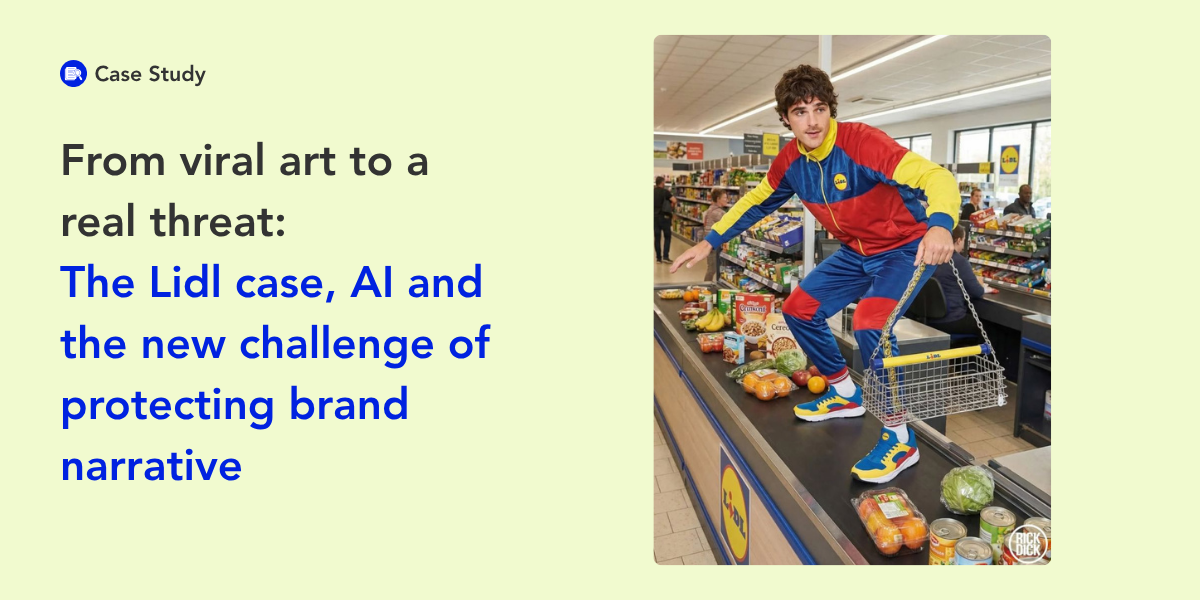
Discover how AI challenges brand protection with the Lidl and Jacob Elordi case, and how Ads Control helps preserve narrative in a dynamic digital environment.
Last week, during a roundtable with several marketing directors, a shared concern emerged: the impact of AI-generated content on brand perception and protection. At the center of the discussion was the viral campaign created by visual artist RickDick, which turned Jacob Elordi into the face of Lidl through a series of digital images so realistic they fooled thousands of users. This imaginary collaboration not only blurred the lines between fashion, pop culture, and visual humor, but also exposed the current power of artificial intelligence to dissolve the boundaries between authenticity and fiction in brand communications.
Today, anyone with access to AI can create an advertising campaign, a product redesign, or an emotional spot within minutes, with visual and narrative quality surprisingly close to official material.
This phenomenon challenges the traditional logic of brand protection. For decades, your strategy was built around coherence established “from within,” relying on multidisciplinary teams to define the brand’s purpose, positioning, and visual expression. The aim was to project a strategic and controlled message outward, maintaining control over the brand’s symbolic reality

That reality has changed. The democratization of AI has shifted the power to create brand narratives beyond the reach of official teams. Now, your competition is not just in the marketplace, but within the collective imagination. Who defines what your brand means today? Which content is circulating, assumed as authentic, and ultimately establishing the cultural references you have to respond to?
This case study addresses the current challenges you face in brand protection, starting with the concrete example of Lidl and reflecting on how technological solutions like Ads Control are essential to preserve narrative coherence and authority in this new environment. We focus both on the semiotic implications and on the legal and operational challenges that make the difference between brands that manage to maintain control over their narrative and those that lose it to viral digital content.
The problem now lies not only in the counterfeiting of products, but in the manipulation and appropriation of brand narratives. The viral campaign created by RickDick in February 2026 illustrates this clearly: an artist, using AI, was able to simulate an authentic Lidl campaign, blending elements of "ironic luxury" with the popular supermarket’s aesthetic and adding the appeal of a well-known figure like Jacob Elordi. The image series, far from being a simple parody, replicated the brand’s visual codes with such precision that it confused both users and the media, especially since it coincided with a real Lidl collaboration at London Fashion Week for the launch of the Trolley Bag, a limited edition bag.
This case demonstrates that building a brand narrative is no longer the sole domain of the branding department. The boundaries between official communications and fan fiction are disappearing, leading to new risks: highly plausible, unauthorized messages that circulate without the brand’s knowledge or control.
Key points in this narrative tension:
This scenario increases exposure to reputational, commercial, and legal risks. Fake ads and unauthorized content can generate confusion, damage a brand’s reputation, and, in many cases, serve as vehicles for fraudulent activities such as phishing or the sale of counterfeits—causing real financial harm to the brand.
In this new digital landscape, continuous monitoring and swift removal of fraudulent ads are critical factors for protecting your brand. The true risk goes far beyond a malicious link: it lies in the erosion of your brand’s authority over its own narrative. This is where a technology solution like Ads Control gains strategic relevance.
Ads Control was created as a specialized service to detect and take down fake ads that exploit brand assets without authorization, across all key channels—including social networks, search engines, and advertising platforms. Its value lies not only in passive monitoring, but also in the ability to act intelligently and automatically, removing threats before they negatively impact the business.
Consider this scenario: an AI-generated campaign perfectly imitates your brand identity and begins to circulate on Instagram or TikTok, advertising fraudulent products or promotions and redirecting users to illegitimate replicas of your online store.
Without active monitoring, these ads can have severe consequences in a very short time:
Ads Control responds to this challenge with a structured approach:
As a brand protection leader, this automated approach means less operational workload and a greater capacity to respond to complex incidents, allowing you to focus resources on strategic planning rather than manual crisis management.
The proliferation of AI-generated content highlights the need to strengthen the protection of intellectual property assets. Your trademarks, copyrights, and patents are not only legal tools—they are the foundation of your legitimacy to assert authority over your brand’s narrative. However, these instruments lose effectiveness in the fast-paced digital environment if they are not paired with agile, automated detection and response operations.
The key is not to engage in indiscriminate battles against external creativity, but rather to build a brand that is so clear and recognizable that any outside intervention is easily identified—and, if legitimate, can even reinforce your narrative. In this sense, effective collaboration between your legal department and technological solutions like Ads Control is essential to anticipate risks, gain reaction time, and maintain brand coherence across all channels.
The rise of AI as a driving force in digital culture has transformed the landscape of brand protection. It is no longer enough to control symbolic production from within; you now require strategic clarity and proactive surveillance tools. Fake ads represent one of the most direct and damaging threats, capable of eroding both trust and the symbolic value of your brand.
Overcoming this scenario requires a dual strategy: reinforcing your internal brand identity and establishing intelligent technological defenses that enable swift action against external interference. For you, achieving narrative sovereignty means not only reacting, but also anticipating and proactively defending every touchpoint of your brand within the digital ecosystem.
At Smart Protection, we understand that protecting your brand narrative is just as crucial as safeguarding your physical assets. Our technology combines visibility, automation, and control, empowering you to take the lead in defending your identity across digital advertising. Discover how you can strengthen your strategy and address the challenges of an increasingly dynamic and digital environment.

.png)


