Thank you! Your submission has been received. We will get in touch with you soon.
Back to site
.png)
Discover how the gray market, unauthorized sellers, parallel imports, and price violations impact your brand’s revenue and margins.
Your brand invests millions in generating demand in Latin America.
The uncomfortable question isn't how much demand you generate.
It's who is capturing it.
Because while your commercial team fights for every sell-out point, there are sellers you don't know selling your product — your original product, not a counterfeit — on marketplaces, discount stores, trade fairs, and WhatsApp groups, at prices you didn't set, in countries where you may not even have distribution.
And because the product is authentic, no one reports it.
Not the consumer, who thinks they got a good deal.
Not the platform, which collected its commission.
Not your own reporting, which only sees the official channel.
As an intellectual property lawyer who works with brands and law enforcement agencies told us:
"There is nothing more dangerous than ignorance. You don't see it coming, you don't take preventive measures, and you're not prepared to react."
This article explains what the grey market is and the three phenomena that make it up — because understanding the problem is the first step to managing it.
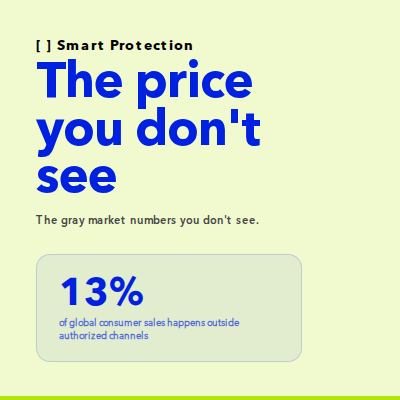
The grey market is the sale of authentic product outside the channels and conditions the brand authorized.
We're not talking about copies. We're not talking about consumer fraud.
We're talking about your own product escaping your control.
This distinction is fundamental.
Counterfeiting is illegal product by definition. It is fought with intellectual property enforcement, legal action, and takedowns.
The grey market, on the other hand, is often not even illegal — and that's exactly why it's invisible. In much of Latin America, reselling original product is perfectly legal.
That turns the problem into something that cannot be solved by lawyers.
It is managed with visibility, contracts, and commercial decisions.
The grey market is not a single phenomenon. It manifests in three distinct forms, and each one has a different impact.

These are third parties reselling your original product without being part of your official distribution network.
They operate on marketplaces, social media, WhatsApp groups, and trade fairs. They are not necessarily illegal. They are simply outside your control.
What it hits: sale price, Buy Box on marketplaces, customer experience, and your relationship with your official channel. Your authorized distributor cannot compete — and they will let you know.
Your product is purchased in a country where the price is lower and resold in another where the price is higher, outside your official distribution.
The mechanism is simple: every price gap between markets is a parallel reseller's business model.
What it hits: regional pricing strategy, exclusivity agreements with local distributors, and per-market margins. What appears to be an internal pricing decision becomes an arbitrage opportunity that others exploit.
Distributors — even authorized ones — who advertise your product below the agreed minimum price (Minimum Advertised Price).
The problem is not just the price of a single transaction. It's the chain reaction: when one seller breaks MAP, the others are forced to follow in order not to lose sales.
What it hits: price integrity across the entire channel, distribution network margin, and perceived brand value. Once the price falls, recovering it is extraordinarily difficult.
Three phenomena. One outcome: your brand loses control over how its own product is sold.
And because the product is authentic in all three cases, the problem doesn't appear in any fraud report or legal alert.
It appears, silently, in the margin.
If any of this sounds familiar — sellers you don't recognize, price inconsistencies you can't explain, distributors raising concerns — it may be worth a conversation.
Our team works with brands across LATAM to map exactly where grey market activity is occurring and what can be done about it. Please, feel free to book a call HERE
1. What is the grey market?
The grey market is the sale of authentic products through distribution channels that are not authorized by the brand. Unlike counterfeiting, the products are genuine, but they are sold outside the markets, distributors or conditions intended by the manufacturer.
2. How does the grey market affect brands?
The grey market can reduce margins, create price discrepancies across channels, cause conflicts with authorized distributors and make it harder for brands to control where, how and at what price their products are sold.
3. How much can the grey market cost a brand?
The impact depends on the industry, sales volume and each brand’s exposure. Based on the data analyzed in this article, the cost can include direct margin loss, pricing pressure and compensation paid to authorized channel partners.
4. What is the relationship between the grey market and MAP violations?
Unauthorized sellers may offer products below the Minimum Advertised Price (MAP), putting pressure on official sales channels. Identifying who is selling, where they are selling and at what price is therefore essential for detecting potential violations and protecting the brand’s commercial strategy.
5. How can brands control unauthorized distribution?
The first step is gaining visibility into sellers, marketplaces, prices and markets where their products appear. With this data, brands can identify unauthorized sellers, prioritize the issues with the greatest business impact and take action to regain control over their distribution.
.png)