Thank you! Your submission has been received. We will get in touch with you soon.
Back to site
.png)
Discover how to remove harmful content from Google. A step-by-step guide on delisting, legal enforcement, and corporate reputation protection.
Control over your company’s digital presence is no longer a secondary option. When malicious links, counterfeit products, or defamation campaigns dominate the top search results, the impact on consumer trust and your revenue is immediate.
As a brand protection leader, you know that the constant visibility of digital threats can overwhelm your operational team. However, converting those alerts into concrete actions is critical. Removing harmful content from search engines, a process known as delisting, cuts off traffic to infringers and protects the integrity of your global brand.
This guide breaks down how to manage and execute delisting on Google, transforming detection into resolution with operational efficiency.
Before initiating any enforcement action, you need to classify the threat. Different types of content require distinct legal and operational routes. From a brand protection perspective, the most critical threats include:
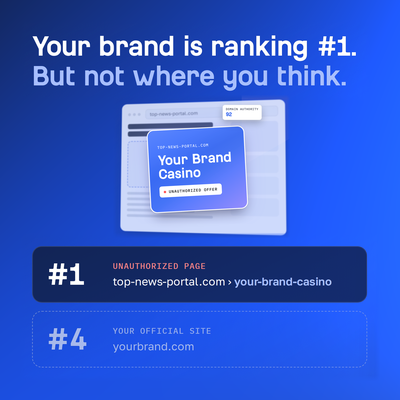
Counterfeit networks and unauthorized sellers use your brand recognition to divert traffic. This includes pirated copies, trademark misuse in domains (typosquatting), or stolen product images. This means that your brand’s visibility is being monetized by illegitimate third parties.
Coordinated campaigns aimed at destroying your company's reputation through false information. Fabricated negative reviews not only deceive consumers but also manipulate the search algorithm to rank harmful narratives above your official content.
The non-consensual publication of financial data, passwords, or the personal information of executives and employees (a practice known as doxxing). For businesses, this results in severe security vulnerabilities and compliance breaches.
Pages that mimic the appearance of your official portals to steal customer credentials or payment information. The rapid removal of these search results is critical to avoiding public relations crises and legal liabilities.
Achieving global operational efficiency requires a structured approach. Google provides specific mechanisms to remove content, but success depends on presenting actionable intelligence accurately.
Before submitting a request, gather irrefutable evidence. Capture exact URLs, date-stamped screenshots, and documents that prove the ownership of your intellectual property (such as patent or trademark registration numbers). Actionable intelligence allows you to prioritize the threats that generate the greatest financial or reputational damage.
Google’s primary tool for legal removal requests is the Legal Help panel (g.co/legal). In practice, this is the channel to report:
Select the exact service where the content appears (for example, "Google Search"), choose the reason for the claim, and complete the form with the required technical and legal documentation. Be direct and avoid emotional language; reviewers are looking for clear legal facts.
If the harmful content originates from pages you have already removed from your own domain (for instance, after a hack), use the URL removal tool in Google Search Console. This temporarily hides the pages from search results while you clean up your infrastructure, ensuring that users do not access broken or compromised links.
Google does not act as a judge in complex disputes. If there is no clear violation of their policies or the law (such as the DMCA), they will likely reject the request. In these scenarios, you must escalate your enforcement efforts.
Identify who hosts the infringing website using WHOIS lookup tools. Sending a formal Cease and Desist notice to the site administrator or hosting provider is often highly effective. Most hosting providers enforce strict policies against fraud and IP violations, and they will remove the content to avoid liability.
When the content does not cross the line of illegality (such as negative but legal opinions), the strategy shifts from removal to suppression. Create and rank high-quality official content, press releases, and strong corporate profiles. The goal is for the digital assets controlled by your company to dominate the first page of results, pushing the harmful content to pages where it loses visibility.
The effectiveness of delisting varies profoundly depending on the jurisdiction, a key factor in global brand protection.
In the European Union and other territories with similar privacy regulations (such as the GDPR), individuals and, in specific cases, linked entities, can request the removal of search results that are inadequate, irrelevant, or excessive.
However, from a corporate protection perspective, the Right to Be Forgotten applies primarily to individuals (personal data of executives), not to corporations themselves. If the information exposes your company's leaders maliciously and is irrelevant to the public interest, you can invoke this right through Google's specific privacy forms.
A removal on Google.es or Google.fr under local regulations does not always guarantee that the content will disappear on Google.com worldwide. To achieve total control of your brand on an international scale, you must build enforcement strategies that attack the root of the problem (the server) rather than just the symptom (the search engine).
Protecting the integrity of your commercial network against digital threats requires shifting from a reactive approach to a strategic one. Constant alerts generate team fatigue and dilute operational focus. To take control of your digital destiny in a scalable way:
Effective brand protection is not an isolated effort, but a continuous process of intelligence, prioritization, and global execution.
To streamline your enforcement operations, reduce manual workload, and ensure the consistent global application of your rights, discover how the automated intelligence and reliable network of experts at Smart Protection can scale your efforts. Take control of your brand's destiny globally—partner with Smart Protection today to secure your digital assets with precision and
.png)