
Thank you! Your submission has been received. We will get in touch with you soon.
Back to site
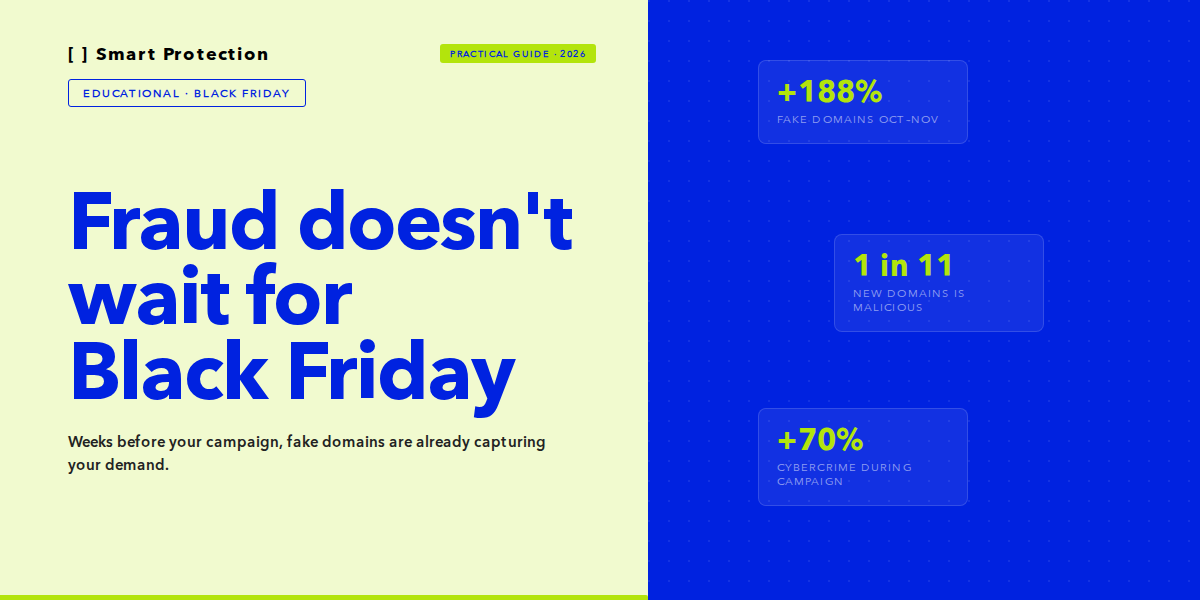
Black Friday fraud starts before November. Learn how to detect phishing, fraudulent domains, and impersonation attempts to protect your brand in time.
Black Friday has already started.
Your brand probably doesn't know it.
While your marketing teams are fine-tuning discounts and your ecommerce team is preparing product listings, another team is working in parallel.
No meetings. No approved budget. No heads up.
Fraudsters have been spending weeks building the infrastructure they'll use to capture the exact demand your brand works so hard to generate.
And the data proves it.
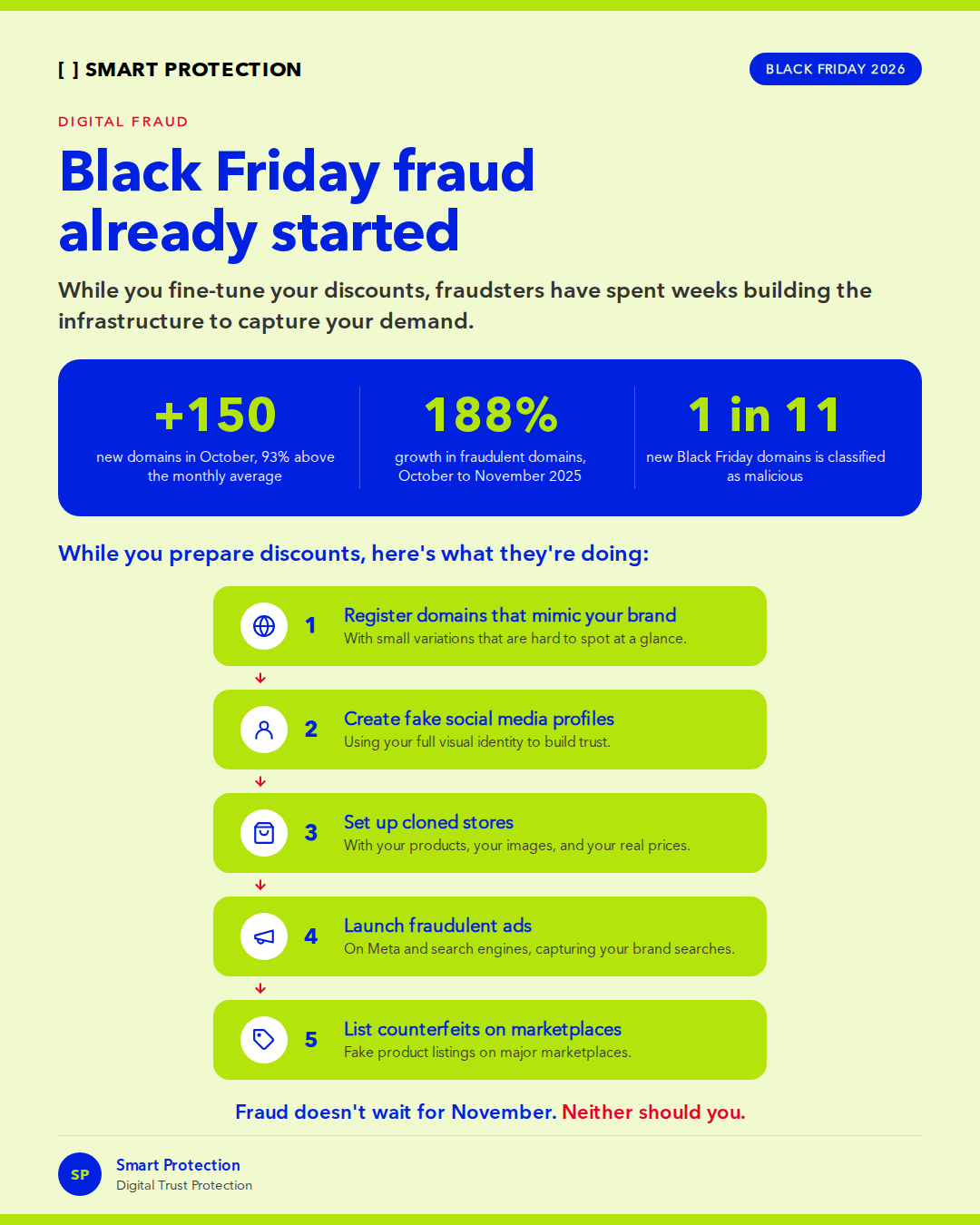
In October alone, over 150 new domains linked to Black Friday are registered.
93% more than usual.
One in every eleven is malicious.
And the growth doesn't stop: fraudulent domains related to Black Friday increase by 188% between October and November.
The domain hokablackfriday.com was registered on October 24 to steal customer credentials from HOKA.
Not on Black Friday. Not in November.
Months before the campaign even started, the fraudulent infrastructure was already active.
Does your brand already have visibility into what's active right now? Let's talk →
There's one figure that deserves special attention.
62% of consumers will avoid shopping at a retailer that has experienced a security breach or fraudulent activity associated with their brand.
Even if the brand didn't make any mistakes.
This completely changes how we understand the problem.
Black Friday fraud isn't a technical incident.
It's an event that erodes trust.
And trust, once lost, can't be recovered with a retargeting campaign.
Cybercriminal activity spikes by 70% during Black Friday and Cyber Monday.
53% of global spam related to Black Friday involves active fraud, not aggressive marketing.
And 56% of small and medium businesses suffered some type of attack during Black Friday 2024.
What this reveals isn't just a seasonal spike.
It reveals an organized, scalable, and increasingly automated ecosystem.
Fraudsters don't improvise.
They plan. They prepare. They launch with precision.
And brands that wait until Black Friday to act aren't protecting themselves.
They're managing a crisis.
Does your brand already have visibility into what's active right now? Let's talk→
When a consumer lands on a fake site that mimics your brand...
When they enter their payment information on a cloned page with your logo...
When they receive a counterfeit product thinking it was yours...
...the damage doesn't fall on the fraudster.
It falls on you.
The consumer doesn't distinguish between the fraud and the brand.
They associate the experience with your name.
And that association has direct consequences on conversion, retention, and long-term customer value.
There's one figure that changes the operational perspective.
More than 40% of threats are detected before they spread when early visibility exists.
This means that early preparation isn't a marginal advantage.
It's the difference between neutralizing a threat before it reaches the consumer or managing it after it's already caused damage.
Acting in August isn't being cautious.
It's being strategic.
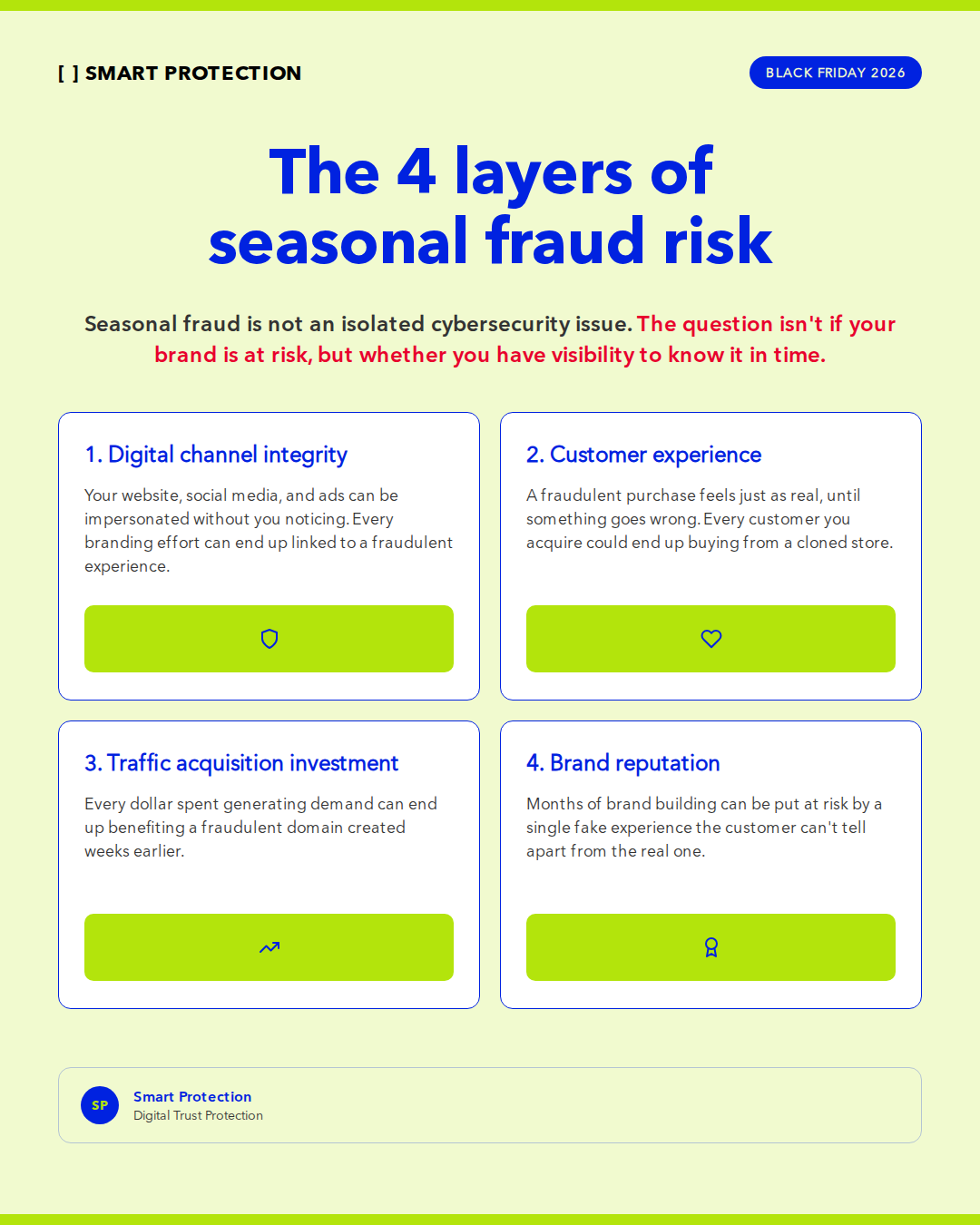
It is a multidimensional business risk that simultaneously impacts:
the integrity of the digital channel,
the customer experience,
the investment in traffic acquisition,
and the reputation built over months of campaigning.
Every dollar invested in generating demand can end up benefiting whoever built a fraudulent domain in October.
Every customer acquired can end up in the hands of a cloned store.
Every branding effort can become associated with a fraudulent experience.
The question is not whether your brand is at risk.
The question is whether you have enough visibility to know it in time. Let's talk →
Black Friday is not a 24-hour event.
It is a risk season that begins weeks before and extends weeks after.
Brands that arrive protected don't do so because they reacted quickly.
They do so because they established early visibility, detected threats before they spread, and coordinated their response before fraud volume reached its peak.
That preparation starts in August and September.
Not in November.
If you want to understand what exposure your brand has before the campaign begins, we can analyze it together.
Contact us and one of our digital protection experts will get in touch with you. Let's talk →


.png)


