
Thank you! Your submission has been received. We will get in touch with you soon.
Back to site
.png)
Discover how sports fraud has evolved into a complex system in 2026 and the key strategies to protect brands against digital and commercial threats.
Historically, brand protection strategies in sports focused on a visible enemy: physical counterfeiting. Unofficial jerseys, counterfeit merchandise, and low-quality products concentrated much of the operational effort. By 2026, that approach is no longer sufficient.
Today, brand protection leaders face a much broader fraud ecosystem. Brand abuse in global football no longer relies solely on counterfeit products. It now combines ticketing fraud, domain squatting, AI-driven impersonation, fake fan portals, illegal streaming, fraudulent social accounts, and phishing campaigns. All of this operates as a coordinated system that exploits the visibility, urgency, and emotional charge surrounding major tournaments.
This changes the underlying problem. It’s no longer just about removing a counterfeit jersey from a marketplace. It’s about protecting a sports brand against a digital infrastructure that captures demand, diverts revenue, steals data, erodes trust, and impacts the integrity of the event.
Data helps quantify the risk. Global losses from piracy and digital fraud in sports are estimated at $28 billion annually. Additionally, analyses published around the 2026 World Cup highlighted over 4,000 suspicious domains registered in just two months, many linked to tickets, broadcasts, host cities, and supposedly official merchandise. Meanwhile, various studies on illegal consumption indicate that accessing pirated sites can compromise a device in 71 seconds, with a 57% probability that certain illegal streaming apps contain malware.
From a brand protection perspective, this means something very specific: fraud is no longer a product; it’s a complete system attacking the brand.
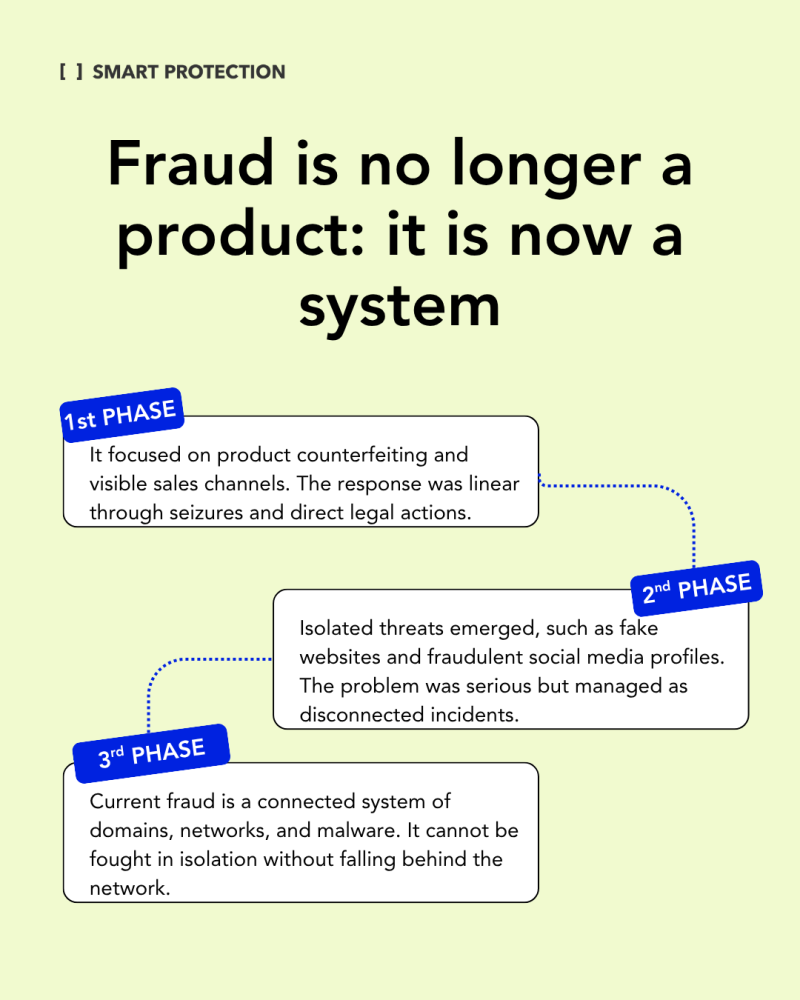
The evolution of sports fraud follows a clear logic.
The first major threat was traditional counterfeiting. Its impact was significant but relatively contained: unauthorized products, informal sales channels, and more visible operations. The response was also more linear: investigation, seizure, removal, and legal action.
Next came a second stage marked by isolated digital abuses: a fake website, a fraudulent social profile, a landing page for non-existent tickets. The problem remained serious but was still treated as a series of incidents.
By 2026, fraud operates as a connected ecosystem. A deceptive domain redirects to a fake ticket sale. That campaign is promoted through cloned social media accounts. Payments are channeled through opaque gateways. Then, the user receives malware or surrenders their credentials. Sometimes the same actor uses that infrastructure to sell counterfeit merchandise, illegal broadcasts, or even illegitimate betting tied to the event.
In practice, each fraudulent digital asset no longer operates alone. It’s part of a chain.
For you, this has a significant operational implication: if you continue addressing each infringement in isolation, you’ll react slower than the network you’re up against.
Major international tournaments are the ideal environment for brand abuse for five reasons:
This explains why FIFA and other international tournaments are epicenters of brand abuse. Not because they’re weak, but because they concentrate visibility, commercial value, and operational complexity simultaneously.
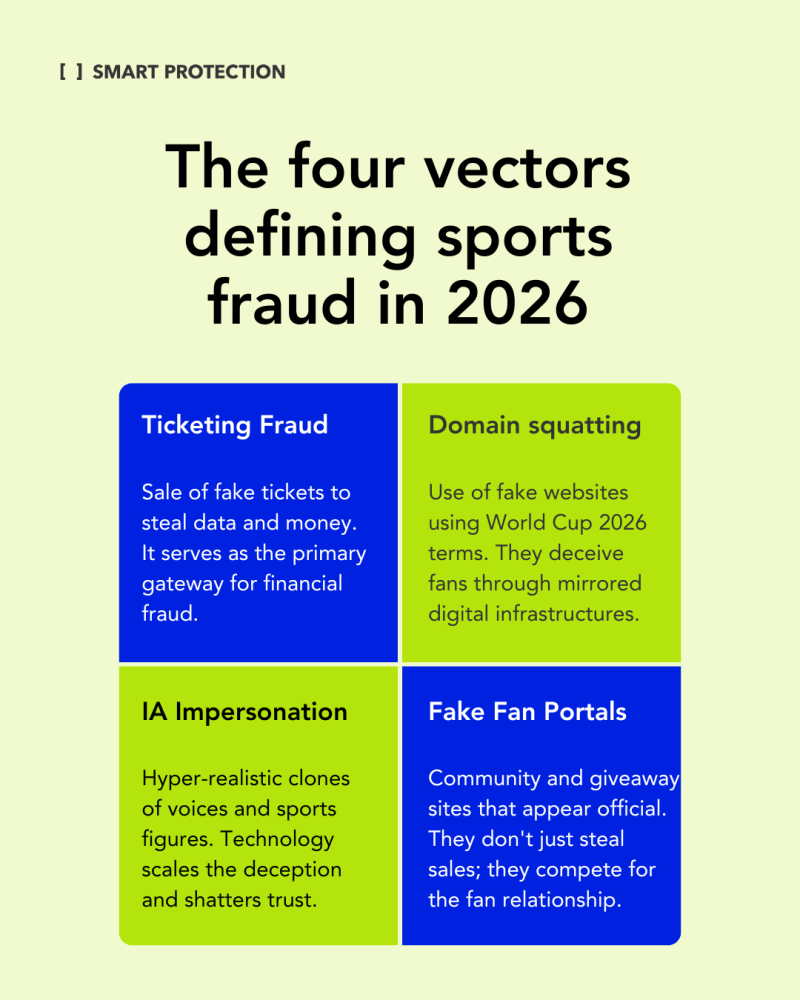
Latin America occupies a central place in this ecosystem for several structural reasons:
An effective response can no longer rely solely on post-legal actions. You need a continuous, integrated, and prioritized approach.
Global football enters 2026 with an uncomfortable but clear reality. Brand abuse is no longer limited to counterfeiting. It has evolved into a hybrid network of commercial, digital, and reputational fraud.
For you, as a brand protection director, this changes the central question. It’s no longer enough to ask how many counterfeit products you remove. You must ask how much fraudulent demand you intercept, how much digital identity you protect, and how much trust you preserve at every fan touchpoint.
That’s the underlying change. Fraud no longer lives on the margins of the sports business. It embeds itself within the fan’s digital experience, official commerce, and brand value.
And that’s why the response must also evolve. More visibility. More coordination. More operational intelligence. Less fragmented reaction.
If you want to understand how to structure this approach more clearly, Smart Protection can help you evaluate where your main digital risk surfaces are today and how to prioritize a more efficient response.
It’s the set of strategies, processes, and technologies you use to detect, prevent, and respond to brand abuse in the football ecosystem, across both physical and digital channels.
Because it now includes ticketing fraud, deceptive domains, AI-driven impersonation, illegal streaming, fake profiles, and fraudulent portals that capture revenue, data, and trust.
Global estimates place losses at around $28 billion annually, reflecting the cumulative economic impact of illegal streaming, digital fraud, and other forms of abuse.
They act as apparent trust infrastructure. They host fraudulent sales, phishing, illegal streaming, and impersonation campaigns. Around the 2026 World Cup, over 4,000 suspicious domains were identified in a very short period.
Due to the combination of high digital demand, intensive use of social networks and messaging, localized campaigns in Spanish and Portuguese, and fragmented enforcement capacity across different markets.
You can reduce it with continuous monitoring of domains and digital channels, brand identity protection, threat prioritization, internal coordination across areas, and educating fans about official channels.
It provides centralized visibility, automation, prioritization, and faster response capabilities to threats dispersed across multiple channels and jurisdictions.
Talk to a brand protection expert HERE.


