
Thank you! Your submission has been received. We will get in touch with you soon.
Back to site
Intangibles are worth $97 trillion. Protect your intellectual property and brand against AI and new digital threats with automated intelligence and global strategies.
Intangible assets—intellectual property, know-how, software, data, brands, and organizational capabilities—have moved from the margins of balance sheets to become the cornerstone of the global economy.
According to calculations by WIPO and Brand Finance, the estimated value of corporate intangibles reached $97 trillion in 2025, representing nearly 67% of the world's GDP and exceeding the combined total of the planet's largest economies. Key industries like Pharma ($4.3 trillion) and Retail ($4.2 trillion) increasingly rely on algorithms, patents, and organizational capabilities, even surpassing traditionally physical sectors like Oil & Gas ($3.7 trillion).
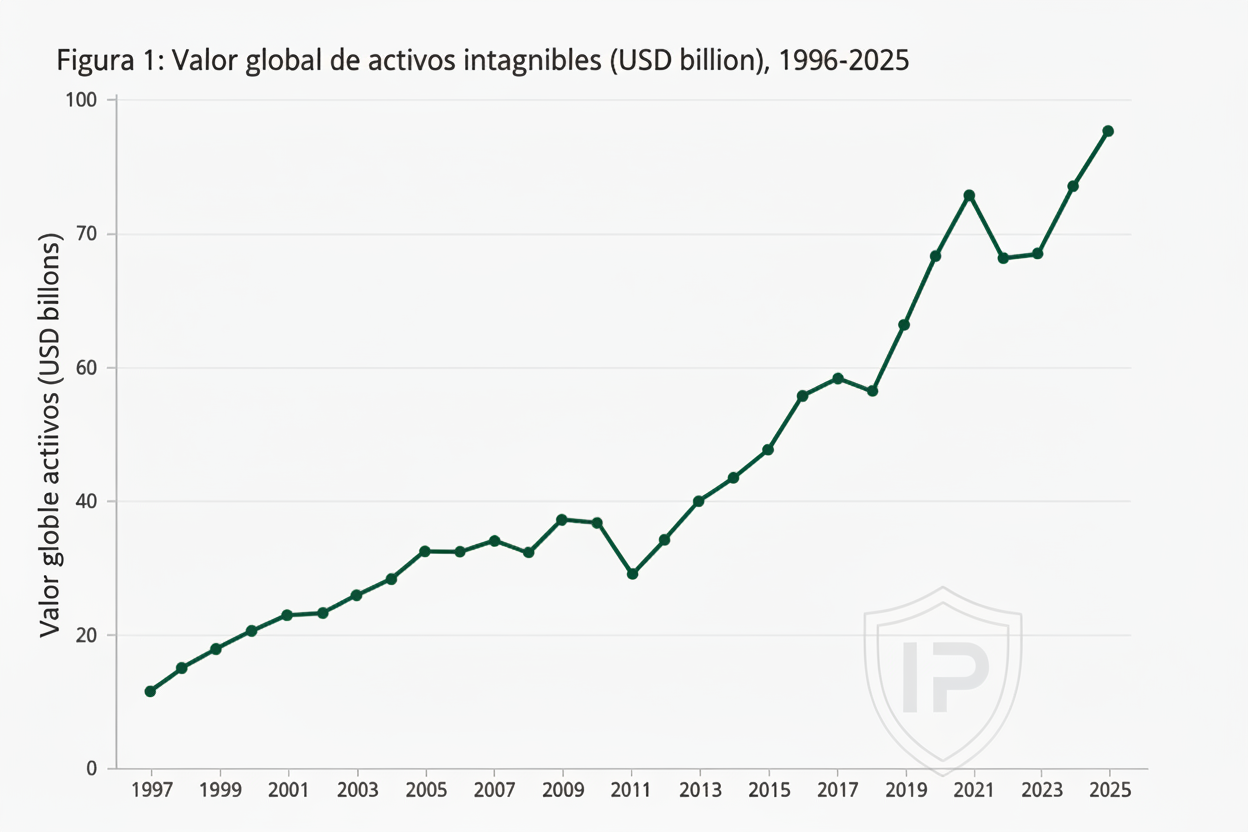
As the "Global Intangible Investment Highlights" report points out, investment in intangible assets has proven much more resilient to crises than physical investment and is the first to recover after economic shocks. The ratio of intangibles to GDP has remained above 50% even in market corrections, "which demonstrates," emphasizes the WIPO team, "the structural entrenchment of this capital in the functioning of companies and the global economy."
In the words of Sacha Wunsch-Vincent, co-author of the Global Innovation Index: "Today, the real value of a company lies in what it knows, in its network, in its brand, in its capacity for innovation and adaptation, not just in what it physically owns."
This transformation means that operational, reputational, and regulatory risks related to intangibles have become critical to the competitiveness and sustainability of any company exposed to international markets.
In fact, according to WIPO and Brand Finance, "practically two-thirds of business value on a global scale is no longer explained by tangible assets, but by patents, brands, data, software, and organizational capabilities that almost never appear on the balance sheet." This trend is structural and resilient: even during the 2022 crisis, the value of intangibles remained above half of global GDP and recovered much faster than investment in physical assets.
This quantitative growth has been accompanied by unprecedented risks: the OECD estimates that international trade in counterfeit and pirated goods reached $467 billion in 2022, more than 2.5% of world trade, and up to 5.8% of European Union imports. In particularly vulnerable sectors like pharmaceuticals and consumer goods, it is estimated that up to 10% of products in global circulation could be fakes, threatening both corporate revenues and consumer safety. This data highlights the growing importance and vulnerability of intangible assets in the contemporary economy.
For brand protection leaders, this number is not an abstract concept. It's the core of your daily work and the source of constant pressure.
Technological innovation has democratized global commerce, allowing brands to reach new markets with ease. However, this same infrastructure is used by counterfeiting networks to sophisticate their operations. The vectors of infringement have multiplied, creating a constantly evolving threat landscape.
Understanding these technologies is the first step to neutralizing them. In practice, this means analyzing how infringers exploit legitimate tools to evade detection and complicate legal enforcement.
Generative artificial intelligence is a double-edged sword. On one hand, it facilitates the mass creation of brand names, logos, product images, and optimized descriptions that almost perfectly mimic your intellectual property assets. This intensifies the "whack-a-mole" effect, where removing one infringing listing causes multiple replicas to appear instantly.
Furthermore, the rise of deepfakes represents an insidious threat to corporate reputation. Malicious actors produce hyper-realistic videos and audio of executives or marketing campaigns to commit fraud. This content can go viral in hours, causing severe financial and reputational damage before your team can even identify it.
Counterfeiters have perfected the art of evasion by using hidden links. They promote illicit products through social media or deceptive ads, but direct buyers to private messaging platforms like WeChat, WhatsApp, or Telegram to complete the transaction.
These applications offer end-to-end encryption, anonymous accounts, and disappearing messages. For your enforcement team, this creates an information black hole. You lack clear metrics on sales volume or inventory, making it exceptionally difficult to trace the flow of counterfeit products and establish legal accountability.
The accessibility of 3D printing has decentralized manufacturing. Unauthorized individuals and entities can replicate industrial designs with extreme ease and distribute them digitally across borders. The anonymous nature of this practice greatly complicates establishing jurisdiction and accountability.
In parallel, blockchain technology and NFTs introduce new avenues for infringement. Although they offer promising solutions for supply chain authentication, the lack of clear legal frameworks allows for the unauthorized creation of digital assets linked to your brand.
Faced with this landscape, relying on manual searches or fragmented technological solutions is unsustainable. As your brand expands into new markets, visibility into threats becomes dispersed. Enforcement mechanisms on non-traditional platforms are often opaque, lack standardization, and offer limited cooperation.
This creates an overwhelming operational burden for your internal team and legal departments. Vendor fatigue increases when you have to coordinate multiple disconnected agencies and tools to try to cover different regions and channels.
To protect your company's innovation ecosystem, you must fight fire with fire. The response to massive technological threats is the integration of automated, scalable intelligence. It's not about generating more alerts, but about obtaining actionable intelligence that prioritizes real risk.
When you manage to connect threat intelligence with scalable enforcement processes, you reduce manual workload and ensure consistent protection.
Using systems driven by "good" artificial intelligence is fundamental. Advanced platforms use image recognition technology and behavioral pattern analysis to detect anomalies, even when infringers avoid using your brand's exact name.
This technology automatically classifies and prioritizes the most critical threats to your revenue and reputation. This means your team can focus on validating strategic decisions and executing high-impact legal actions, rather than wasting time reviewing thousands of false positives.
Modern brand protection doesn't end with the removal of an online listing. Digitally generated data must be used to track the physical operations of infringers. Using internal information, such as customer service reports and returns, helps map out counterfeiting networks.
By combining test purchases, customs intelligence, and physical tracking tools, you can build strong cases. This transition from digital to physical is what allows you to coordinate police raids, seize inventories, and permanently dismantle illicit supply chains.
As international forums like INTA have pointed out, the most successful innovation ecosystems thrive through connection and collaboration. No single brand can face the global counterfeit market, valued at hundreds of billions of dollars, by working in isolation.
Cultivating direct relationships with platform operators, customs authorities, and law enforcement agencies is imperative. Sharing intelligence on emerging infringement tactics strengthens the collective response and streamlines takedown processes in complex channels.
Likewise, having a network of reliable technology partners reduces operational complexity. By unifying your efforts under a strategic provider, you ensure coherent legal enforcement adapted to the jurisdictional particularities of each market.
The $100 trillion value of intangible assets underscores the magnitude of what is at stake. As infringers adopt more sophisticated technologies, your brand protection strategy must evolve just as quickly. The key to success lies in abandoning manual and reactive processes in favor of automated, global intelligence.
At Smart Protection, we understand the complexity of managing these risks on a global scale. Our platform integrates seamlessly with your operations, providing actionable intelligence and automated enforcement that reduces your workload. We help you protect your intangible assets efficiently, allowing you to regain control of your brand in the digital environment.


