
Thank you! Your submission has been received. We will get in touch with you soon.
Back to site
.png)
35% of phones in Argentina are sold outside the formal channel. Discover how to detect and combat the gray market to protect your distribution and margins.
The gray market in Argentina is no longer a marginal phenomenon. According to industry data (April 2026), 35% of the phones sold in the country move outside the formal channel — equivalent to more than 3.2 million devices per year and estimated tax losses of between USD 400 and 500 million annually. For manufacturers and distributors, the problem goes far beyond tax evasion: the gray market erodes margins, destroys distribution channels, damages the customer experience, and fragments control over how the brand is marketed in the digital environment. This guide explains what the gray market is, why it is scaling in Argentina, which sectors are most exposed, and which strategies — legal, commercial, and technological — make it possible to regain control of digital distribution.
The gray market refers to the sale of authentic products through channels not authorized by the manufacturer or official distributor.
Unlike counterfeit products, gray market goods are genuine. The irregularity does not lie in the product itself, but in how and where it circulates.
Concrete examples in Argentina:
In all these cases, the product is real. The problem is that the brand loses control over how, where, and at what price it is sold.
The gray market is not a new phenomenon in Argentina, but its current scale is unprecedented.
Several structural factors explain it:
The price gap is the main driver. In consumer electronics, the difference between the formal and informal channel ranges from 30% to 40%, reaching 45% on premium models. This gap is not accidental: it reflects the tax burden of the legal channel, which in the case of phones represents 34% of the final price (national, provincial, and municipal taxes).
Ecommerce amplifies reach. Selling outside the authorized channel no longer requires a physical store or a distribution network. All it takes is a Mercado Libre account, an Instagram profile, or a WhatsApp group. 60% of gray market phone transactions take place through social media; the remaining 40% through digital platforms.
Digitalization has lowered the barriers to entry. Today, any operator with access to parallel stock can build an online presence in hours, capture demand, and scale sales without the obligations of the formal channel.
Operationally, this creates a scenario where manufacturers and authorized distributors compete under deeply asymmetric conditions.
Phones are the most documented and most revealing case.
In less than three years, the informal market went from representing less than 1% of sales to 35% of the total (April 2026 data). Smuggling volume exceeds 3.2 million devices annually, with an estimated flow of 50,000 units per week.
The premium segment is the most affected. During the first quarter of 2026, in high-end products, informal sales matched the level of domestic production. For brands like Samsung, the informal channel represents 36% of what they sell in their premium range.
The price gap explains it. A 512 GB Galaxy S26, available in official stores for $3,699,999, can be found through informal channels for $2,677,500. A 28% difference, which can climb to 45% on other models.
The impact, according to Rodolfo Romeo, Director of Samsung Argentina's Mobile division, goes beyond the brands:
"The final impact ends up going beyond what may happen to the brands. For retailers, the volume of the local market dies. The entire commercialization chain, distribution network, and everything you've built in Argentina dies."
Identifying the unauthorized seller is the first step toward taking action. In practice, the gray market ecosystem in Argentina responds to four distinct profiles:
Each profile requires a different response. Parallel importers demand legal and customs action. Distributors with diversions require channel audits and stricter contracts. Professional sellers and opportunists are managed primarily through digital monitoring and platform takedown requests.
From a legal standpoint, the gray market in Argentina operates in a complex zone.
Law 22.362 on Trademarks and Designations (Ley 22.362 de Marcas y Designaciones) grants the holder of a registered trademark the exclusive right to market its products under that trademark within the national territory. This means the holder can, in principle, oppose the sale of authentic products that enter without their authorization.
The National Institute of Industrial Property (Instituto Nacional de la Propiedad Industrial — INPI) is the body responsible for trademark registration and protection in Argentina. Having up-to-date registrations with the INPI is the first requirement for initiating legal action against unauthorized distributors.
However, practical application faces important limitations. The doctrine of exhaustion of rights — which determines whether the holder can control the resale of products once they have been placed on the market — is not uniformly resolved in Argentine case law, generating uncertainty in cases of parallel imports of authentic products.
This distinction is fundamental to understanding the problem and designing the right response.
This distinction matters because the legal, operational, and technological tools for each case are different.
The small-shipment regime — which allows the import of goods by individuals within certain value and quantity limits — has been systematically exploited to feed the gray market at scale.
What was a mechanism designed for personal purchases became an informal supply channel for resellers. The operation is simple: multiple people make individual purchases abroad that, added together, represent significant commercial volumes.
The Customs Collection and Control Agency (Agencia de Recaudación y Control Aduanero — ARCA, formerly AFIP) has intensified controls, but the volume is difficult to dismantle completely. According to industry estimates, between USD 3.3 and 5.8 billion annually leave the country in informal physical dollars to finance this type of import.
For brands, this scenario means the boundary between the formal and informal channel is more porous than ever.
The gray market is not just a compliance problem. It is a business risk with multiple simultaneous dimensions.
Mercado Libre is Argentina's leading marketplace and one of the channels most used by gray market operators.
The platform has a Brand Protection Program (BPP) that allows registered trademark holders to report and request the removal of unauthorized listings, counterfeit products, or sales conditions that violate their distribution policies.
However, the BPP has important operational limitations:
In practice, the BPP is a necessary but insufficient tool without a strategy of continuous monitoring and structured evidence management.
Cross-border commerce adds an additional layer of complexity.
International platforms allow Argentine consumers to purchase products directly from abroad — sometimes legally within the customs allowance, sometimes not. The problem for brands is that these authentic products arrive with no local warranty, no authorized technical support, and without meeting the certifications required in Argentina (such as ENACOM homologations for connectivity equipment).
From a digital distribution perspective, cross-border ecommerce creates a parallel channel that:
Social media has become the main ecosystem of the informal gray market in Argentina.
60% of gray market phone transactions take place on social media (Los Andes, April 2026). This is no coincidence: Instagram, Facebook Marketplace, and TikTok offer massive reach, low entry cost, and low traceability.
Gray market operators on social media use deliberate techniques to evade detection:
For brands, this means that monitoring traditional marketplaces is not enough. Digital risk is distributed across multiple channels simultaneously.
Detecting the gray market in time requires knowing what to look for. These are the most frequent warning signals:
Each of these signals indicates that the brand has lost control over some segment of its digital distribution chain.
Effective gray market detection requires a structured digital intelligence strategy, not one-off checks.
Platforms like Smart Protection integrate these capabilities into a unified 24/7 monitoring system, with coverage across marketplaces, social media, search engines, and ecommerce channels. The goal is not only to detect — it is to prioritize which threats have the greatest commercial impact and act accordingly.
The response to the gray market is not a single action. It is a set of measures that reinforce one another.
The scale of the gray market in Argentina makes manual management unfeasible.
An operator with a presence across multiple social networks and platforms can generate hundreds of simultaneous listings. Without automated detection technology, brands always arrive late.
Next-generation brand protection platforms — such as Smart Protection — combine:
The result is not simply more visibility. It is actionable intelligence: knowing which sellers most impact the business, where they are, and how to act with the right evidence.
The gray market in Argentina is a symptom of structural imbalances — fiscal, currency-related, regulatory — that will not be resolved with a single measure or in the short term.
But the loss of control over digital distribution can be managed.
The brands winning this battle are not necessarily the ones with the largest legal teams. They are the ones with greater visibility, faster response capacity, and a stronger ability to prioritize the threats with the greatest commercial impact.
That capacity requires technology. It requires processes. And it requires understanding that the gray market is not a problem for the legal department: it is a business risk that simultaneously affects ecommerce, sales, marketing, distribution, and brand reputation.
The organizations that treat it as such — with an integrated digital intelligence strategy — are the ones that regain control.
Those that treat it as a one-off problem will keep arriving late.
If your brand operates in Argentina and you suspect the gray market is already affecting your distribution channels, the first step is to gain real visibility into what is actually happening.
At Smart Protection, we conduct digital distribution analyses for manufacturers and distributors across LATAM: we identify unauthorized sellers, detect price deviations, map risk channels, and assess the impact on your authorized network.
Request a free analysis of your digital distribution and discover the real scope of the problem before it continues to scale.
[Request analysis]
The gray market involves authentic products — manufactured by the original brand — that are sold outside the channels authorized by the manufacturer. Counterfeiting involves products that imitate the brand without being it. These are distinct problems with different legal and operational responses. The gray market is harder to detect precisely because the product is genuine.
It depends on the case. If the products entered the country through smuggling (evading customs controls), there is illegality in the import. If they entered legally but are marketed outside the manufacturer's distribution contracts, illegality may arise from contractual breaches or from Law 22.362 on Trademarks. The legal analysis requires evaluating each situation specifically.
The clearest indicators are: prices significantly below the official retail price, seller accounts with no known relationship to your distribution network, and consumer complaints about warranty or technical support. Systematic monitoring of the platform — ideally automated — is the most efficient way to detect them on a continuous basis.
It is a program that allows registered trademark holders to report listings that violate their intellectual property rights or their distribution policies. It requires brand documentation, evidence of the infringing listing, and justification for the claim. Resolution varies depending on the type of report. Its effectiveness increases significantly when combined with well-documented evidence and continuous monitoring.
MAP (Minimum Advertised Price) is the minimum price at which a distributor may advertise or sell a product, according to the conditions established by the manufacturer. Implementing and monitoring MAP makes it possible to detect price deviations as an early signal of parallel distribution, before the problem escalates.
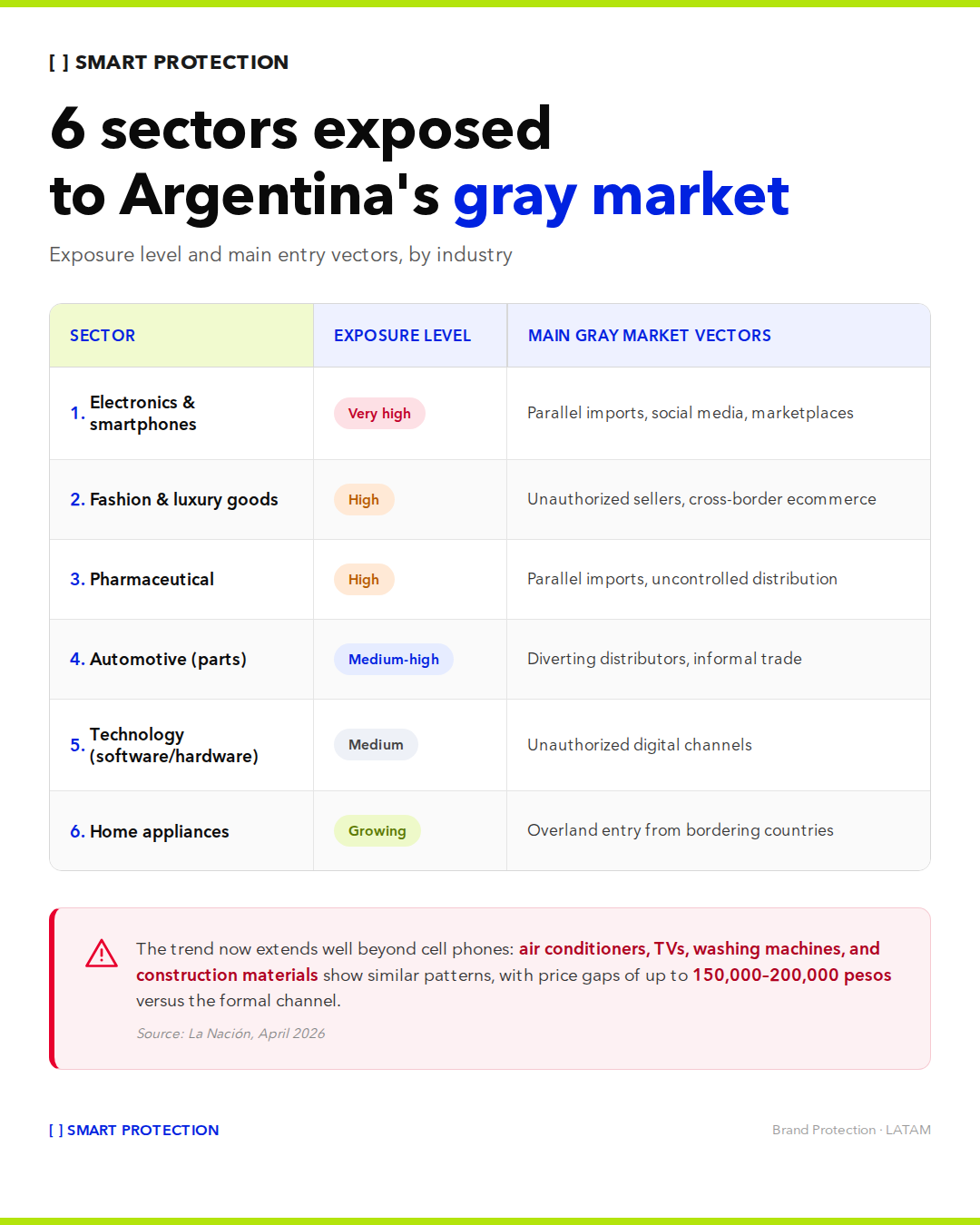
The sectors with the greatest exposure are consumer electronics (especially smartphones), fashion and luxury goods, pharmaceuticals, automotive (spare parts), and home appliances. Vulnerability is directly proportional to the price gap between the formal and informal channel, and to the level of consumption digitalization in each category.
Authorized distributors bear costs that gray market operators avoid: import taxes, VAT, certifications, warranties, technical support, and compliance with contractual conditions. When they compete on price with operators who do not carry those burdens, they lose sales and margin. In many cases, this generates conflict with the manufacturer and can lead to abandonment of the official channel.
For a report to succeed quickly, you need: a valid trademark registration with the INPI, screenshots of the infringing listing or post with date and URL, evidence that the seller does not belong to your authorized network, and documentation proving ownership of the trademark. The quality and organization of the evidence determine the speed of resolution.
Yes. Platforms like Smart Protection continuously and automatically monitor not only marketplaces like Mercado Libre, but also Instagram, Facebook Marketplace, TikTok, and other social commerce channels. Detection on social media is especially relevant because 60% of gray market transactions in Argentina occur in these environments.
There is no standard timeframe. It depends on the level of gray market penetration in digital channels, the contractual strength of the distribution network, the availability of digital evidence, and operational response speed. Brands that implement continuous monitoring, seller intelligence, and clear action protocols report significantly shorter response times. The goal is not to eradicate the problem all at once — it is to manage the risk continuously and progressively reduce its commercial impact.


