Thank you! Your submission has been received. We will get in touch with you soon.
Back to site
Discover how the grey market affects margins, pricing and brand distribution, and what the data reveals about the true cost of losing channel control.
The gray market stopped being an airport anecdote years ago.
Today, it is one of the quietest — and most costly — margin leaks facing consumer brands globally.
And most brands still aren't measuring it.
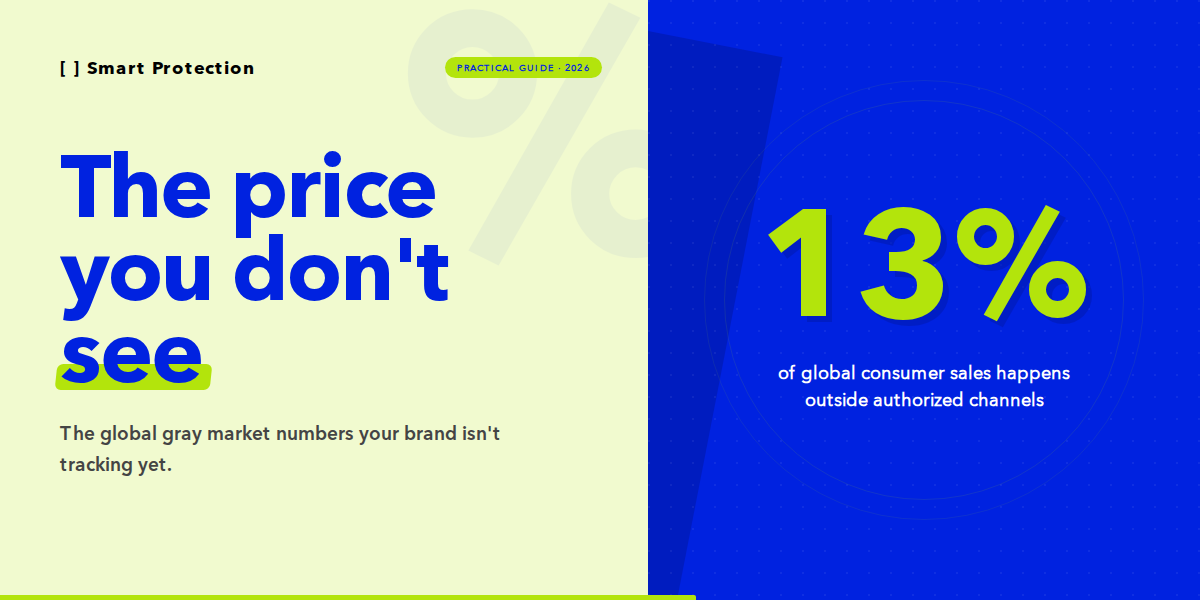
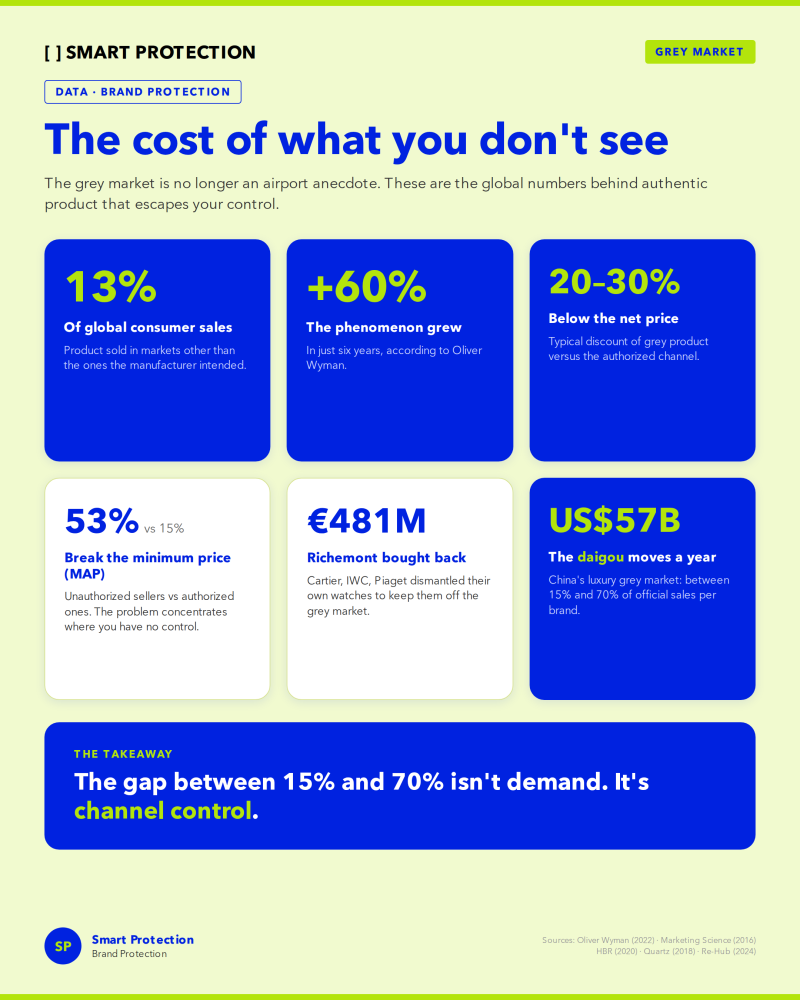
According to Oliver Wyman (2022), 13% of global consumer sales involve products sold in markets other than those the manufacturer intended.
A phenomenon that grew by more than 60% in six years.
We're not talking about counterfeits. We're talking about authentic, original products sold outside the brand's authorized channel — at prices the brand didn't set, in markets the brand didn't choose.
Gray market products typically sell at 20–30% below the net price of the authorized channel.
And the total cost to consumer brands is around 5 gross margin points:
3 points of direct price loss.
2 additional points in compensation to distributors who do respect the channel rules.
For a brand with US$50 million in annual sales, that's approximately US$2.5 million per year — before accounting for the strain on the official channel, uncovered after-sales service costs, and the cumulative erosion of brand value.
Is your brand measuring this leak? If you want to know how much the gray market could be costing you, speak with one of our unauthorized distribution experts →
A study published in Marketing Science (2016) documented something that reframes the problem entirely.
53% of unauthorized sellers violate MAP — the minimum advertised price.
Compared to just 15% of authorized sellers.
Price erosion is not a diffuse or evenly distributed phenomenon across the channel.
It is concentrated among the sellers you don't control.
This has a direct implication: the official channel is not the source of the problem. It's the victim.
And the good news is that the problem has an operational solution.
According to Harvard Business Review (2020), brands that enforce their pricing policies with real consequences — not just communications, but actions — reduce violations by 40% to 80% within months.
Control is not a distant ideal. It's a decision with measurable returns.
Do you know how many unauthorized sellers are breaking your MAP right now? An initial assessment can answer that question with real data. Talk to an expert →
Richemont, the group behind Cartier, IWC, and Piaget, went so far as to buy back €481 million worth of its own watches from its retailers.
And destroyed them.
Not to recover inventory. To prevent that stock from reaching the gray market at a discount and eroding the value of its brands (Quartz, 2018).
A decision that illustrates something deeper than a channel policy: when you lose control over how your own product is sold, the cost of recovering it can far exceed the cost of maintaining it in the first place.
The second case is even more revealing in scale.
Daigou, the Chinese luxury gray market, moves approximately US$57 billion per year.
It accounts for between 15% and 70% of official sales for each brand, depending on how much control they have over their wholesale channel (Re-Hub, 2024).
Fifty-five percentage points of difference between one brand and another.
Same category. Same consumer. Same demand.
The difference between 15% and 70% is not demand.
It's not the country. It's not the category. It's not the reference price.
It's channel control.
Brands that understand this stop treating the gray market as a legal problem to delegate.
They manage it for what it is: a commercial problem — one of visibility, data, and decisions with real consequences.
And only 15% to 36% of consumer CEOs say they are well prepared to combat it (Oliver Wyman, 2022).
Most are still operating in the dark.
This article is part of a series on the gray market. If you want to understand what's happening with your brand's digital distribution, our team can help you map the blind spot in an initial 15-minute conversation — no commitment required.
Talk to a gray market expert →
1. What is the grey market?
The grey market is the sale of authentic products through distribution channels that are not authorized by the brand. Unlike counterfeiting, the products are genuine, but they are sold outside the markets, distributors or conditions intended by the manufacturer.
2. How does the grey market affect brands?
The grey market can reduce margins, create price discrepancies across channels, cause conflicts with authorized distributors and make it harder for brands to control where, how and at what price their products are sold.
3. How much can the grey market cost a brand?
The impact depends on the industry, sales volume and each brand’s exposure. Based on the data analyzed in this article, the cost can include direct margin loss, pricing pressure and compensation paid to authorized channel partners.
4. What is the relationship between the grey market and MAP violations?
Unauthorized sellers may offer products below the Minimum Advertised Price (MAP), putting pressure on official sales channels. Identifying who is selling, where they are selling and at what price is therefore essential for detecting potential violations and protecting the brand’s commercial strategy.
5. How can brands control unauthorized distribution?
The first step is gaining visibility into sellers, marketplaces, prices and markets where their products appear. With this data, brands can identify unauthorized sellers, prioritize the issues with the greatest business impact and take action to regain control over their distribution.