
Thank you! Your submission has been received. We will get in touch with you soon.
Back to site
.png)
Fraudsters expand your brand's attack surface as early as August: phishing, lookalike domains, and brand abuse. Is your protection strategy ready?
While your e-Commerce team is planning the final details for Black Friday and Cyber Monday 2026, another operation has already been underway for months.
And it's not yours.
Fraudsters don't improvise in November.
They plan from the summer.
What October data reveals — more than 150 fraudulent domains registered, 93% above the monthly average, is not the beginning of fraud.
It's the visible escalation.
By the time those domains appear, the infrastructure is already built. Fake accounts are already active. Cloned sites are already waiting for traffic.
October is the signal. Not the starting point.
And in the first ten days of November, the pace accelerates: more than 330 additional domains appear. One in eleven is classified as malicious.
This is not statistical noise. It's a planned, scalable operation, designed to execute exactly when your brand has the most visibility, and your customers, the least caution.
The real strategic preparation window starts in August.
Not to react to fraud once it's already active, but to structure visibility, processes, and response capacity before malicious activity reaches its peak.
That's what separates brands that arrive at Black Friday protected from those that manage it as a crisis.

When brand teams think about digital fraud, they usually think of it as a one-off problem.
The reality is different.
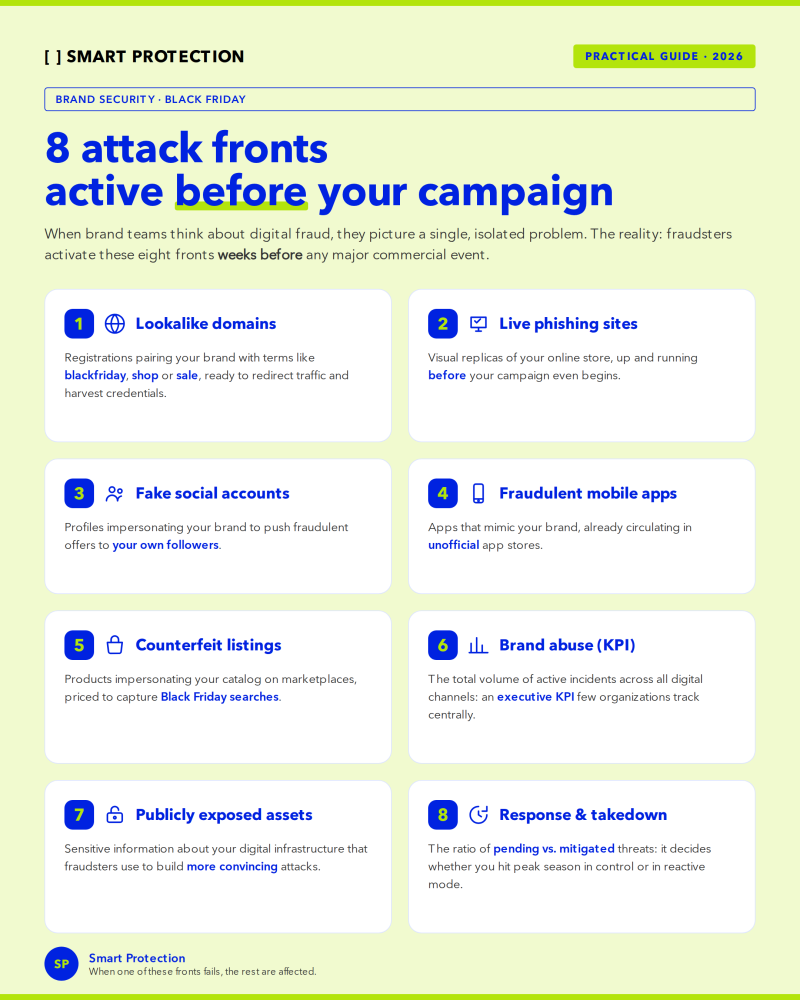
The Pre-Campaign Attack Surface framework identifies eight fronts that fraudsters activate weeks before any major commercial event:
1\. Lookalike domains — Registrations that combine your brand name with terms like blackfriday, shop, or sale, designed to redirect traffic and capture credentials.
2\. Active phishing sites — Visual replicas of your online store, up and running before your campaign even launches.
3\. Fake social media accounts — Profiles that impersonate your brand identity to distribute fraudulent offers to your own followers.
4\. Fraudulent mobile apps — Apps that mimic your brand and are already circulating in unofficial app stores.
5\. Counterfeit marketplace listings — Products that imitate your catalog with prices engineered to capture Black Friday searches.
6\. Brand abuse cases — The total volume of active incidents across all digital channels: an executive KPI that few organizations monitor centrally before the season begins.
7\. Publicly exposed assets — Sensitive information about your digital infrastructure that fraudsters use to build more convincing attacks.
8\. Response and takedown capacity — The ratio of pending threats versus those already mitigated. A metric that determines whether your organization will reach peak campaign season in control or in reactive mode.
When one of these fronts fails, the others are affected.
Black Friday fraud is not opportunistic.
It is structured.
One case illustrates this perfectly.
The domain hokablackfriday.com was registered on October 24—weeks before Black Friday—to impersonate the sportswear brand HOKA.
Real logo. Authentic images. Aggressive discounts.
The goal: to steal credentials and payment details during a completely fake checkout process.
Customers couldn't tell the difference.
The damage was already done before the official campaign even started.
Does your organization have visibility into which domains are being registered with your brand name right now?
There is one factor accelerating this ecosystem exponentially.
Generative AI has democratized fraud.
Today, any actor without advanced technical knowledge can clone a brand's visual identity in hours, generate localized content for multiple countries simultaneously, and launch convincing, personalized phishing campaigns at scale.
The volume of fraudulent domain registrations linked to Black Friday grew by 188% between October and November in 2025.
This is not a one-time trend. It is a trend that accelerates every season.
And the barrier to entry for fraudsters is getting lower and lower.
There is a reason this issue goes beyond cybersecurity.
62% of consumers would stop buying from a brand if they found out they were victims of a fraudulent experience linked to it—even if the brand had no direct responsibility.
The damage isn't just caused by the fraudster.
It's caused by the inability to detect and take it down in time.
When fraud reaches the consumer, it rarely arrives as an obvious alert.
It comes as an isolated complaint you don't understand the source of.
As a conversion that should have been yours.
As a negative review that erodes the trust you worked so hard to build.
The difference between acting before and acting after is not philosophical.
It is operational.
Platforms operating with early visibility detect more than 40% of threats before they reach the consumer.
Organizations with proactive protection manage to reduce digital risk by up to 80%, with threat takedown rates exceeding 95%.
This doesn't happen because they react faster.
It happens because they act before the damage is consolidated.
Reactive protection—waiting for the complaint, report, or alert—remains the dominant model.
And it remains insufficient.
Before your Black Friday campaign reaches its peak traffic:
Is there active monitoring of domains being registered with your brand name?
Are there active fraudulent ads hijacking traffic from your campaigns?
Are there cloned sites or fake apps operating while your team finalizes the creative details?
Do you have centralized visibility of the eight pre-campaign attack fronts?
These questions cannot be answered if there is no visibility before the season starts.
Fraud doesn't wait for you to be ready.
It operates exactly when your customers place the most traffic, investment, and trust in your brand.
Black Friday is not the time to start protecting your digital presence.
It's the time to have already blocked what has been active for weeks.
Protection that arrives late doesn't protect.
It simply documents the damage.
Do you have clarity on the current state of your brand in the digital ecosystem?
If there are aspects that are not completely under control, it makes sense to discuss it with someone who can analyze your specific case.
Speak with a brand protection expert →
.png)

.webp)


