Thank you! Your submission has been received. We will get in touch with you soon.
Back to site
.png)
Discover how unauthorized sellers affect your brand’s margins, pricing, and profitability on Amazon.
You are growing your Amazon sales. But do you know who is actually capturing that demand?
Brands can invest heavily in PPC, SEO, listings and content, while unauthorized sellers and parallel imports compete for the same demand, putting pressure on margins, pricing and Featured Offer performance.
So where is that inventory coming from?
To explore this challenge, we spoke with , Amazon Growth Expert, specializing in Amazon PPC, FBA, Seller Central, listing optimization, Amazon SEO, and marketplace growth. He works with Amazon sellers and brands to improve advertising efficiency, strengthen marketplace operations, optimize product visibility, and build sustainable growth strategies.
In this interview, Sikandar Ali Safdar explains why unauthorized sellers and parallel imports emerge, how they impact profitability, and why distribution visibility should be part of the Amazon growth strategy.
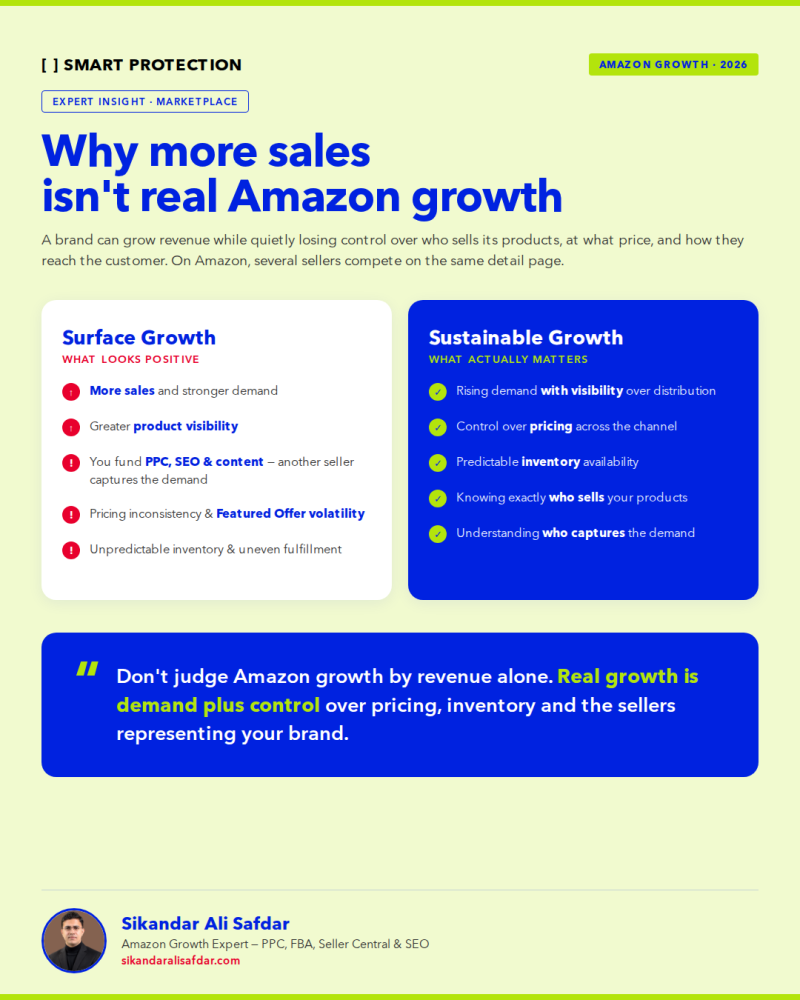
Growth can look positive on the surface while the underlying business becomes increasingly difficult to manage.
A brand may be generating more sales, stronger demand, and greater product visibility, but if it does not know who is selling its products, where that inventory is coming from, or how those sellers are pricing it, the brand can gradually lose control over both the customer experience and the economics of the channel.
On Amazon, multiple sellers can compete on the same product detail page. This means a brand may invest heavily in PPC, listing optimization, SEO, creative content, and demand generation, while another seller ultimately captures part of that demand.
Over time, this can lead to pricing inconsistency, Featured Offer volatility, unpredictable inventory availability, different fulfillment standards, and less control over how the product reaches the customer.
For that reason, I would not judge Amazon growth purely by revenue.
Sustainable growth means increasing demand while maintaining sufficient visibility over distribution, pricing, inventory, and the sellers representing the product.
More sales are valuable, but growth becomes much stronger when the brand also understands who is capturing that demand and how its products are moving through the marketplace.
The biggest challenge is that these areas are closely connected.
When grey-market or parallel-import sellers enter the same ASIN at lower prices, authorized sellers may come under pressure to reduce their own prices to remain competitive for the Featured Offer. That can quickly compress margins and make pricing more difficult to manage.
It can also affect conversion. Customers may see multiple offers with different prices, delivery times, fulfillment methods, or seller reputations. Even when the underlying product is genuine, an inconsistent buying experience can create uncertainty.
There is also an important advertising consideration.
A brand may be spending money to generate traffic and demand for a product detail page without having complete control over which seller ultimately captures the sale. If the intended offer loses Featured Offer visibility, the economics of the advertising strategy can change significantly.
So the impact goes beyond another seller simply appearing on the listing. It can affect pricing discipline, margins, conversion, advertising efficiency, inventory planning, Featured Offer performance, and ultimately the profitability of the Amazon channel.
The brand may still be creating strong consumer demand, but some of the commercial value generated by that demand can begin flowing outside its intended distribution structure.
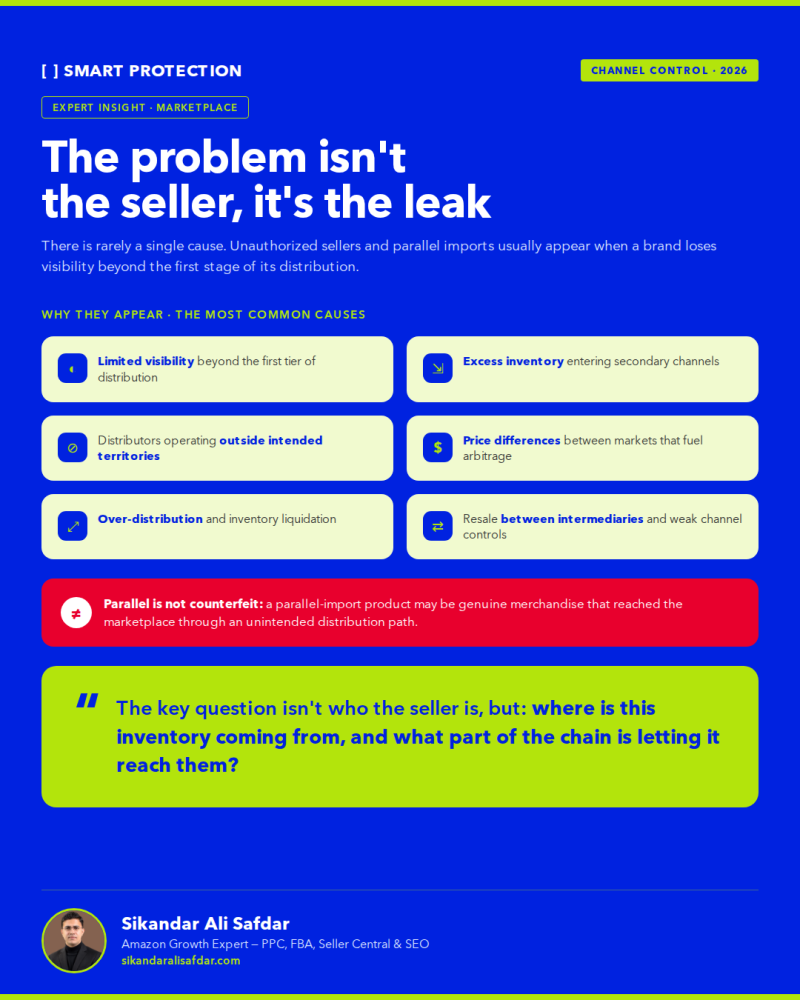
There is rarely one single cause.
A common issue is limited visibility beyond the first stage of distribution.
A brand may sell to distributors, wholesalers, retailers, or regional partners, but once inventory begins moving further downstream, it can become difficult to understand where every unit ultimately ends up.
Other factors can include excess inventory entering secondary channels, distributors or resellers operating outside intended territories, regional pricing differences, over-distribution, inventory liquidation, weak channel controls, and products being resold between intermediaries.
International price differences can also create an economic incentive for parallel trade. If a genuine product can be sourced more cheaply in one market and profitably resold in another, sellers may take advantage of that opportunity.
It is also important to distinguish grey-market or parallel-import products from counterfeit products. A parallel-import product may be genuine merchandise that reached the marketplace through an unintended distribution path.
From a marketplace-management perspective, I believe brands should look beyond the individual seller and ask a more important question:
Where is this inventory coming from, and what part of the distribution chain is allowing it to reach this seller?
Understanding the source of the leakage is usually more valuable than repeatedly reacting to individual marketplace sellers
Because all of those growth investments are designed to create commercial value, and the brand needs a distribution structure that allows it to capture that value effectively.
A brand can build excellent listings, invest heavily in Amazon PPC, improve organic visibility, develop strong A+ Content, and generate more branded searches and customer demand.
But if uncontrolled sellers can access the same inventory and compete aggressively on the same listings, part of that investment may benefit sellers the brand never intended to support.
That is why I see distribution visibility as part of marketplace growth rather than simply a supply-chain issue.
PPC creates demand. SEO creates visibility. Listing optimization improves conversion. Inventory keeps the product available. Distribution control helps determine who ultimately captures the commercial value generated by those activities.
This does not necessarily mean that a brand must have absolute control over every unit in every market. It means the business should understand its distribution pathways, authorized partners, seller landscape, regional pricing, and where unexpected inventory may be entering the marketplace.
Amazon growth becomes much more sustainable when advertising strategy, commercial strategy, and distribution strategy are working together.
A brand can certainly grow for a period of time without strong distribution visibility, but scaling sustainably becomes more difficult as demand increases.
The more successful a product becomes, the more commercially attractive it can become to additional sellers. If the brand does not understand where inventory is moving, growth itself can create more opportunities for unauthorized resale, arbitrage, and pricing disruption.
I would focus first on visibility rather than assuming complete control is always possible.
Commercial and e-commerce leaders should understand who their authorized sellers and distributors are, where inventory is intended to be sold, which sellers are appearing on important marketplace listings, how pricing differs across regions, and where unexpected inventory may be entering the channel.
I also believe this requires stronger cooperation across internal teams.
Amazon teams, commercial teams, supply-chain teams, finance, legal, and distribution partners may each hold different pieces of the same information. Those teams need to communicate more closely if the business wants to manage marketplace growth effectively.
Marketplace monitoring should not begin only after a serious pricing or Featured Offer issue appears.
Distribution visibility should be treated as an ongoing part of marketplace management.
For me, the long-term objective is straightforward:
Create demand, capture that demand efficiently, and make sure the distribution system supports rather than undermines the brand’s growth strategy.
Generating demand is only part of Amazon growth. Brands also need to know who is capturing that demand and how their products are moving through the marketplace.
Thank you to Sikandar Ali Safdar for sharing his experience and perspective on this challenge.
If your brand is facing similar issues with unauthorized sellers or parallel imports, speak with a Smart Protection expert specialized in this area. Book a free conversation HERE
Here you can find more information about our guest specialist: