Thank you! Your submission has been received. We will get in touch with you soon.
Back to site

Is your brand facing unauthorized sales in Mexico? Discover the grey market landscape, the legal framework, the affected industries, and the protection strategies.
The grey market in Mexico is not a fringe phenomenon.
It is an active problem that compresses margins, erodes distribution networks, and damages relationships with authorized resellers — and most brands only discover it when the damage is already done.
This article analyzes the real landscape of the grey market in Mexico, its legal framework, the most exposed industries and marketplaces, and concrete strategies to protect your digital distribution.
If you want to explore deeply into ¿What is grey market?, you can consult our latest article.
Mexico is one of the fastest-growing e-commerce markets in Latin America.
Mexican e-commerce exceeds 700 billion pesos annually, with sustained expansion rates above 20% in recent years.
That growth creates opportunities.
But it also amplifies the risks of unauthorized distribution.
Parallel imports represent a growing portion of the total volume of products circulating in Mexico's digital channel.
In the smartphone sector, 3% of devices sold between Q3 2022 and Q2 2023 corresponded to the grey or unlocked market. The online smartphone channel grew from representing 2% before the pandemic to exceeding 7% of total sales.
The grey market in Mexico is not limited to technology.
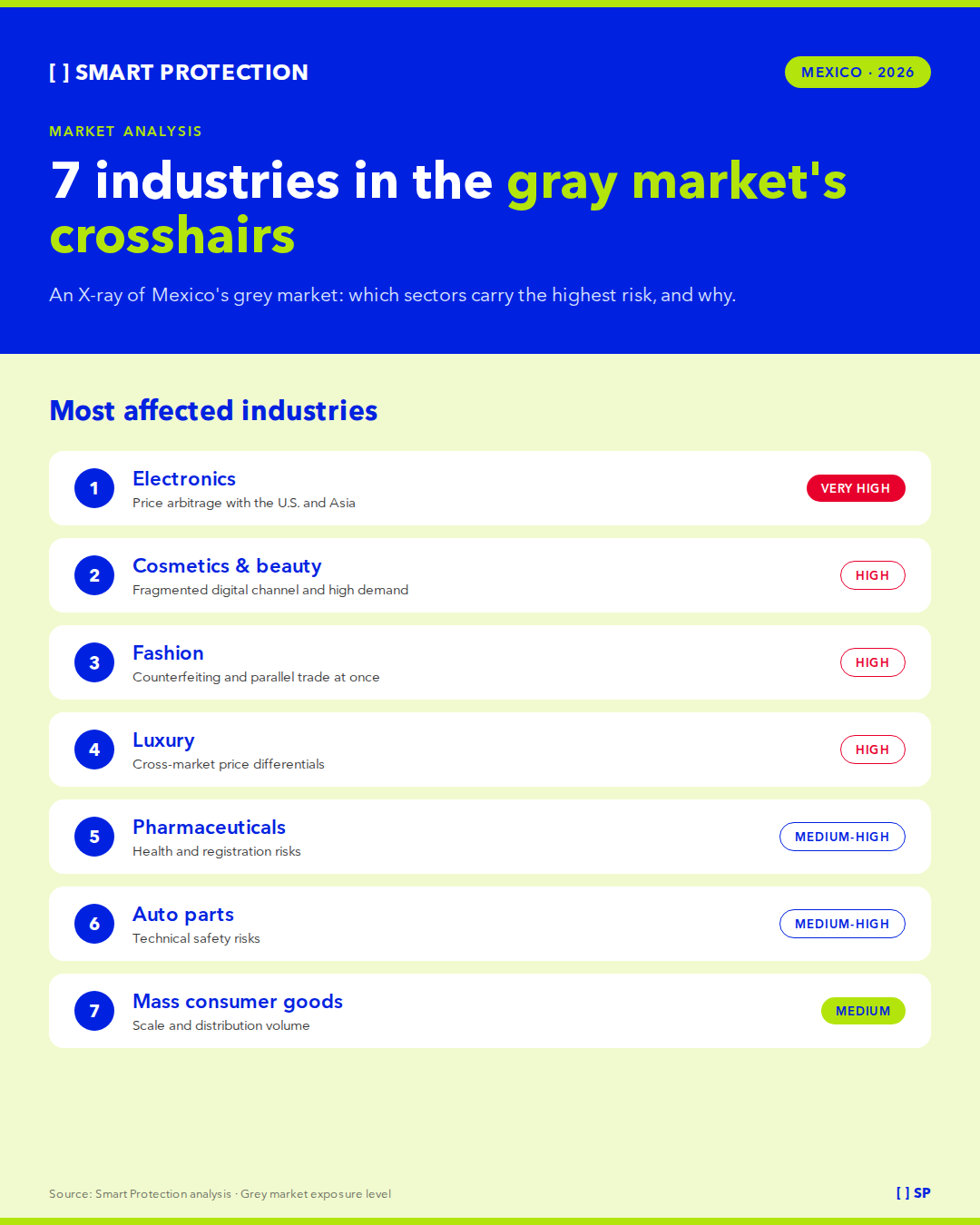
It affects cosmetics, fashion, luxury goods, auto parts, and pharmaceuticals.
Each industry has its own dynamics.
All share the same common denominator: the brand loses control over how its product is distributed.
Mercado Libre concentrates the highest volume of grey market activity in Mexico. The ease of opening a store and the limited verification of product origin create ideal conditions for unauthorized sellers.
Amazon Mexico presents a similar dynamic. The open marketplace model allows third parties to sell without proving authorization. Authorized distributors losing the Buy Box to unidentified sellers is one of the most direct symptoms.
Walmart, Liverpool Marketplace, Coppel, Sears, and Claro Shop have lower volume, but are not exempt. As these retailers open their platforms to third parties, they also open the door to unauthorized distribution.
Unauthorized sellers in Mexico typically operate under one of three profiles:
The grey market generates an impact that goes far beyond price.
The most common operational and commercial risks include:
Three trends define the grey market in Mexico today.
Digitalization of the parallel channel. The growth of marketplaces amplifies the visibility and reach of unauthorized sellers. What was once a physical retail problem is now a digital distribution problem at scale.
Border arbitrage. Proximity to the U.S. and sustained exchange rate differentials maintain a constant flow of parallel imports in electronics, cosmetics, and fashion.
Regulatory change on the horizon. The new Article 92 of the LFPPI Regulation, entering into force on July 22, 2026, formally incorporates the figure of the "authorized distributor" (distribuidor autorizado) to accredit the legitimacy of imports. This will expand the legal possibilities for parallel importers operating through foreign authorized distributors.
Mexico's vulnerability is not accidental.
It is the result of a combination of structural factors that reinforce each other.
Border with the United States. Geographic proximity facilitates access to products at prices lower than those of the official Mexican channel. Differences in electronics, cosmetics, and fashion can exceed 20–30%. That gap is the engine of arbitrage.
The rise of marketplaces. Platforms like Mercado Libre and Amazon Mexico allow listings with low friction. This makes detecting unauthorized sellers more complex.
Digital cross-border commerce. Mexican consumers frequently purchase from international platforms that ship directly to the country. That flow feeds the grey market without passing through any official local channel.
Accessible logistics. The development of fulfillment networks and international shipping has reduced the costs of informal importation, making arbitrage more profitable than ever.
The grey market in Mexico is legal.
This is the first distinction every brand must understand before taking action.
The Ley Federal de Protección a la Propiedad Industrial (LFPPI), in Article 175, Fraction II, recognizes the principle of international exhaustion of intellectual property rights. Once a product is lawfully commercialized anywhere in the world, the trademark owner cannot prevent its subsequent importation, distribution, or sale in Mexico.
IMPI (Instituto Mexicano de la Propiedad Industrial) can intervene when there is counterfeiting, consumer deception, or improper use of a registered trademark. Not when dealing with original products imported without authorization.
PROFECO (Procuraduría Federal del Consumidor — Federal Consumer Attorney's Office) has publicly warned about the risks of the grey market for consumers, particularly in smartphones: lack of homologation for Mexican frequency bands, absence of warranty under the Ley Federal de Protección al Consumidor (LFPC), and labeling that does not comply with NOM-024-SCFI-2013.
The 2026 regulatory change. The new Article 92 of the LFPPI Regulation, in force from July 22, 2026, incorporates the figure of the "authorized distributor" to accredit legitimacy. This will increase pressure on exclusive distribution networks.
The direct implication is clear: Mexico's legal framework favors the existence of the grey market. Real protection does not come from the law alone — it comes from operational intelligence and active channel management.
Only publicly documented cases are included
Smartphones and consumer electronics. Motorola reported that the sale of its devices through unauthorized distributors grew fivefold in three years in Mexico. The devices circulate without homologation for local frequency bands and without national warranty. Mobile network operators recorded a 10% drop in sales, driven directly by the proliferation of devices across marketplaces and department stores.
Cosmetics and beauty. Mexico ranks among the leading economies of origin for cosmetic products at risk of counterfeiting globally (OECD-EUIPO, 2025). The grey market in this sector operates through marketplaces and social media, with original products imported without passing through authorized local distributors. The risk of confusion with counterfeits is high.
Luxury goods. Luxury brands are especially vulnerable because their pricing strategies are highly differentiated by market. A handbag or watch sold in Asia or Europe at a price lower than the Mexican one can re-enter the country without authorization, eroding both margins and exclusivity positioning.
Industrial tools and auto parts. The risk here is not only commercial — it is a safety issue. Products imported outside official channels may not meet the technical specifications of the Mexican market. Brands lose control not only over price, but over the final use of the product.
Amazon Mexico's open marketplace model allows third parties to sell products from any brand without proving authorization. The most visible symptom: authorized distributors lose the Buy Box to unidentified sellers offering lower prices through parallel imports.
It is the marketplace with the highest sales volume in Mexico and, therefore, the environment with the greatest grey market exposure. The ease of opening a store and the high volume of consumer traffic create ideal conditions for unauthorized sellers to operate with low risk and high visibility.
Walmart has progressively opened its platform to external sellers. The grey market volume is lower than on Mercado Libre or Amazon Mexico, but the impact on price perception and the relationship with authorized distributors is equally real.
Liverpool represents a channel with a higher-purchasing-power consumer profile. The grey market presence here is more selective, concentrated in fashion, luxury, and high-end electronics categories.
Coppel, Sears, and Claro Shop round out Mexico's digital distribution ecosystem. As these channels continue to grow and open their platforms, grey market exposure will keep rising.
Electronics. Price differences between the local market and the U.S. or Asia can exceed 20–30% in smartphones, laptops, and peripherals. The arbitrage is systematic and sustained.
Beauty and cosmetics. High demand, elevated margins, and a complex distribution chain. The distinction between an original product from the official channel and one imported without authorization is practically invisible to the consumer.
Fashion. A dual dimension: parallel trade of original products and simultaneous counterfeiting. Mexico ranks 7th globally among economies of origin for counterfeit textiles (OECD-EUIPO, 2025).
Luxury. The grey market in this segment does not only erode margins — it erodes positioning. A luxury product sold through an unauthorized channel damages the brand's perception, even when it is 100% authentic.
Pharmaceuticals. The primary risk is not commercial — it is health-related. Products imported outside official channels may not meet storage conditions or health registration requirements in Mexico.
Automotive. Parts imported without quality control can compromise the safety of the end user. Brands face exposure to claims that go far beyond a distribution dispute.
Mass consumer goods. Volume and scale mean that even small channel deviations generate a significant impact on margins and distributor relationships.
The grey market rarely announces itself.
It manifests through symptoms that, in isolation, look like unrelated problems.
These are the most common warning signs:
Each sign, on its own, may seem minor.
Together, they point to a systemic problem of visibility and control over digital distribution.
Effective grey market detection requires four capabilities operating simultaneously:
Marketplace monitoring. Continuous tracking of Mercado Libre, Amazon Mexico, and other channels to identify unauthorized seller listings.
Identification of unauthorized sellers. Systematic comparison between the sellers active in the digital channel and the official distribution network.
Price tracking. Detection of deviations from the brand's commercial policy, with prioritization by impact.
Data-driven intelligence. Analysis of channel diversion patterns, stock origin, and seller behavior to anticipate the problem before it scales.
Without visibility across these four vectors, the brand operates with incomplete information. And distribution decisions made with incomplete information generate real commercial consequences.
The response to the grey market is not exclusively legal.
Mexico's legal framework permits parallel trade. Trying to fight it solely from the legal department creates operational strain without sustainable results.
The effective response is operational, intelligent, and continuous.
Selective distribution. Clear contracts with distributors that include territorial and channel restrictions, backed by active audit mechanisms.
Channel auditing. Periodic review of the distribution chain to detect diversions before they reach the end consumer.
Continuous monitoring. 24/7 tracking of marketplaces, price comparison engines, and digital channels to identify unauthorized sellers in real time.
Evidence for legal action. When the grey market combines with illegal practices — consumer deception, incorrect labeling, sales without NOM compliance — documented evidence is what makes legal action possible.
Brand Protection technology. Platforms like Smart Protection monitor the main Mexican and Latin American marketplaces 24/7 — including Mercado Libre, Amazon Mexico, and Walmart — identifying unauthorized sellers, price deviations, sales through restricted channels, and parallel imports.
Since 2014, Smart Protection has helped global brands regain control over their digital distribution. The result is not only visibility. It is operational intelligence to act where it truly matters.
The grey market in Mexico has structural conditions that make it persistent: an active border with the U.S., sustained price differentials, open-access marketplaces, and a legal framework that permits it.
The brands that win are not the ones that try to eliminate it through legal resources alone.
They are the ones that monitor it systematically, prioritize the highest-impact cases, and act with operational intelligence across their distribution network.
The first step is always the same: gaining real visibility into the problem.
If your brand is starting to see signs of grey market activity across its channels — or simply doesn't have enough visibility to know — it may be worth talking with one of our digital risk experts.
Request a conversation with our team
Yes. The grey market is legal in Mexico under the principle of international exhaustion of intellectual property rights, recognized in Article 175, Fraction II of the Ley Federal de Protección a la Propiedad Industrial (LFPPI). An authentic product, lawfully commercialized in any country, can be imported into Mexico and resold without the authorization of the trademark owner.
The difference is fundamental. Counterfeiting involves illegitimate products that imitate a brand without authorization. The grey market consists of 100% authentic, original products — commercialized outside the distribution channels authorized by the owner in Mexico. One is illegal. The other is not.
Contraband involves the illegal introduction of goods into the country, evading customs authorities or dodging taxes. The grey market refers to legal imports of authentic products that enter through regular customs channels, but outside the official distribution network. Contraband is illegal. The grey market in Mexico is not.
The categories with the greatest exposure are consumer electronics, cosmetics and beauty, fashion, luxury goods, pharmaceuticals, auto parts, and mass consumer goods. The reasons vary by industry, but the common driver is always the same: price differential between markets and access facilitated by marketplaces.
Parallel imports generate price erosion, conflict with authorized distributors, loss of the Buy Box on marketplaces, reputational damage from the absence of local warranty, and loss of control over the consumer experience. The impact is not only commercial — it simultaneously affects ecommerce, legal, distribution, and marketing teams.
Detection requires continuous monitoring of the main marketplaces, systematic comparison of active sellers against the official distribution network, tracking of price deviations, and analysis of channel diversion patterns. Without active monitoring technology, manual detection is inefficient and reactive.
Effective protection combines selective distribution with clear contracts, active channel auditing, continuous marketplace monitoring, and Brand Protection technology that makes it possible to identify, prioritize, and act on the highest-impact commercial cases. Legal action is a complement — not a substitute — for operational intelligence.