
Thank you! Your submission has been received. We will get in touch with you soon.
Back to site

When an affiliate agreement ends, their reviews, codes and profiles can keep using your brand. How to tell what’s legitimate from what still looks authorized, and what to do i
Picture this. A player searches for your casino and lands on a page with your logo and your welcome bonus. It looks like yours, but it belongs to an affiliate you stopped working with a year ago, and the sign-up button no longer points to your site. It points to another operator. The player was looking for you and may end up signing up somewhere else.
Ending a commercial relationship doesn't make the pages disappear. Whatever that affiliate published with your brand can keep ranking and pulling in branded traffic, and it's easy for nobody to check it, because it's no longer part of the program. That's why casino affiliate monitoring has to look beyond the program too, at anyone still using your brand to intercept players who are already looking for you.
When an affiliate leaves your program, some of the digital assets they published with your brand can stay available. These might be reviews and bonus guides that have been indexed for years, banners and creatives from your media kit, or "exclusive" codes. Sometimes there's also a domain or a social profile set up to promote you. What changes is that you lose visibility and direct control over them, even though you still own the rights to your brand.
Being visible doesn't, on its own, mean they're diverting sign-ups. Following their links lets you check whether a promotion leads somewhere other than where it says, which is the signal of possible affiliate traffic leakage. Knowing how many players actually took that path requires other data.
Your contract may require the affiliate to remove links and materials when the relationship ends. But the clause doesn't take anything down by itself, and that content can fall outside your program's regular reviews.
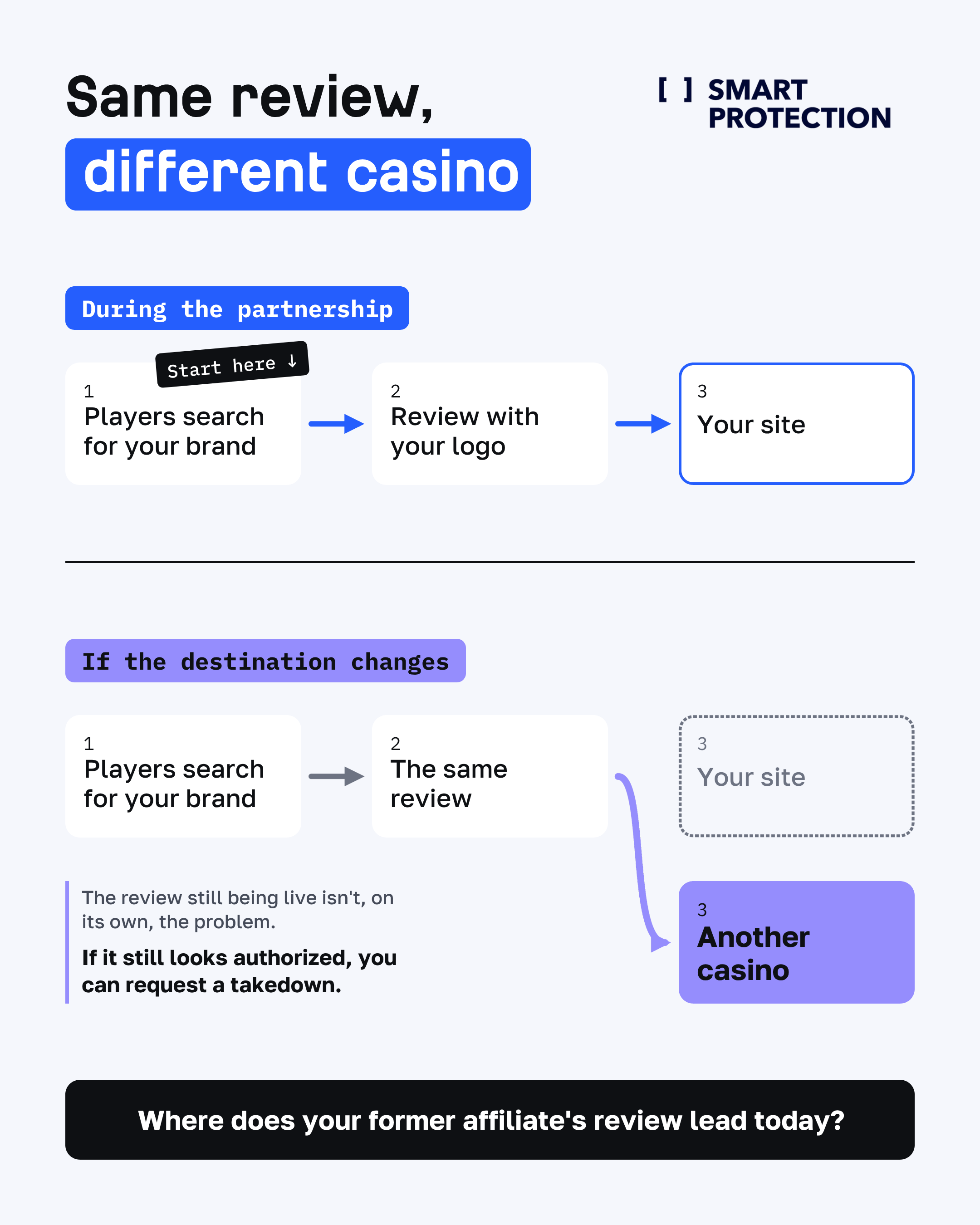
A former affiliate still talking about your casino isn't, on its own, a problem. The more useful question is a different one. Does the page imply a relationship that no longer exists?
An editorial review that analyzes you, compares you with other operators and links wherever it likes is usually legitimate, even if you don't like the verdict. It's a different matter when a page implies an authorization it doesn't have, presents itself as your official channel or advertises a misleading offer in your name, such as a bonus that no longer exists. At that point the player isn't reading an opinion anymore, but something that is passing itself off as you. If it also keeps using your creatives after the contract has ended, it's worth checking what the agreement allowed.
The same can happen with an active partner. An affiliate can stick to the terms on one page and impersonate you on another, for example with a domain like "yourbrand-bonus" or a profile called "YourBrand Official". As Javier Capilla, CEO of Smart Protection, puts it, "an authorized affiliate, an affiliate in breach of the agreement, a competitor, an editorial comparison site and a website impersonating the casino are not the same problem and don't call for the same response."
When that content is published on third-party sites with a strong reputation, it becomes the problem we covered in our article on parasite SEO in online gambling.
Javier Capilla recommends reviewing "what users actually see in each market for the highest-intent searches" and following "the link to its final destination." This check applies that idea to your former affiliates. The broader audit of your branded searches is covered in our guide to SEO for casinos and brand protection.
A review like this gives you a snapshot, not ongoing monitoring. To make it useful, document the source URL, the promotion it advertises, the redirects, the final destination and the market you tested from. That way you can tell a page that is merely exposed in your search results apart from a diversion you've actually seen happen.
What can be taken down is content that misuses your brand, not everything that mentions you. First, that misuse has to be validated for a specific piece of content. After that, the decision lies with the search engine or the platform, based on their policies. If Google removes a result, it stops appearing in the branded searches where it was visible, even if the original page is still live. When the case allows it, you can also request removal from the hosting provider.
With those conditions in mind, this is the response that usually fits each case.
Priority doesn't depend on the type of case alone. A page that ranks at the top of a branded search and advertises a misleading promotion may need faster action than one that's barely visible. To decide where to start, weigh how visible the result is, how much confusion it creates, which market is affected and where it sends the player.
Each of these cases is handled through a different channel. Profiles, apps or results that present themselves as official channels may be brand impersonation. If the misleading use is in an ad, it falls under ad monitoring, and websites and domains that imitate the operator fall under domain management. An affiliate bidding on your brand needs a separate analysis, because it isn't always an infringement and depends on what your contract allows.
To avoid acting against your own partners, you can share your list of authorized affiliates as an allowlist, which is checked against every detection. It isn't a free pass. If an authorized partner publishes a misleading promotion, that specific content can still be reviewed.
Taking down a former affiliate's page doesn't guarantee the problem goes away. Another page may show up using your brand or the same promotion, on a domain with one letter changed, behind a redirect or on a new profile. If you only count takedowns, every reappearance looks like a new case.
That's why, for Francisco Vega, Head of Customer Success at Smart Protection, "removal is no longer the only thing you can measure." The goal is "the ability to prevent recurrence and force the infringer to change tactics or give up the attack."
In practice, that means searching again continuously and flagging what reappears as a repeat case. Detecting a reappearance doesn't prove the same party is behind it, but it does let you handle it with the context of what has already been taken down. It also means keeping evidence for every case, with a screenshot, URL and timestamp, which serves as proof if a platform doesn't act on the request.

Timeline of a casino case: a former affiliate’s page that still looks authorized is removed, then new appearances show up on a lookalike domain, behind a redirect and on a new profile. Beyond counting takedowns, it’s worth checking whether it comes back, changes tactics or gives up.
They can stay live and indexed, and send people looking for you to another operator. If they still look authorized or advertise misleading offers in your name, a takedown can be considered. If they only mention you in a review, usually not.
No. It helps you avoid acting on legitimate content from your authorized partners, because it's checked against every detection. But if one of them publishes something misleading, that specific content can be reviewed like any other.
An affiliate program is managed through contracts, but your brand travels far beyond them. Every time a player searches for you, they see part of that presence. It includes current partners, former partners and strangers dressing up in your brand.
That's why the Smart Audience Protection® method detects the pages using your brand, validates each case, requests takedowns through the right channel and keeps searching for the ones that come back.
Do you know who's still using your brand outside your authorized channels, and where they're sending your players? Request your free analysis to find out which pages they are, which markets they appear in and which ones to review first.


