
Thank you! Your submission has been received. We will get in touch with you soon.
Back to site
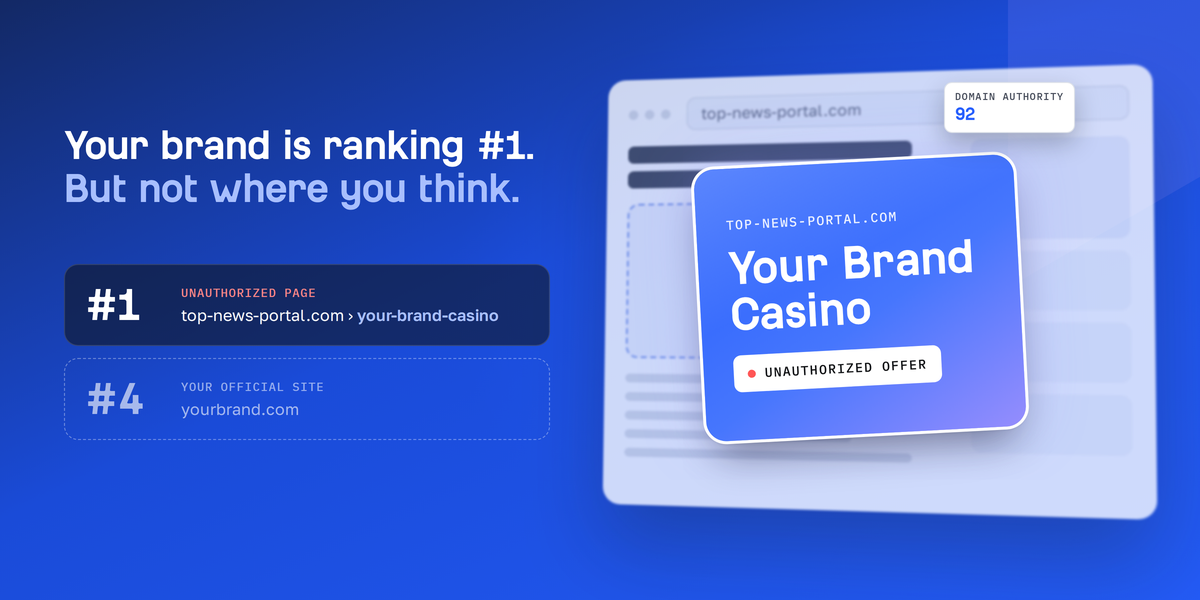
Third-party sites can hijack your casino's branded search results. Learn how to detect, prioritize, and respond to Parasite SEO threats.
Casino brands spend years building search authority. It takes weeks for a third-party site to borrow that trust and rank above them for their own name.
That's the uncomfortable truth behind parasite SEO. It's a well-documented tactic in iGaming marketing, used to push competitive keywords onto page one fast. But when it touches your brand name, your bonuses, or your promotions, it stops being a marketing tactic. It becomes a brand protection issue.
This distinction matters more than most casino SEO and marketing teams realize. Search visibility is brand visibility. And brand visibility, when captured by a third party, means loss of control over what your players see when they search for you.
Parasite SEO is the practice of publishing content on a high-authority third-party website to rank for a specific keyword, rather than building that ranking on your own domain.
The tactic works because search engines already trust the host site. A new or low-authority domain can take months to rank for a competitive term. Content placed on an established platform can rank in a fraction of that time, because it inherits the host's existing credibility.
This is a neutral definition. Parasite SEO itself isn't inherently harmful — it becomes relevant to brand protection only when the keyword being targeted is your brand name, your bonus terms, or your commercial offers.
The mechanics follow a consistent pattern:
A high-authority domain publishes third-party content, optimized for a competitive keyword. That content ranks on Google. The ranking generates traffic. And if the keyword carries commercial intent — like a casino bonus or brand name — that traffic represents demand someone else is capturing.
In practice, this means a page you didn't create, hosted on a domain you don't control, can appear between your brand name and the user searching for it.
Online gambling has a specific combination of characteristics that makes it especially exposed to this tactic:
Consider the keyword patterns players actually search for: [Casino Brand] bonus, [Casino Brand] review, [Casino Brand] promo, [Casino Brand] free spins, [Casino Brand] login, [Casino Brand] app.
Each of these carries commercial or transactional intent. Each represents a moment where a player has already decided to interact with your brand — and where a third-party result can intercept that decision before it reaches you.
Third-party pages can occupy meaningful real estate in the search results around your brand name — the exact space where players expect to find you first.
Outdated bonus terms, incorrect promotional conditions, unauthorized claims, or inconsistent branding on third-party pages can shape a player's perception of your brand before they ever reach your official site.
A player searching for your brand may land on a third-party page before reaching your official platform. That single detour can be the difference between a completed registration and a lost player.
This is the underlying issue. Once a third party ranks for your brand terms, your organization loses control over how your brand is presented in that result — its accuracy, its offer, and its user experience.
Branded search demand splits into distinct categories, each with a different level of exposure:
Transactional and commercial keywords tend to carry the highest conversion risk, because they represent players closest to taking action.
A structured detection process typically follows four steps:
1. Monitor branded SERPs. Track combinations like brand + bonus, review, promo, login, app — the terms most likely to surface third-party capture.
2. Identify third-party domains. Look for unfamiliar domains, high-authority publishers, affiliate websites, expired domains repurposed for new content, and unusual landing pages.
3. Analyze the content. Review brand usage, logo presence, promotional claims, outbound links, affiliate codes, commercial offers, and whether the information is current.
4. Assess the risk. Not every result carries equal weight. Risk scoring — based on visibility, brand usage, and potential harm — determines what gets prioritized first.
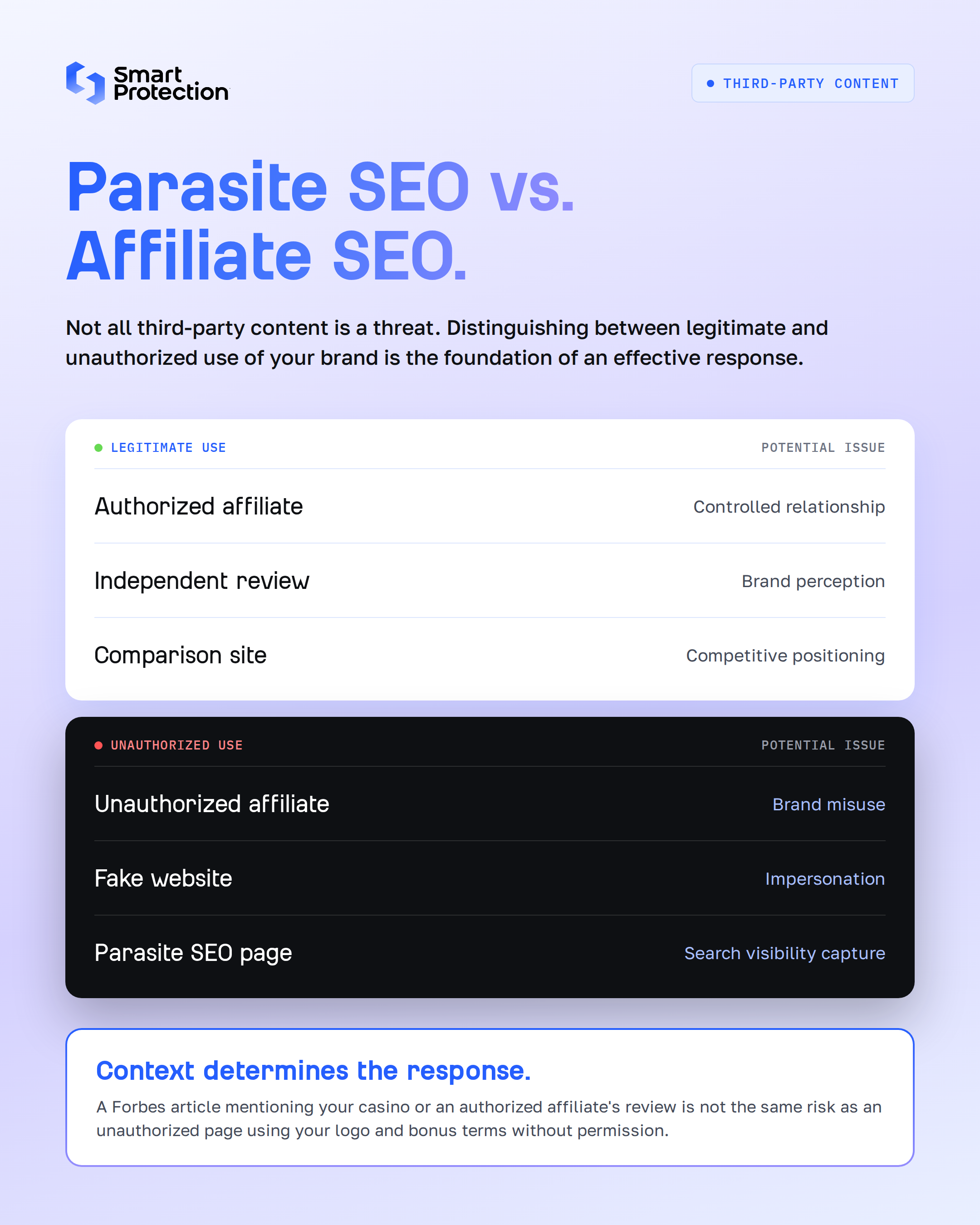
Visibility around your brand name is not the same as infringement.
An independent review site ranking for "[Brand] review" is not automatically a threat. Neither is an authorized affiliate doing exactly what your partnership allows.
The real analysis has to weigh several factors together: authorization, brand usage, content accuracy, commercial intent, and potential harm. A result only becomes a priority when several of these factors align — not from a single signal in isolation.
Traditional SEO teams already track a familiar set of metrics: rankings, traffic, backlinks, technical performance, and content quality.
But branded SERP monitoring requires a parallel set of metrics — branded results, third-party pages appearing around your domain, unauthorized domains, brand mentions across the web, affiliate pages, and fake promotional content.
SEO teams monitor where their website ranks. Brand protection teams monitor what else ranks around it.
That distinction is the operational gap most casino organizations haven't closed yet.
Marketing teams bring a complementary lens to the same problem, typically organized around six questions:
Answering these consistently — not just once, but on an ongoing basis — is what separates reactive cleanup from proactive brand control.
Response depends entirely on what was found:
The broader framework behind all of this follows five stages: detection, investigation, prioritization, enforcement, and monitoring. Skipping any one of these stages — especially ongoing monitoring — is why threats tend to reappear after a single takedown.
The scope of brand protection has been expanding for years. It started with protecting the domain. Then it expanded to protecting the website itself from cloning and impersonation.
The next stage is protecting the entire search environment around the brand — everything a player sees, clicks, and experiences before they ever reach an official page.
Brand protection is no longer only about removing fake websites. It is also about understanding what users see when they search for your brand.
For casino operators, this reframing matters operationally. It means branded SERP monitoring, domain protection, and reputation management aren't separate initiatives — they're facets of the same underlying challenge: maintaining control over a digital environment that's constantly shifting around your brand name.
If your organization is still measuring brand protection by takedown volume alone, it's worth asking a different question: not how many threats were removed, but how much of your branded search results page do you actually control today?
Talk with one of our digital risk experts to get a clearer picture of what's showing up around your brand right now.
What is Parasite SEO?
Parasite SEO is a search strategy that publishes content on a high-authority third-party website to rank for a specific keyword, borrowing the host domain's established trust instead of building it independently.
Is Parasite SEO legal?
Parasite SEO itself is not inherently illegal — it's a recognized marketing tactic. It becomes a legal or brand protection concern when it involves unauthorized use of a trademark, brand name, or proprietary content.
Is Parasite SEO a problem for online casinos?
It becomes a problem when third-party sites target a casino's brand name, bonus terms, or promotional offers without authorization, intercepting branded search traffic before it reaches the official site.
Can Parasite SEO affect casino brand reputation?
Yes. Third-party pages can display outdated bonus terms, incorrect promotional conditions, or inconsistent branding, shaping a player's perception before they reach the operator's official platform.
How can casinos monitor Parasite SEO?
Through consistent branded SERP monitoring — tracking brand + bonus, review, login, and app searches — combined with domain identification and content analysis to assess risk.
Can Parasite SEO affect branded search results?
Yes. It's one of the primary ways third-party content occupies search real estate directly around a brand's name, competing for space that would otherwise belong to the official site.
What is the difference between Parasite SEO and affiliate SEO?
Affiliate SEO typically operates through an authorized relationship with defined terms. Parasite SEO becomes a brand protection concern specifically when it involves unauthorized use of brand assets, names, or promotional claims.
How can a casino protect its branded SERPs?
By combining continuous branded search monitoring with a structured response framework — detection, investigation, prioritization, enforcement, and ongoing monitoring — rather than one-time takedowns.
How can casinos detect unauthorized affiliate content?
By analyzing third-party domains for brand usage, logo presence, promotional accuracy, affiliate codes, and outdated or incorrect offer terms, then cross-referencing against authorized partnership records.
How can casinos remove unauthorized content from search results?
Through a structured enforcement process that assesses the nature of the violation — incorrect information, unauthorized brand usage, impersonation, or trademark infringement — and applies the appropriate escalation channel for each.


.png)


