
Thank you! Your submission has been received. We will get in touch with you soon.
Back to site
Parallel imports are genuine products sold outside a brand's intended distribution channels. Learn what they are, why they happen, when they are legal, and how to detect and m
Parallel imports are genuine, original products that reach the market through distribution channels the brand never intended or authorized. They are not counterfeits. The product is legitimate — what changes is the channel, the territory, and the level of control the brand retains over it.
For any organization selling on marketplaces, this distinction is critical. This guide explains what parallel imports are, how they work, why they happen, when they are legal, and what real risks they create for brand protection, margin, and distributor relationships. And, above all, how to detect and investigate them using digital distribution intelligence.
A parallel import occurs when a genuine product — made by or for the brand — is sold in a market or channel other than the one the brand intended.
The journey typically looks like this:
Brand → Authorized Market A → Unauthorized Market B
The product leaves the official supply chain at one point and reappears in another market, sold by a third party with no contractual relationship with the brand.
The formula is straightforward:
Parallel import = genuine product + unintended market or channel.
The product does not change. What changes is the path it takes to the consumer.
And with that change, the brand loses visibility into who is selling it, under what conditions, and at what price.
This is the fundamental distinction — and the most commonly misunderstood one.
A parallel import product is genuine. The brand manufactured it. It carries the legitimate trademark. It meets the manufacturer's standards.
The problem is not with the product.
It is with how, where, and through which channel it reaches the market.
A counterfeit is a fake product that illegally imitates a registered trademark. A parallel import is a real product that simply appears where the brand did not expect it.
Conflating the two leads to the wrong decisions. Brands apply intellectual property enforcement actions to situations that actually require a commercial and distribution control response.
Parallel imports follow a recognizable pattern. Here is the step-by-step journey:
Each step moves the product further from the brand's control.
There is no single cause. Several factors typically combine.
The primary reason. When a product is significantly cheaper in one market, someone will buy it there and resell it where it is worth more.
A distributor with surplus stock looks for a fast way to move it — even outside their assigned territory.
An authorized distributor channels product into markets outside their agreement. The loss of control begins within the brand's own network.
Intermediaries operating between countries, exploiting structural price differences.
The ease of opening a marketplace storefront allows any seller to list genuine products without authorization.
A product out of stock in one market and available in another creates a natural flow between the two.
Exchange rate movements constantly open and close arbitrage windows.
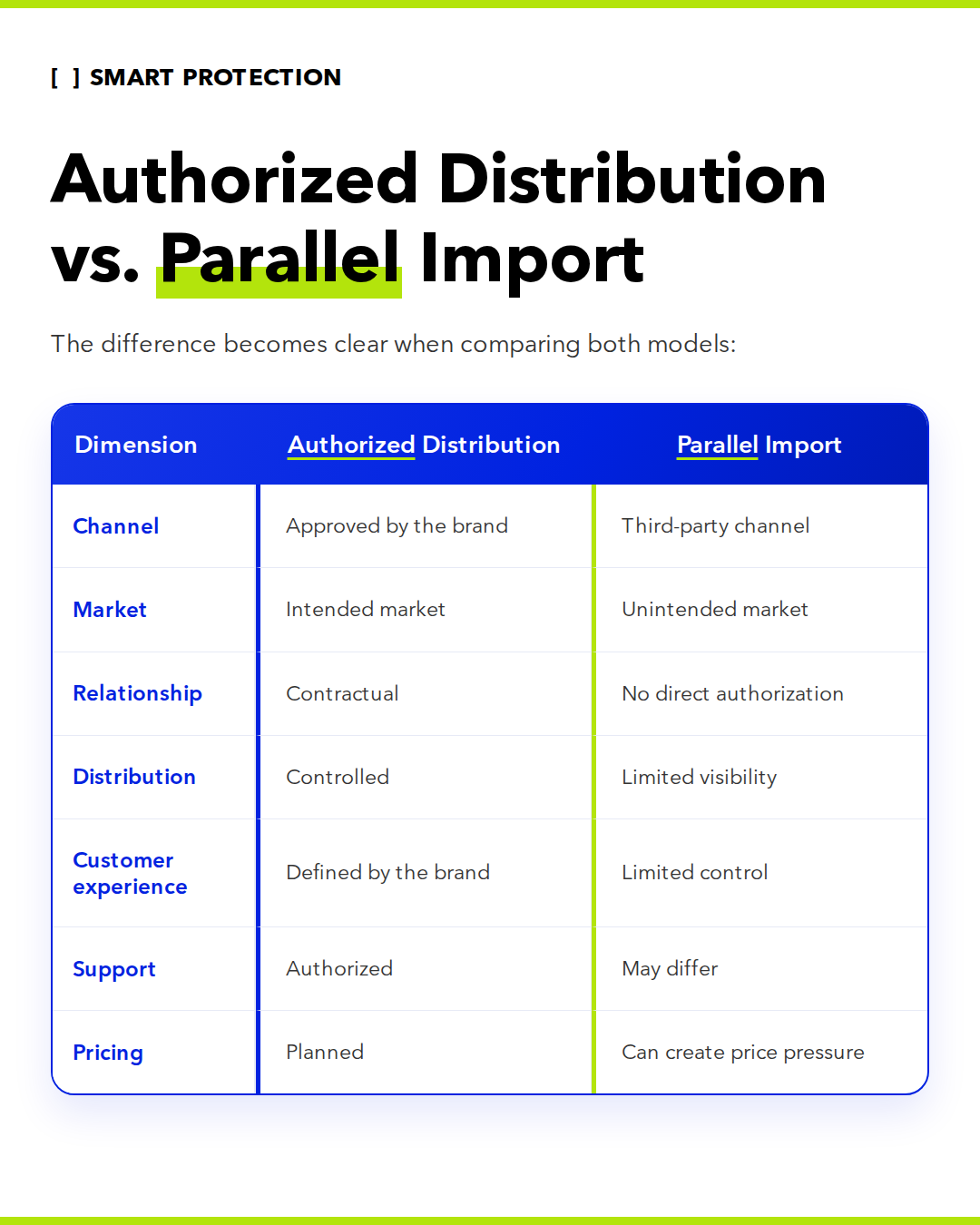
The difference becomes clear when comparing both models side by side:
Precision matters here.
A parallel import can be genuine. A counterfeit product never is.
That said, genuine products can still create significant brand protection challenges when they enter markets or channels outside the brand's intended distribution strategy.
This table summarizes the difference:

In short: counterfeiting is an authenticity problem. Parallel imports are a channel problem.
It depends on the jurisdiction and the applicable trademark exhaustion regime.
The key concept is trademark exhaustion: once the brand places a product on the market, it loses part of its ability to control subsequent resale.
There are three main regimes:
In practice, the same case may be legal in one jurisdiction and challengeable in another.
Legal disclaimer: This content is provided for informational purposes only and does not constitute legal advice. The legality of parallel imports depends on the jurisdiction, the applicable exhaustion regime, and the specific circumstances of each case.
Even when the product is genuine — and even when the activity is legal — parallel imports create real commercial risks.
These are the main ones:
From a digital trust perspective, this matters.
The damage is not always legal. It is the loss of control over how the brand exists in the channel.
Official distributors are often the first to feel the impact.
They face a familiar set of tensions:
The result is tension within the distribution network — exactly where the brand needs the most loyalty.
The grey market is not limited to marketplaces. It appears across multiple channels:
The key point is simple: if your product is sold online, it is likely already present in channels you do not control.
The phenomenon looks different depending on the industry.
Consumer electronics. Devices with incompatible plugs, non-local language settings, invalid warranties, different packaging, or technical specifications that do not match the local market.
Beauty and cosmetics. Packaging in a foreign language, missing regulatory information, and direct conflict with official distributors.
Luxury. Original product purchased in one market and resold in another, outside the brand's intended selective distribution network.
Pharmaceuticals. Packaging and relabeling that must meet market-specific regulatory requirements. In the European Union, the Commission recognizes the legality of parallel trade in medicines under the free movement of goods, provided it does not threaten public health or intellectual property rights.
Food and beverages. Differences in formulation, ingredients, labeling, language, and pack sizes between markets.
Effective detection follows a logical sequence. It is not about monitoring more listings — it is about reading them with intelligence.
Step 1 — Monitor sellers. Continuously track who is selling the brand across digital channels.
Step 2 — Track product listings. Record SKU, product variations, price, seller, marketplace, country, and stock level.
Step 3 — Identify patterns. Look for signals such as recurring sellers, unusual pricing, cross-border listings, and product-market mismatches.
Step 4 — Trace the source. Understand where the out-of-channel product is coming from.
Step 5 — Connect the dots. Link seller → distributor → market to reconstruct the distribution path.
Reducing parallel import activity requires an ordered, sustained process:
Monitor → Investigate → Trace → Document → Act where actionable → Strengthen distribution controls.
The last step is where it matters most.
Detecting without reinforcing distribution controls only creates repetitive work. Rigorous documentation — product, price, channel, frequency, and estimated impact — is what allows brands to act with purpose, whether through a commercial response or, when warranted, a legal one.
Managing this manually is not viable at the scale of today's digital commerce. Technology turns noise into actionable intelligence.
A digital risk intelligence platform enables:
This means moving from receiving alerts to understanding what is actually happening with the distribution.
Marketplaces concentrate much of the problem. Several phenomena coexist within them simultaneously:
The problem is no longer simply knowing where your product is sold.
It is understanding why it is there, who is selling it, and where it came from.
That is the difference between monitoring a marketplace and having intelligence about it.
Investigating an unauthorized seller follows a clear sequence:
Identify → Locate → Compare → Verify → Trace → Assess → Document → Act.
First, identify the seller and locate their origin. Then compare their offer against the brand's commercial policy and verify whether they belong to the official network. Next, trace the product's path, assess commercial impact, document the evidence, and act based on what that analysis reveals.
Each step adds context. And context is what turns data into a decision.
There is a significant difference between two statements:
"I found an unauthorized seller."
"I understand the distribution path that created that seller."
The first is detection. The second is intelligence.
Most brands stop at the first. They detect a seller, report it, another one appears. The cycle repeats indefinitely.
Grey market intelligence shifts the focus. Instead of chasing symptoms, it seeks to understand the cause: which distributor generated the surplus, which price gap opened the window, which pattern connects several seemingly independent sellers.
This shift in perspective has a clear strategic implication.
The challenge is no longer detection. It is intelligent prioritization: knowing where to act first, because not every case deserves the same response.
A legal parallel import requires a commercial response. An infringement requires a legal one. Distinguishing between them — and prioritizing by impact — is what separates brands that react from brands that genuinely control their digital distribution.
Parallel imports are rarely an authenticity problem. They are a control problem.
The product is real. What the brand loses is visibility into who is selling it, where, at what price, and with what impact on margin, distributor relationships, and customer experience.
The answer is not generating more alerts. It is converting those alerts into intelligence: detect, understand, prioritize, and act where it truly matters.
If you want to understand where your brand may be losing visibility and control over its digital distribution, speaking with one of our digital risk intelligence specialists may be a useful next step.
Genuine, original products sold in a market or channel other than the one intended by the brand, through sellers with no contractual relationship with it. The product is legitimate; the channel is not authorized.
No. A parallel import is a genuine product that arrives through an unintended channel. A counterfeit is a fake product that illegally imitates a brand. One can be legal; the other never is.
It is the umbrella term for the commercialization of original products through unauthorized distribution channels. Parallel imports are one of its most common forms.
Primarily because of price differences between markets. Excess inventory, distributor diversion, currency fluctuations, and the ease of selling on marketplaces also play a role.
It depends on the jurisdiction and the applicable trademark exhaustion regime. They may be legal under international or regional exhaustion, and challengeable under national exhaustion. This content is informational and does not constitute legal advice.
It is the legal principle by which, once a brand places a product on the market, it loses part of its right to control subsequent resale. National, regional, and international regimes exist.
It depends. If the product is genuine and the activity is legal, the response must be commercial: strengthening selective distribution and channel controls. If there is an infringement, legal action may be appropriate.
They create channel conflict, price erosion, and frustration among official partners, who compete against unknown sellers offering the same product for less.
Yes. Parallel sellers typically compete on price, pushing the brand's commercial pricing architecture downward and eroding margin.
On marketplaces, e-commerce stores, independent retailers, wholesalers, B2B platforms, social commerce channels, cross-border websites, and even physical retail. It is not limited to marketplaces.
By monitoring sellers, tracking listings, identifying anomalous patterns, tracing the product's origin, and connecting seller, distributor, and market.
By cross-referencing active sellers on marketplaces and social networks against their internal registry of authorized distributors. Any seller without a documented relationship is unauthorized.
Yes. Digital risk intelligence platforms automate monitoring, identify sellers, detect pricing anomalies, collect evidence, and prioritize action based on commercial impact.
The grey market involves original product sold through an unauthorized channel. The black market involves illegal product — counterfeit or smuggled goods. One is a channel problem; the other is a legality problem.
Document the case, assess whether the activity is legal, prioritize by commercial impact, and act accordingly: a commercial response if legal, a legal response if there is an infringement.
Yes. When a product arrives with an invalid warranty, a foreign language, or no local support, customers attribute the poor experience to the brand — not to the seller who bypassed the official channel.
.webp)

.png)


