
Thank you! Your submission has been received. We will get in touch with you soon.
Back to site
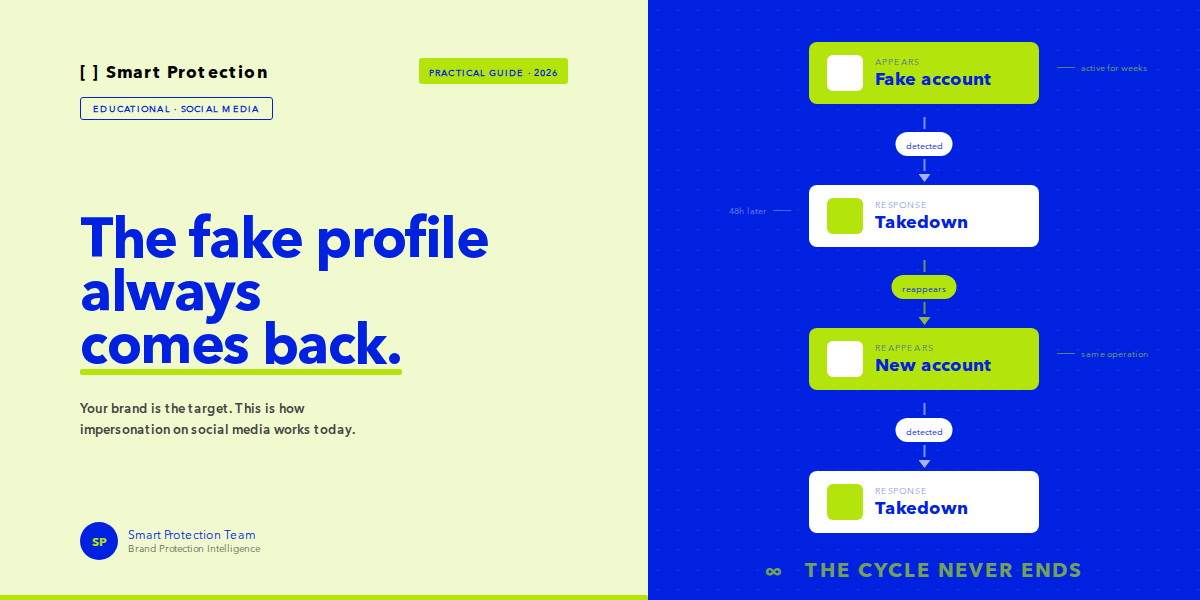
Social media impersonation attacks the trust your brand has built. Learn why the fake profile keeps coming back and how to protect your business.
Social media impersonation is the creation of fake profiles or accounts that use a brand's name, logo or imagery to deceive its customers. When the target is a company, it is not an isolated incident: it is the visible tip of a coordinated digital fraud ecosystem that comes back if you only remove the symptom.
There's a scene that plays out at a lot of brands. Someone on the team stumbles, almost by accident, onto an Instagram account with the company logo, the same product photos and a username nearly identical to the official one. It's been live for weeks. It has talked to real customers. And no one had spotted it. From there the race begins: report it, wait, get the platform to take it down. Two weeks later an identical account appears. And another. That feeling of putting out fires without ever getting ahead is the symptom of a problem almost no one is looking at for what it really is.
Most articles on this topic are written for an individual whose personal profile has been copied. That's real and it's serious, but it's a different conversation from the one happening inside a company.
When someone impersonates a person, the damage is individual: harassment, defamation, a one-off scam targeting their contacts. When someone impersonates a brand, the attacker isn't trying to deceive one person, but the brand's entire customer b ase at once. They use the trust the company spent years building as leverage to steal data, sell fake products or divert payments. The consumer can't tell the fake profile from the official one, and when something goes wrong, the frustration lands on the brand, not the impostor.
At Smart Protection we've spent a decade watching this problem evolve, and we hold a conviction that runs against how most of the market treats it: the fake profile is almost never the problem, it's the symptom. Behind an account impersonating a brand there is rarely an improvised actor. There's usually an operation working several fronts at once, one that learns from every takedown and rebuilds whatever you tear down. That's why removing the profile without understanding the dynamic that generates it is, quite literally, playing whack-a-mole.
Not all impersonation looks the same, and understanding the formats helps you know where to look.
This is the most common form: a new account that copies the logo, the name, the tone and even the brand's active campaigns. Sometimes it posts legitimate content for weeks to build followers and credibility before launching the scam. When the moment comes, it promotes fake giveaways, impossible discounts or fraudulent customer service that asks for data or payments.
There are two especially damaging variants. The first impersonates executives or company spokespeople to lend credibility to a scam or manipulate employees and partners. The second creates fake support accounts that intercept customers with a question or a complaint —often replying faster than the official account— to lead them to a fraudulent site. In both cases, the attacker hijacks something that seemed untouchable: the brand's voice.
Here's the part the rest of the market overlooks. The fake profile almost never works alone. It leans on paid ads that use the brand's assets, on cloned domains that replicate the official site, and on private messaging to close the fraud out of sight. Detection, takedown and reappearance form a cycle because the infrastructure behind it stays intact. Looking only at social media is looking at a single piece of a much bigger board.

If you feel like you're constantly removing fake accounts and never finishing, that's not your imagination. It's by design.
The most widespread mistake in the market is reacting to the visible symptom instead of the dynamic that generates it. You remove a profile today and another appears tomorrow because no one has understood where it comes from, who's behind it or how it connects to the rest of the operation. Each takedown feels like a win, but the real scoreboard doesn't move. It's the difference between wiping the surface and cutting the root.
For anyone managing brand protection, there's an uncomfortable truth: a fast takedown without well-documented evidence does little when the goal is to actually stop the repeat offender. The digital infringer leaves no physical trail, and every day that passes without properly documenting an infringement is a day the evidence degrades. Catching the repeat offender before it reappears —and doing it with a chain of custody that can support later action— is what turns a reactive effort into a real defense.
This is where the conversation changes departments. Impersonation stops being a technical or legal problem and becomes a matter of revenue, trust and marketing efficiency.
Digital trust is built slowly and breaks fast. 62% of consumers stop buying from a brand after a bad experience with a counterfeit or an unauthorized channel. The worst part is that the customer doesn't always identify who's responsible: they associate the bad experience with the brand, not the impostor. Every active fake account is a silent leak of something that doesn't show up on any dashboard until it's already gone.
When a fake profile or a fraudulent ad hijacks a brand's audience, it doesn't just divert customers: it diverts the investment the brand made to acquire them. The company pays to generate desire and attention, and a third party captures part of that return without having contributed anything. In categories where the first moment of contact defines the perception of value, losing that moment to an impostor is extremely costly, even if it never shows up as a line of spend.
The highest cost of impersonation isn't the incident you see. It's what stops happening: customers who abandon a purchase out of distrust, campaigns that underperform their potential, a CAC that rises with no clear explanation. It works like SEO in reverse: what you don't control today determines the results several months from now. That's why measuring success only in profiles removed is misleading. The number that matters is the damage that never happened.
The brands that handle this best aren't the ones with the fewest threats. They're the ones that have changed how they look at them.
A few years ago the problem was a lack of visibility: we didn't know what was out there. Today the problem is the opposite, an excess of noise: we know too much but don't understand what matters. More alerts don't mean more control; they mean saturation. The qualitative leap isn't about detecting more, it's about knowing which of those threats truly affect the business and deserve a priority response.
The digital environment changes too fast to rely on manual, reactive processes. The most mature brands build a continuous intelligence layer that lets them prioritize and get ahead before the damage escalates. It's not about eliminating everything, but about turning millions of scattered signals into actionable decisions. That's the real change of category: from managing tickets to making business decisions with judgment.
With that approach in mind, these are the levers that actually move the needle.
Searching for your brand on Google once a month is fine, but it's late. When you spot a problem manually, it's usually been live for weeks and the damage is already spread. Continuous monitoring of social media, domains and ads lets you find the threat while it's still small, not after it has talked to hundreds of your customers.
Not every fake account deserves the same urgency. An obvious parody with ten followers isn't the same as a profile that mimics your customer service and is capturing payments. A good strategy separates noise from real risk and spends resources on what truly threatens trust and revenue.
Beyond removing profiles, what protects a brand is the ability to connect signals across channels, catch the repeat offender, document actionable evidence and translate all of it into language leadership understands. Technology is essential to process the volume, but the judgment about what's a priority remains human. The combination of both is what separates a tool from a true protection partner.
The numbers behind protection that works
Data from Smart Protection operations. Early detection is what separates containing a threat from managing a crisis.
Nothing is more expensive than not knowing. The fastest way to understand what your brand is exposed to is to look at it with real data, no commitment.
Is social media impersonation a crime?
Yes. Impersonating a person or company to pass as them and deceive third parties is unlawful and can also infringe image rights and trademark rights. For a company, what matters is not only that it is actionable, but that the evidence is properly documented so the action is effective.
What should a company do when it finds a fake profile impersonating it?
The first step is to document the evidence (screenshots, URLs, dates) before it disappears, and report it to the platform. But to stop it from reappearing, you need to go beyond the one-off report: understand whether it's part of a larger operation and monitor continuously to catch the repeat offender before it returns.
How do you tell a fake account apart from a fan or parody account?
Fan, parody or critique accounts are legitimate uses as long as they don't cause confusion or seek fraudulent gain. Impersonation is identified by its intent: passing as the brand to deceive, steal data, sell fake products or divert payments. The key is whether a reasonable consumer could believe they're interacting with the official profile.
Why do fake profiles reappear after they are removed?
Because most of the time the profile is just one piece of a larger operation that stays intact after the takedown. As long as the infrastructure behind it —other profiles, domains, ads— isn't addressed in a coordinated way, spinning up a new account costs the attacker very little. That's why attacking the symptom doesn't stop the problem.
Can brand impersonation be prevented?
No single action eliminates it completely, but its impact can be drastically reduced. Combining continuous monitoring, prioritization by real risk and a fast response backed by actionable evidence lets you catch threats while they're still small and stop them from escalating. The difference isn't having no threats, it's seeing them in time.
.png)


