Thank you! Your submission has been received. We will get in touch with you soon.
Back to site
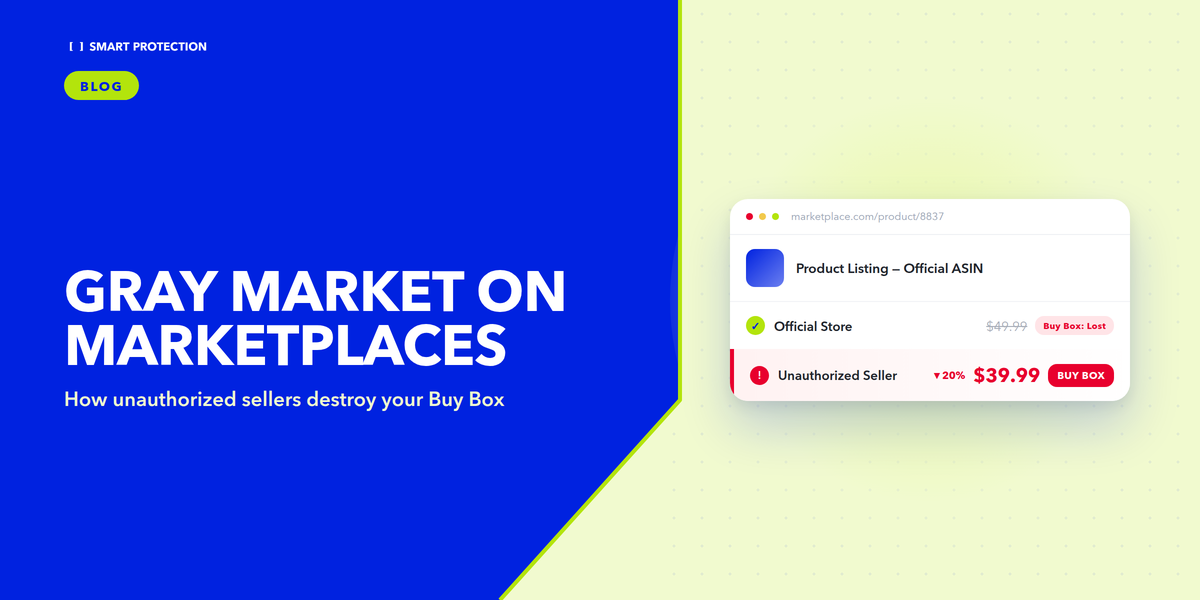
How unauthorized sellers on Amazon and Mercado Libre destroy your Buy Box, erode margins, and damage your official channel. Strategies and tools to regain control.
Quick answer: The grey market on marketplaces occurs when genuine products are sold through unauthorized channels. Unauthorized sellers trigger price wars, erode margins, steal the Buy Box, and damage brand reputation. According to recent estimates, this phenomenon moves more than $20 billion annually at a global level and in some sectors accounts for between 5% and 10% of total online sales.
You have the right price.
You have the right content.
You have the right strategy.
And yet, you're losing the Buy Box.
Because someone else is selling your product. Cheaper. Without authorization. And without following any of the rules you play by.
That's the grey market.
And on platforms like Amazon or Mercado Libre, its consequences are immediate, measurable, and hard to reverse.
This article explains what the grey market is, why it's different from counterfeiting, how it affects your Buy Box and official channel, and what concrete strategies exist today to fight back.
The grey market — also known as the parallel market — refers to the sale of genuine brand products through channels not authorized by the manufacturer.
The product is real.
The brand is yours.
But the channel sits outside your official distribution network.
Here's what sets it apart from counterfeiting:
This distinction matters operationally.
You can't report a genuine product as counterfeit. But you can — and should — take action against the channel distributing it without your authorization.
Where do these products come from? The most common sources include production surpluses sold to unauthorized distributors, parallel imports from lower-priced markets, authorized distributors diverting part of their inventory to offload stock, and products manufactured for specific regions that end up selling in others.
The Buy Box is the single most important conversion point on Amazon and similar platforms.
Win it, and you sell.
Lose it, and you disappear from the main purchase flow.
Unauthorized sellers attack it directly. And they do so in ways your team doesn't always catch in time.
An unauthorized seller lists your product below your price.
Your repricing system detects the competition and lowers your price to stay competitive.
The seller drops again.
The cycle repeats.
Within hours, your product's price has fallen below your profitability threshold. Not because you chose that — but because an external actor, operating without brand costs or restrictions, started a race to the bottom.
Amazon doesn't reward the lowest price alone. It rewards the seller with the best combination of price, availability, shipping speed, and seller metrics.
An unauthorized seller with available stock and a lower price can win the Buy Box — even if their service is inferior to yours.
The result is direct: your advertising campaigns drive traffic to a page where you don't appear as the primary seller. Every dollar invested in PPC could be generating sales for an unauthorized third party.
Buyers who purchase your product through an unauthorized seller experience a service you don't control.
Different delivery windows.
Different packaging.
No valid official warranty.
No recognized post-sale support.
And when something goes wrong, the negative review lands on your product — not on the seller.
Your listing's reputation erodes because of experiences that should never have happened in your channel.
The damage doesn't stop at the Buy Box.
The grey market acts simultaneously across three dimensions of the official channel that, taken together, represent a structural risk to the brand.
Margin erosion. When prices fall on marketplaces, authorized distributors are forced to match them to compete. Their margins compress. And at some point, they lose the incentive to prioritize your brand.
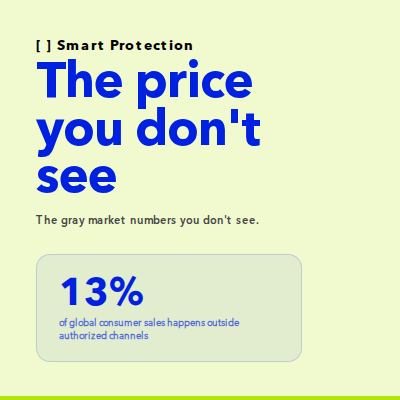
Reputational damage. According to data from Oliver Wyman, in 2021, 13% of global consumer sales came from products sold in markets other than those intended by the manufacturer — at prices 20% to 30% below the net retailer price for those markets. When consumers get used to seeing your product at that price point, your official price starts to feel artificially inflated. That directly erodes perceived value, especially in premium categories.
Tension with distribution partners. An authorized distributor who meets every one of your contractual conditions watches an unconstrained third party undercut them on price and visibility. The logical consequence is channel conflict: reduced commercial effort, less investment in the brand, and a relationship that deteriorates over time.
Amazon concentrates some of the most critical grey market risks, largely due to how its product architecture is designed.
Unified listing. On Amazon, all sellers compete on the same product listing. There's no visible distinction between an authorized and an unauthorized seller. Consumers can't easily tell them apart — and your brand competes directly against actors who don't follow your commercial terms.
Commingled inventory. If an unauthorized seller uses FBA and commingles their inventory with yours through shared EAN codes, there's a real risk that a buyer receives a product from an unauthorized channel — even if they purchased through your official account.
Account suspensions. Negative reviews generated by grey market products, when they accumulate against your ASIN, can trigger review or restriction mechanisms on your seller account. Damage caused by third parties can have direct consequences on your official operation.
Buy Box loss and advertising performance. Losing the Buy Box turns your advertising investment into a tool that benefits someone who shouldn't be in the channel at all.
On Mercado Libre, the problem takes a different shape — one that reflects the realities of the Latin American market.
Listing proliferation. Unlike Amazon, Mercado Libre allows multiple listings for the same product. This makes it easy for unauthorized sellers to create their own listings competing directly against official publications, fragmenting brand visibility and diluting position in search results.
The Catalog as a Buy Box. Mercado Libre operates a Catalog system that functions similarly to Amazon's Buy Box. An unauthorized seller with a lower price can position themselves as the winning offer in the Catalog, displacing the official brand from its highest-converting placement.
Loss of MercadoLíder status and official benefits. Unauthorized seller listings can compete with yours on reputation metrics and internal scores. If they capture enough sales volume, they can build competitive metrics that affect your relative positioning.
Warranty confusion. Buyers on Mercado Libre don't always understand the difference between the marketplace's warranty and the manufacturer's official warranty. A product purchased from an unauthorized seller can generate warranty claims that reach your after-sales team — even though the sale never went through your channel.
Lower regulatory and compliance burden. Grey market sellers in the region frequently operate with less regulatory overhead. That allows them more aggressive margins and pricing structures that an authorized distributor simply cannot match without compromising profitability.
Regaining channel control requires a combination of technology, contractual policy, and active monitoring.
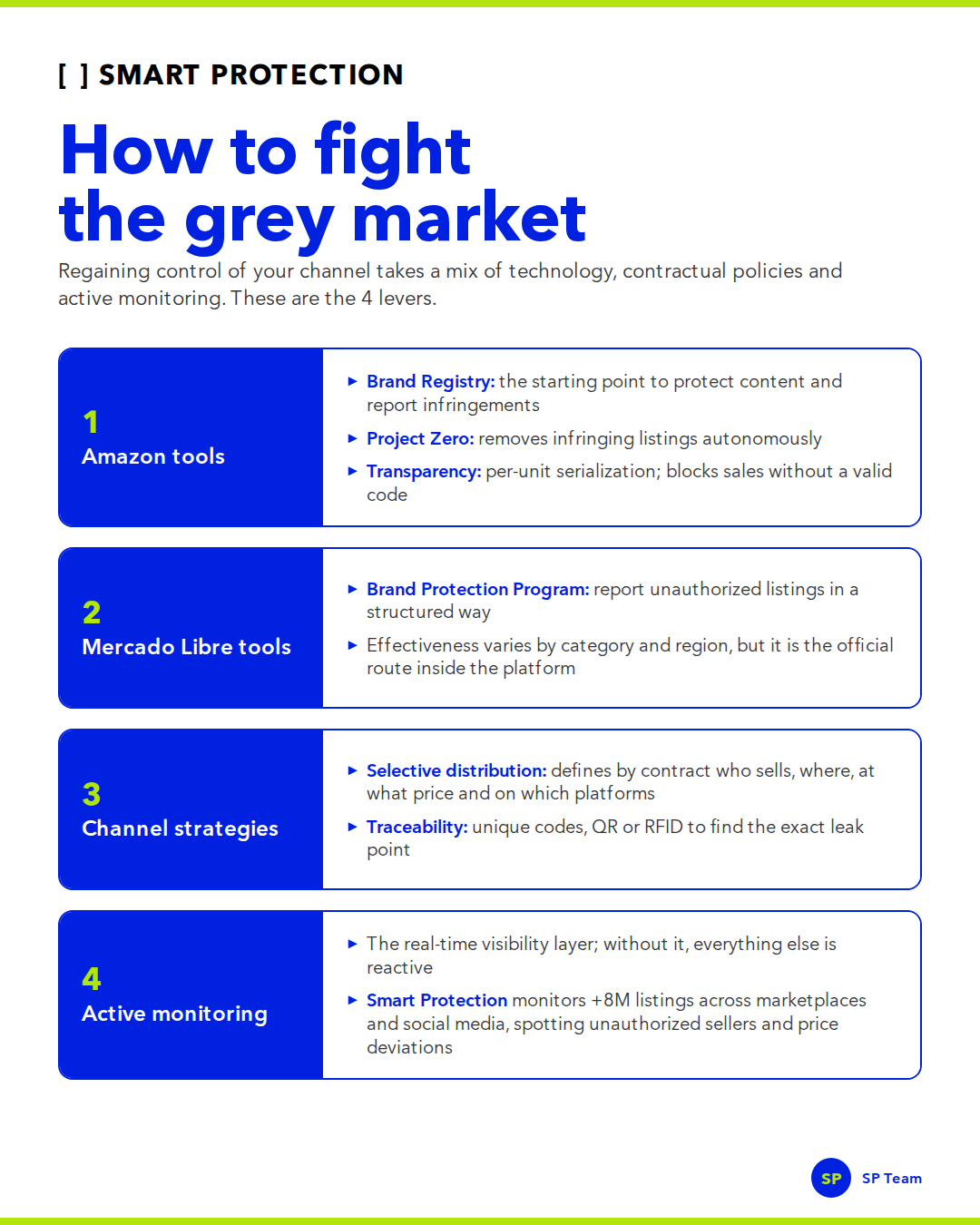
Amazon Brand Registry is the mandatory starting point. Registering your brand unlocks content protection tools, more efficient infringement reporting, and priority review processing on the platform.
Amazon Project Zero combines automated tools with the ability to remove infringing listings autonomously — without waiting for manual Amazon review. It requires prior accreditation but significantly reduces response time.
Amazon Transparency is Amazon's serialization program. Each product unit receives a unique code that the buyer can verify. If an unauthorized seller can't provide valid Transparency codes, the system automatically blocks the sale. It's the most effective tool against commingled inventory and unit-level unauthorized distribution.
Mercado Libre's Brand Protection Program allows registered brands to report unauthorized listings and manage complaints in a structured way. Effectiveness varies by category and region, but it's the official path for action within the platform.
Selective distribution policies contractually define who can sell, in which territories, at what price, and on which platforms. Without a clear and up-to-date policy, any action against a distributor who has gone off-channel carries weaker legal backing.
Active monitoring of prices, sellers, and listings in real time is the visibility layer without which everything else becomes reactive. Brand protection platforms like Smart Protection monitor more than 8 million listings across major marketplaces and social networks, automatically identifying unauthorized sellers and price deviations using customized criteria.
Product traceability through unique codes, QR, or RFID allows you to identify exactly where in the distribution chain the leak is happening. Without traceability, you can detect the symptom — but not the source.
The grey market is not a problem that gets solved with a one-time action.
It's a constant pressure on your channel, your margins, your reputation, and the trust of your authorized distributors.
Brands that manage it well don't do so by removing a seller here and there.
They do it by building continuous visibility, clear policies, and coordinated response capacity.
The difference between a brand that regains control and one that keeps losing the Buy Box month after month isn't the technology they use.
It's whether they've decided to treat the grey market as a strategic risk — or as a one-off problem.
If your brand is live on marketplaces and you're seeing signs of unauthorized sales, Buy Box loss, or unexplained pricing pressure, the Smart Protection team can help you identify the real scope of the problem. Talk to a digital protection expert.
The grey market sells genuine brand products through channels not authorized by the manufacturer. Counterfeiting sells imitation products that violate intellectual property rights. The distinction matters because the legal remedies and available tools for fighting each are different. A grey market product can't be reported as counterfeit — but action can be taken against the unauthorized distribution channel.
Because unauthorized sellers compete on the same product listing, often with lower prices than the official channel. Amazon assigns the Buy Box based on a combination of price, availability, and seller metrics. An unauthorized seller with a lower price can win it, displacing the official brand from the platform's highest-converting position.
Authorized distributors who meet every contractual condition watch unauthorized competitors operate without restrictions and at lower prices. This creates channel conflict, reduces incentives to prioritize the brand, and can deteriorate commercial relationships over the long term.
Amazon offers three main tools: Brand Registry, to register the brand and access content protection tools; Project Zero, to remove infringing listings autonomously; and Transparency, a serialization program that assigns unique per-unit codes and blocks the sale of products that don't include them.
On Mercado Libre, the grey market primarily manifests through a proliferation of unauthorized seller listings competing directly with official publications. The platform allows multiple listings of the same product, which fragments brand visibility. The Catalog system — Mercado Libre's equivalent of the Buy Box — can be won by an unauthorized seller with a lower price, displacing the brand from its highest-converting placement.
A selective distribution policy is a contractual framework that defines who can sell a brand's products, through which channels, in which territories, and under what pricing conditions. Without this documented policy, legal action against distributors who have gone off-channel carries weaker backing. It's the legal foundation on which any channel control program is built.
The most common signals are: Buy Box loss without any changes to your own metrics, conversion drops during periods when your inventory and pricing are competitive, negative reviews related to warranty or packaging issues, and listings of your product at prices significantly below your official price. Active marketplace monitoring allows you to detect these signals systematically — before the impact becomes structural.
.webp)