
Thank you! Your submission has been received. We will get in touch with you soon.
Back to site
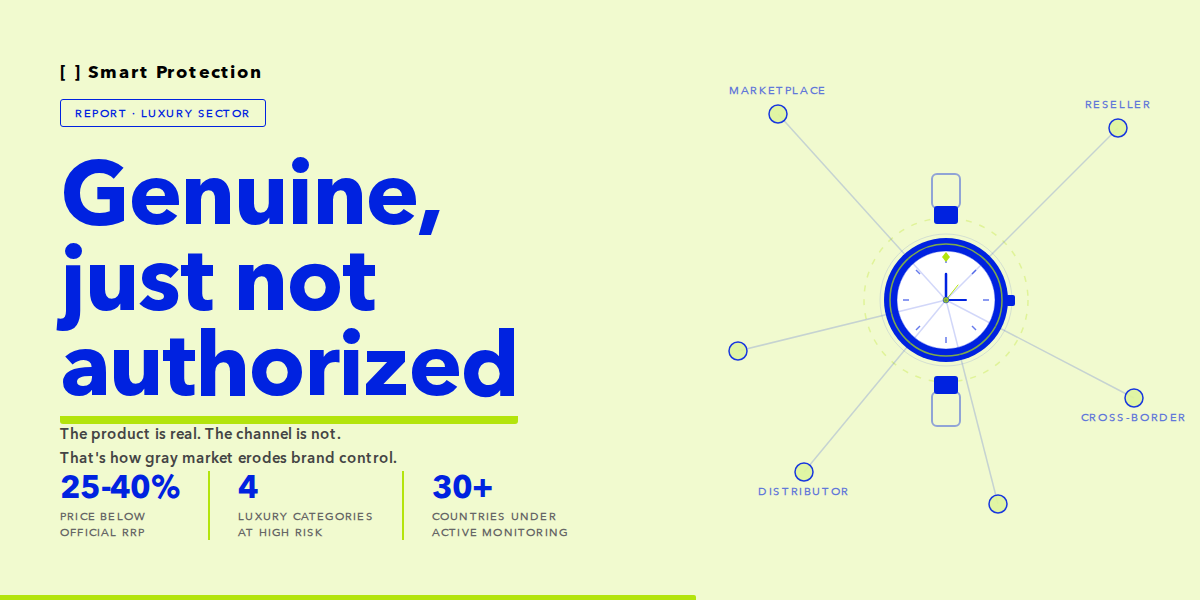
What is the grey market in the luxury sector and how does it affect your distribution? Discover how to detect it, control it, and protect your margins, price, and brand positi
A luxury brand can have absolute control over its product and, at the same time, lose control over where it is sold, who sells it, and at what price.
That is exactly what happens with the grey market in the luxury sector.
The product is authentic. The brand is recognised. But the channel is not authorised, the price is not controlled, and the experience the consumer receives has nothing to do with what the brand has designed.
This article analyses what the grey market in luxury products is, how it operates, which categories are most exposed, how to detect it, and what brands can do to regain control over their distribution.
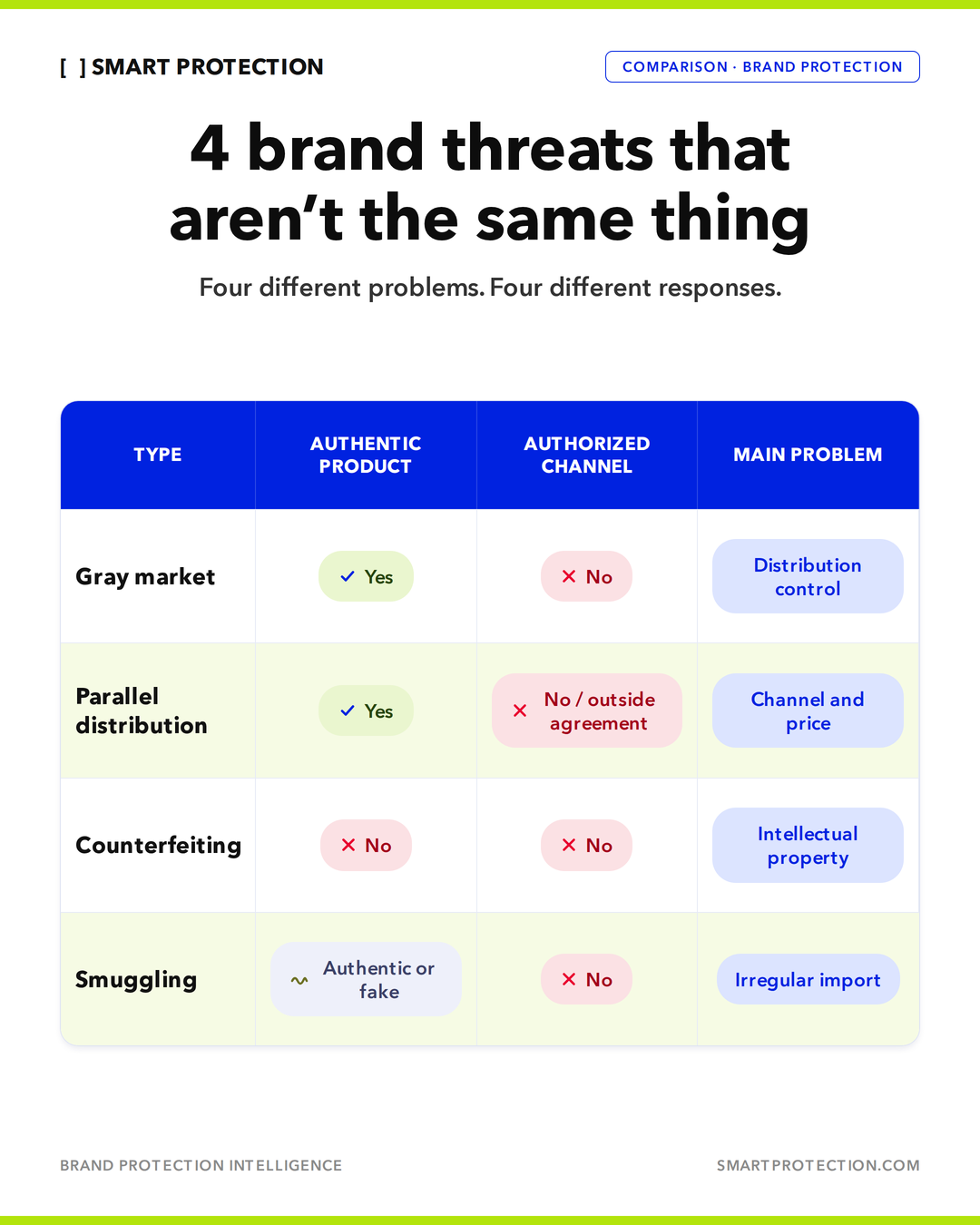
The grey market in the luxury sector refers to the commercialisation of authentic brand products through unauthorised channels.
The product is real. It is not counterfeit. It has not been stolen.
But it is sold outside the brand's official distribution ecosystem: without an agreement, without control, and without the experience the brand has designed for that product.
This clearly differentiates it from other problems:
In the grey market, the problem is not the authenticity of the product. It is the lack of control over its distribution.
This distinction is fundamental to understanding why the grey market is so complex to manage. There is no direct intellectual property infringement. There is no fake product to remove. What exists is a distribution network operating outside established agreements, silently eroding the brand's positioning, price, and perception.
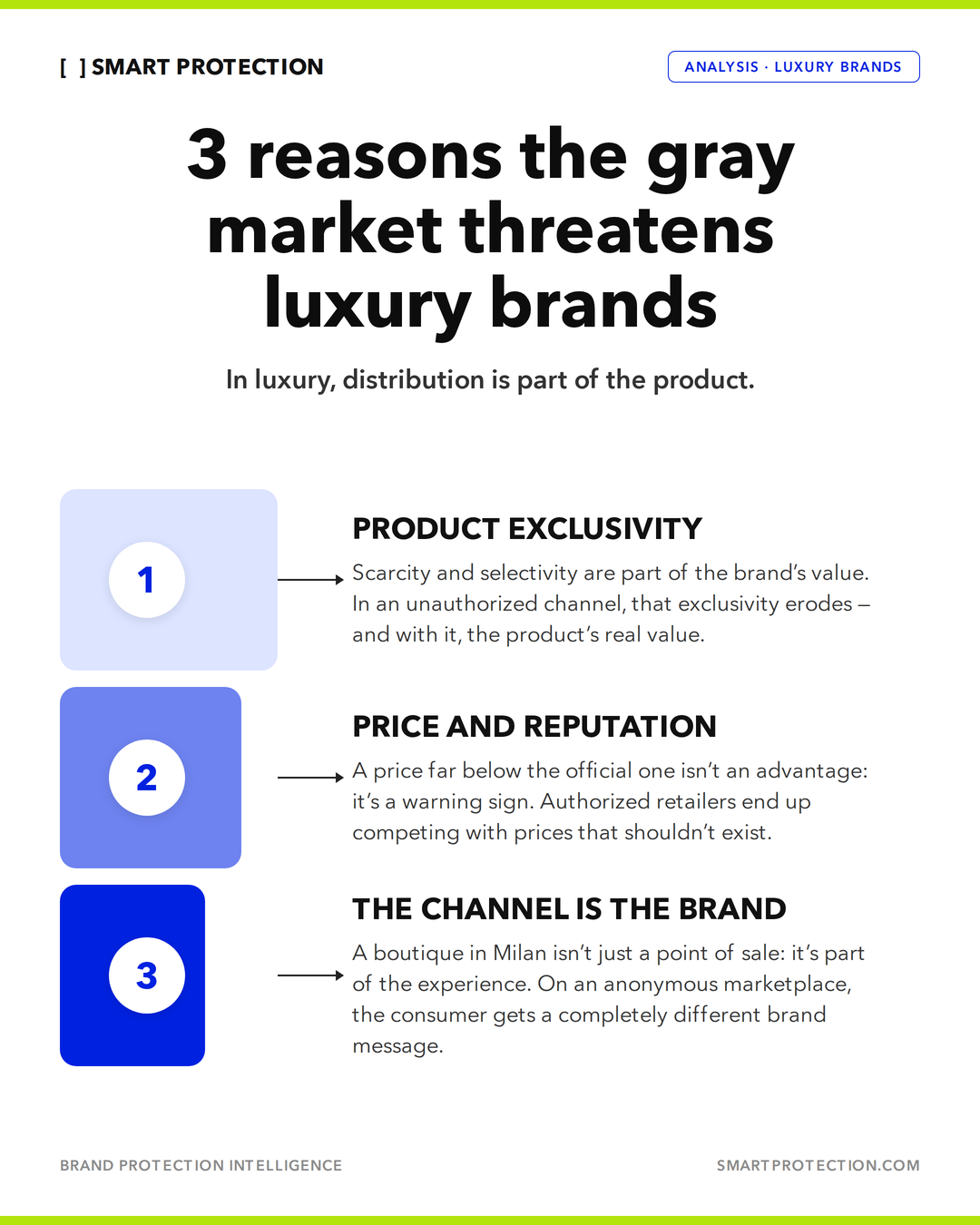
The grey market affects many product categories. But in the luxury sector, the impact is qualitatively different. Here, distribution is not simply a mechanism to move product. It is part of the product itself.
Luxury brands build their value on scarcity, selectivity, and experience.
According to the conceptual framework of luxury widely accepted in the industry, exclusivity is not an additional attribute of the luxury product: it is a structural condition of its value proposition.
The price does not only reflect the cost of production. It reflects the perception of limited access, of belonging, of positioning.
When that product appears in an unauthorised channel — an unknown marketplace, an online store with no brand identity, an anonymous seller — exclusivity erodes. And with it, part of the real value of the product.
In most markets, a lower price is a competitive advantage.
In luxury, a lower price can be a serious reputational problem.
When a luxury product appears at a price between 25% and 40% below the official RRP, consumers may interpret that the official price is an unjustified overcharge. Or that the product is not worth what the brand claims it is worth.
That perception puts pressure on authorised distributors, who are forced to compete with prices that should not exist in their market.
An official boutique on a premium street in Milan or Paris is not just a point of sale.
It is a brand communication element. It is part of the experience that defines the consumer's relationship with the product.
When that same product appears on a third-party marketplace, without context, without service, without the brand narrative, the consumer receives a completely different message.
The channel, in luxury, is not neutral. It plays an active role in positioning.
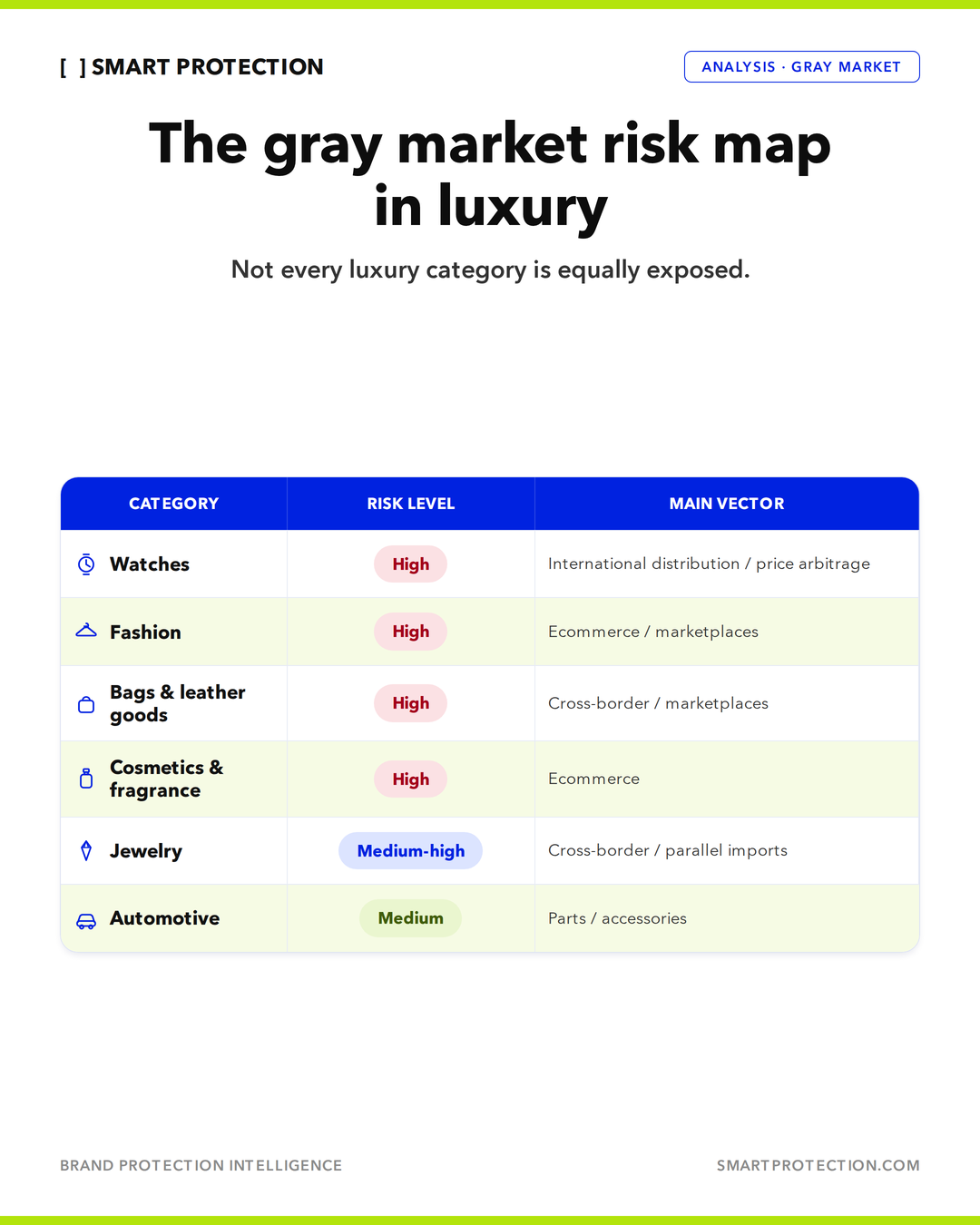
High-end watches are one of the most active segments of the international grey market. The existence of significant price differentials between markets — Europe, Asia, the Middle East, the Americas — creates ideal conditions for arbitrage. A watch purchased in Switzerland or Singapore can be resold with margin in markets where the official price is considerably higher.
Luxury fashion garments and accessories circulate widely through ecommerce and specialist marketplaces. The proliferation of resale platforms and the rise of the second-hand market have created a grey zone where the distinction between legitimate resale and unauthorised parallel distribution becomes blurred.
Luxury bags, especially those from brands such as Hermès, Louis Vuitton, or Chanel, have extraordinarily active secondary markets. Cross-border ecommerce and international marketplaces facilitate their distribution outside official channels, often without the brand having any visibility over who is selling them or under what conditions.
Luxury jewellery presents a medium-to-high exposure to the grey market, particularly in cross-border purchasing contexts. Price differentials between markets and ease of transport make this segment a common vector for parallel imports.
Luxury cosmetics and perfumery is one of the most active categories in unauthorised ecommerce. The ease of international shipping, high sales volumes, and the multiplicity of digital platforms make this segment one of the most affected by parallel distribution.
The luxury automotive sector presents medium grey market exposure, concentrated primarily in spare parts, accessories, and complementary products. Vehicles themselves are less susceptible due to logistical barriers, but accessories and components flow more easily outside authorised channels.
Premium electronics products — where price differentials between markets are significant and demand is high — are common vectors for parallel imports, particularly from Asian markets towards Europe and Latin America.
High-end wines and luxury gourmet products present an active grey market, particularly in the online channel and in contexts of informal imports from producing regions to consumer markets.
The grey market is one of the main risks for these companies in the digital environment. It refers to the illegal or unauthorised import of products from producing regions to consumer markets. This type of fraudulent activity can have serious consequences for companies, including sales losses and damage.
The grey market does not always start outside official distribution.
Frequently, it starts inside.
The typical chain is:
Brand → Authorised Distributor → Retailer → Unauthorised Seller → Marketplace
A leak can occur at every link in the chain. Understanding who is who in that chain is essential to correctly diagnosing the problem.
Authorised distributors that divert stock: Some official distributors sell part of their stock to intermediaries outside their territory or outside their assigned network. They do so when demand in their market does not absorb the available volume, or when margins in other channels are more attractive.
Parallel importers: Operators who acquire product in markets where the price is lower, taking advantage of differentials between countries, and import it into markets where they can sell it with margin, without going through the brand's official distribution channels.
Unauthorised retailers: Physical or online stores that sell luxury products without having been accredited by the brand as official distributors. They may have acquired the product second-hand, through unauthorised wholesalers, or directly from parallel markets.
Professional marketplace sellers: Operators who use Amazon, eBay, Tmall, or similar platforms to sell luxury products outside the brand's selective distribution agreements. In many cases, they operate at significant volumes and on multiple platforms simultaneously.
Resellers: Individuals or small operators who acquire product in countries where it is available at a lower price and resell it in other markets, primarily through digital channels.
Cross-border ecommerce: Cross-border electronic commerce has removed many of the geographical barriers that previously limited the grey market. An operator can buy in Europe and sell to consumers in Asia, Latin America, or North America from a single platform, without any physical structure.
The grey market no longer needs a physical store.
It can build an international distribution network from multiple digital channels, operating in a manner that is practically invisible to the brand.
The main environments where the digital grey market operates are:
Generalist marketplaces: Amazon, eBay, Rakuten, Mercado Libre, and similar platforms frequently host unauthorised sellers of luxury products. The scale of these platforms makes control and visibility difficult.
Specialist luxury platforms: Farfetch, Vestiaire Collective, The RealReal, and other specialist platforms operate in a space where the distinction between a legitimate secondary market and unauthorised parallel distribution can be blurred.
Independent ecommerce: Standalone online stores, built specifically to sell luxury products outside official channels, with a professional appearance and search engine positioning.
Social commerce: Instagram, TikTok, Facebook, and other social networks facilitate the direct sale of luxury products without going through any structured distribution channel. Traceability is minimal.
Cross-border ecommerce: Cross-border commerce platforms that allow operators in any country to sell to consumers in any other market, taking advantage of price differentials and customs regulations.
Search engines and Google Shopping: Unauthorised sellers invest in SEO positioning and Google Shopping campaigns to capture demand from consumers searching for specific luxury products, competing directly with official channels.
The grey market is not solely a distribution problem. It simultaneously affects multiple areas of the business.
Margin loss: Unauthorised sellers operate without the structural costs of official distribution. This allows them to offer lower prices, eroding the margins of authorised distributors and putting pressure on the brand itself.
Price erosion: The sustained presence of prices below the official RRP on digital channels can devalue the brand's perception of fair price, affecting its long-term positioning.
Conflict with authorised distributors: When official distributors see their products competing on the same marketplace at lower prices, coming from unauthorised sources, the relationship with the brand deteriorates. Confidence in the selective distribution system erodes.
Loss of channel control: The brand loses visibility over who is selling its products, where, at what price, and with what type of presentation. That loss of visibility is, in itself, an operational risk.
Deterioration of exclusivity: When a luxury product is available across multiple uncontrolled channels, the perception of exclusivity diminishes. The product remains the same, but the experience of accessing it is no longer differentiated.
Inconsistent customer experience: A consumer who purchases from an unauthorised channel may receive the product without original packaging, without documentation, without after-sales service. That negative experience is associated with the brand, even though the brand had nothing to do with it.
Reputational risk: If the product acquired through an unauthorised channel has a defect, has been stored incorrectly, or arrives in inferior condition, the consumer does not hold the seller responsible. They hold the brand responsible.
Revenue leakage: Every sale made through an unauthorised channel is a sale that does not pass through official distributors, does not generate the expected margin, and does not contribute to the commercial objectives of the authorised distribution network.
Detecting the grey market requires going beyond one-off price monitoring.
It requires distribution intelligence.
The first indicators of the grey market are usually price anomalies:
Identifying who is selling is as important as identifying at what price. Seller analysis must consider:
The objective is to map the complete chain:
Brand → Product → Seller → Channel → Country → Price
That map makes it possible to identify at which point in the chain the product leaks towards unauthorised channels and which actors are involved.
An operator active in the grey market is rarely present on just one channel.
They typically operate simultaneously across several marketplaces, social networks, their own ecommerce, and Google Shopping.
Cross-referencing that information makes it possible to identify behavioural patterns, estimate volumes, and prioritise interventions according to their real business impact.
These signals, in isolation, may be one-off anomalies.
Several simultaneous signals typically indicate a structural distribution problem.
A single signal may be an anomaly.
Several simultaneous signals typically indicate a structural distribution problem.
Controlling the grey market requires an active and sustained strategy. It is not a problem that can be resolved on a one-off basis.
Define a clear distribution policy: The foundation of control is having explicit rules: which channels are authorised, in which territories, under what pricing and presentation conditions. Without that policy, there is no framework for detecting deviations.
Monitor prices continuously: Systematic monitoring of prices on digital channels makes it possible to detect early deviations, identify patterns, and act before the problem escalates.
Map sellers: Identifying all operators selling the product on digital channels — both authorised and unauthorised — is an exercise in distribution intelligence that most brands do not carry out in a structured way.
Identify channel deviations: Tracing at which point in the distribution chain the product moves towards unauthorised channels makes it possible to act on the source of the problem, not just its consequences.
Control marketplaces: Establishing an active presence on the main marketplaces, or explicit agreements with them, gives the brand visibility and the capacity to intervene when it detects unauthorised sales.
Monitor cross-border: Cross-border commerce is one of the most active vectors of the grey market. Monitoring it requires analysis capacity across multiple languages, currencies, and territories simultaneously.
Create digital evidence: To intervene effectively against unauthorised sellers or platforms, the brand needs documented and structured evidence. That evidence must be generated systematically, not reactively.
Prioritise threats according to commercial impact: Not all grey market cases have the same impact. Prioritising by estimated volume, affected market, and impact on authorised distributors allows resources to be concentrated where the problem is most serious.
The real problem is not detecting an unauthorised seller.
The problem is understanding which of those sellers are genuinely affecting the business, and where to intervene first.
That requires specialised technology.
Distribution Intelligence: Capacity to map the complete distribution chain of the product, from the brand to the end consumer, through every intermediary and channel.
Pricing Intelligence: Continuous and automated price monitoring across multiple channels, with alerts on deviations and pattern analysis by seller, platform, and territory.
Seller Intelligence: Identification and analysis of all operators commercialising the product, with the capacity to track their activity across multiple platforms simultaneously.
Marketplace Monitoring: Active presence on the main global marketplaces to detect unauthorised listings, compare prices, and map seller behaviour.
Cross-border Monitoring: Capacity to follow the flow of product between different geographic markets, identifying parallel imports and territorial deviations.
Risk Prioritisation: Systems that allow detected threats to be ranked according to their estimated commercial impact, so that teams can act where it matters most.
Digital Evidence: Automated generation of structured and legally valid digital evidence to support interventions against sellers, platforms, or distributors.
Smart Protection offers a platform specialised in controlling unauthorised distribution and the grey market for luxury brands and premium categories. The platform combines distribution intelligence, price monitoring, and seller analysis across more than 30 countries, with the capacity to act on marketplaces, ecommerce, social networks, and cross-border channels. Brands such as HANRO and Dermaceutic already use Smart Protection to regain control over their digital distribution network and protect their margins and brand positioning.
For a long time, the grey market has been managed as a legal problem. An intellectual property problem. A problem for the legal department.
That approach is insufficient.
The grey market in the luxury sector simultaneously affects:
Treating the grey market exclusively as an intellectual property problem is addressing only the surface of the issue.
The grey market is, in essence, a distribution control and commercial integrity problem.
Its management requires an interdepartmental perspective, distribution intelligence data, and coordinated action capacity throughout the entire value chain.
Brands that understand this do not only protect their distribution better.
They protect their revenue, their positioning, and the trust their consumers place in them.
If you want to better understand how the grey market may be affecting your distribution network, our distribution intelligence experts can help you identify risk signals and prioritise the interventions with the greatest commercial impact.
[Talk to a distribution control expert →]
The grey market in the luxury sector refers to the commercialisation of authentic brand products through unauthorised distribution channels. The product is original and genuine, but it is sold outside the brand's official distribution ecosystem — without an agreement, without control, and without the experience the brand has designed for that product.
No. Grey market products are authentic. The difference from counterfeiting is that the product is genuine, but the channel through which it is sold is not authorised by the brand. The problem is not the authenticity of the product, but the lack of control over its distribution.
Both terms refer to the distribution of products outside the brand's official channels. In practice, they are used interchangeably. Parallel distribution is the mechanism through which the grey market is generated: authentic product flowing through unauthorised channels, often as a result of price arbitrage between markets.
Parallel imports are a specific type of grey market in which independent operators acquire luxury products in markets where the price is lower and import them into markets where the official price is higher, obtaining a margin from the differential. This occurs frequently with luxury watches, bags, cosmetics, and other products with significant price differentials between regions.
The grey market introduces prices below the official RRP into the market, which can give consumers the perception that the official price is an overcharge. This puts pressure on authorised distributors, who are forced to compete with prices that should not exist in their market, and erodes the brand's value perception over the long term.
Authorised distributors invest in presentation, service, training, and customer experience to meet the brand's standards. When their products compete on the same digital channels against unauthorised sellers offering lower prices — without those structural costs — their profitability is directly affected. The result is a deterioration of the relationship with the brand and a loss of confidence in the selective distribution system.
Detecting unauthorised sellers requires systematic monitoring of marketplaces, independent ecommerce, social networks, and cross-border channels. The most common signals include anomalous prices, sellers with high-volume behaviour, presence on multiple simultaneous platforms, and sales in territories where the brand has no active distribution.
Controlling prices online requires a clear distribution policy, continuous price monitoring on digital channels, identification of the sellers generating the deviations, and the capacity for coordinated action against distributors, platforms, and unauthorised operators.
Protection against the grey market requires an integrated strategy that combines: the definition of a rigorous selective distribution policy, distribution intelligence to map the complete sales chain, price and seller monitoring on digital channels, and coordinated intervention capacity. Tools such as Smart Protection make it possible to automate that intelligence and prioritise interventions according to commercial impact.
The main marketplaces — Amazon, eBay, Tmall, Mercado Libre — have policies on the sale of branded products, but the application of those policies varies. In practice, unauthorised sellers can operate on these platforms for extended periods before being detected or removed. The brand needs active monitoring and action capacity to manage its presence in these environments.
Controlling international distribution requires monitoring capacity across multiple languages, currencies, platforms, and territories simultaneously. It involves tracking the flow of product between markets, identifying parallel imports, and detecting sellers operating on cross-border channels outside the brand's distribution agreements.
Yes. When a luxury product is available across multiple uncontrolled channels — without selection, without brand experience, without the exclusivity context that defines luxury — the consumer's perception of exclusivity diminishes. That erosion is not always immediate or visible in the short term, but accumulated over time it can significantly affect the brand's positioning and its ability to sustain premium prices.
Meta title: Grey market in the luxury sector: control guide
Meta description: What is the grey market in the luxury sector and how does it affect your distribution? Discover how to detect it, control it, and protect your margins, price, and brand positioning.
.png)


