
Thank you! Your submission has been received. We will get in touch with you soon.
Back to site
.png)
Discover how Real Madrid tackles the impact of piracy and counterfeiting. An in-depth analysis of brand protection and intellectual property in the world of football.
When discussing counterfeiting in sports, the focus often centers on a visible problem: unofficial jerseys, counterfeit scarves, and products sold through informal channels. However, that focus is no longer sufficient. Today, when analyzing the risks for a club like Real Madrid, you realize you are not merely dealing with a simple market of replicas. Instead, you are facing a global parallel economy that monetizes prestige, urgency, identity, and trust.
Real Madrid holds a unique position in football. It not only competes as a club but also operates as a high-value global brand, with attributes increasingly resembling those of a luxury brand: international reach, strong aspirational appeal, high recognition, premium products, multigenerational audiences, and a visual identity that drives immediate purchases. This combination makes it a prime target for brand abuse networks.
From a brand protection perspective, this changes the analytical framework. The problem is no longer just about how many fake jerseys are circulating. The issue is how various actors exploit the symbolic value of the club across multiple channels: eCommerce, social media, domains, ticketing, betting, apps, marketplaces, and impersonation campaigns.
Data helps put the phenomenon into context. The OECD - OCDE and the EUIPO - European Union Intellectual Property Office have estimated in various reports that the international trade of counterfeit and pirated products reached approximately $509 billion, equivalent to 3.3% of global trade. In the European Union, imports of counterfeit goods have accounted for up to 6.8% of total imports. Added to this is a digital ecosystem where sports lose around $28 billion annually due to piracy and associated digital fraud.
This means that if you manage brand protection for an elite club, you can no longer separate physical counterfeiting from digital fraud. Both are part of the same illicit monetization infrastructure.
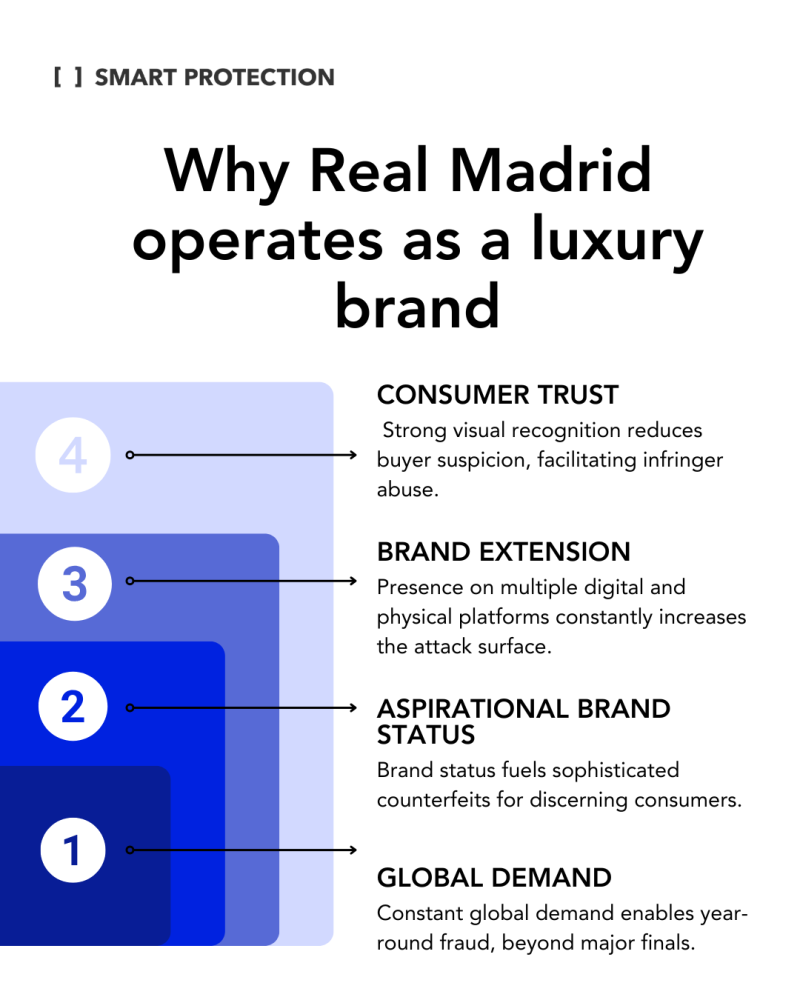
Not all clubs suffer the same type of abuse. Real Madrid experiences an exceptional level of exposure because it combines several attributes typical of premium brands.
Most sports brands experience demand peaks. Real Madrid maintains constant demand. The official jersey, special kits, collaborations, tickets, stadium experiences, and international merchandise generate traction year-round.
In practice, this means that fraud does not need to wait for a final match. It can operate on a continuous calendar.
In luxury brands, much of the value lies not in the product's function but in what it represents. For Real Madrid, this logic is clear. Purchases do not always respond to a sporting need. Often, they reflect belonging, status, cultural identity, or international admiration.
This explains the proliferation of "premium fake" jerseys—visually sophisticated counterfeits designed not for low-price markets but for consumers willing to pay more if they perceive proximity to the official product.
Real Madrid no longer exists solely in the stadium or official store. It lives in:
The more the brand extends, the more attack surface it presents.
4.Immediate Consumer Trust
An elite global brand generates less friction. Consumers believe they recognize the aesthetics, colors, crests, promotional messages, and visual codes. This recognition accelerates decision-making while simultaneously reducing suspicion.
From a brand abuse perspective, this prior trust is an advantage for the club and an asset for the infringer.
Counterfeiting in football is no longer an isolated circuit of production and sales. It functions as a connected economy with multiple monetization points.
Previously, the model was simple: produce copies, distribute them, and sell them. Now, the model is more complex:
This means a fake jersey may only be the first point of contact. Other risks then emerge:
In elite sports, counterfeits no longer compete solely on price. They also compete on appearance, speed, and legitimacy narrative. This is why you see products marketed as:
In many cases, the language is designed to align with the premium discourse of the official brand.
Here lies the central point. Real Madrid is not just a victim of counterfeits. It is the reputational foundation upon which third parties operate. They use its notoriety to sell products, capture leads, divert traffic, generate clicks, fuel betting, or execute transactional fraud.
In other words, the club as a luxury brand becomes a target of a global parallel economy.
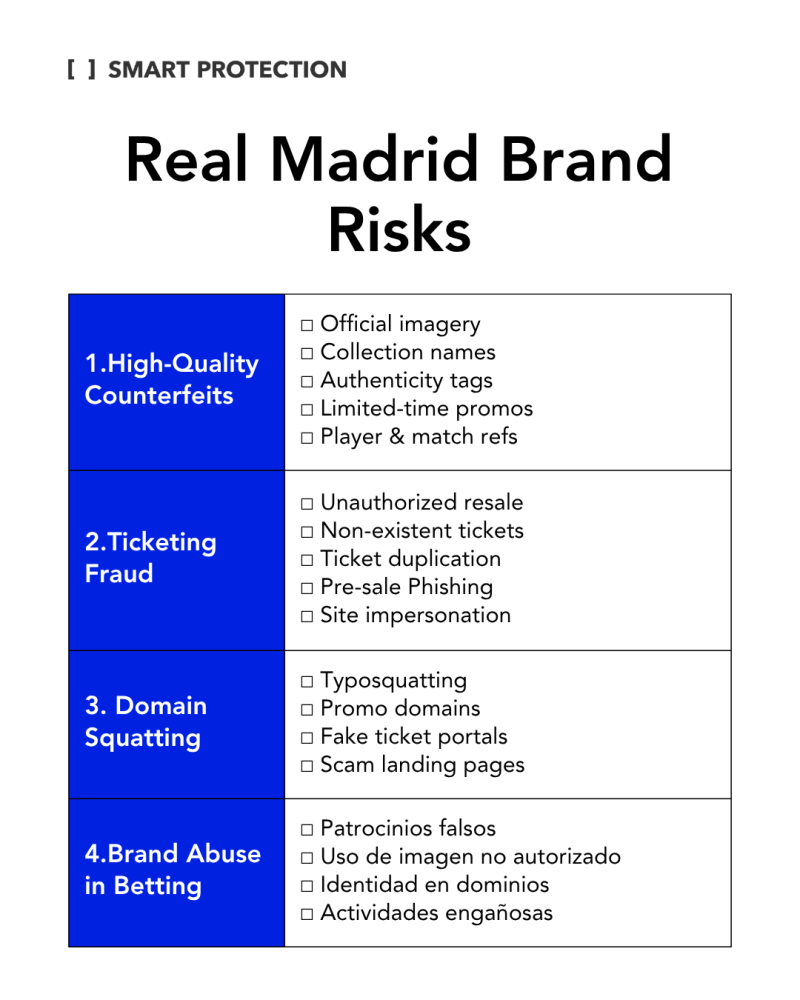
Jerseys remain one of the most visible categories of infringement. But the problem has evolved. It is no longer just about cheap copies in informal markets. You also find highly polished listings on marketplaces, proprietary sites, and social media that mimic:
For you, this has a clear consequence. The more sophisticated the counterfeit, the harder it is for consumers to distinguish it. And the harder it is to distinguish, the greater the reputational damage when the experience fails.
Additionally, the global market for counterfeit clothing, footwear, and fashion items remains one of the highest-volume categories. In various OECD/EUIPO analyses, these categories rank among the most affected by international illicit trade. Sports benefit from the intersection of fashion, identity, and collectibility, making them particularly exposed.
High-demand tickets are another critical point. For decisive matches, classics, Champions League games, or hospitality experiences, market pressure creates the ideal environment for fraud.
The most common schemes include:
This affects more than direct revenue. It also impacts fan experience, sponsor relationships, and the club's perception of control.
In practice, the ticket is not just a product. It is a gateway to digital fraud.
Domain impersonation has become the basic infrastructure of brand abuse. Sites including terms like "official," "tickets," "shop," "VIP," "matchday," or variations of the club's name aim to capture traffic with a legitimate appearance.
This phenomenon includes:
From an operational perspective, the fake domain serves multiple functions simultaneously: capturing demand, legitimizing fraud, and acting as a bridge between social media, ads, and payments.
The link between football and betting adds an additional layer of risk. Some operators, affiliates, or opportunistic networks improperly use names, crests, visual references, or messages suggesting an official relationship with the club.
The most frequent issues include:
Here, the risk is not just legal. It is also reputational. When consumers perceive an official connection where none exists, the club may become associated with experiences, messages, or practices it does not control.
In such a scenario, the response cannot rely solely on reactive enforcement. You need a structure of visibility, prioritization, and action.
Coordinate monitoring of:
This allows you to detect patterns, not just isolated incidents.
The club's digital identity includes its crest, name, colors, photographs, promotional language, players, and campaign assets. Protecting these elements requires a comprehensive view of how they are replicated and where they generate transactional risk.
Not all infringements deserve the same response. Prioritize based on:
This reduces operational burden and improves enforcement quality.
Education remains a useful defense, especially during high-demand campaigns. Explaining how to identify official channels, what warning signs to look for, and how to validate a purchase reduces some exposure.
Brand protection, legal, eCommerce, marketing, ticketing, and external partners must work under a unified operational logic. When each area acts separately, the response is delayed or fragmented.
In a global environment, the difference lies not only in detecting more but in turning scattered signals into actionable intelligence. This involves automating monitoring, prioritizing threats, and centralizing evidence to act faster and more consistently.
Real Madrid illustrates a broader shift in brand protection in sports. Elite clubs are no longer just owners of sports rights. They are global brand holders with premium dynamics, high digital exposure, and extraordinary capacity to drive emotional consumption.
This makes them prime targets for an illicit economy that no longer limits itself to copying products. It also captures traffic, exploits identity, diverts revenue, and monetizes trust.
For you, the challenge is not just removing infringements. It is understanding the architecture of abuse. When the club operates as a luxury brand, protection can no longer be partial. It must cover products, identity, domains, tickets, promotions, and the digital context.
That is the underlying conclusion: the more valuable, aspirational, and global the brand, the more sophisticated and transversal the abuse surrounding it will be.
If you are reviewing how to strengthen this capability with greater visibility and less operational friction, Smart Protection can help you understand where your digital exposure is concentrated today and how to prioritize a more efficient response.
Talk to a Brand Protection Expert HERE.


